Category: Visitors and Residents

  • Belonging is inconvenient

    Over the pandemic there has been much discussion of the need for community and belonging as part of the education experience. The emphasis in these discussions is that online didn’t/doesn’t ’do’ community very well. However, it’s more accurate to say that that sudden shifts from residential provision to online caused by a pandemic are not ideal for sustaining community.

    Residential assumptions

    As we develop, or expand, our fully online provision it’s important not to fall into the trap of designing with ‘residential assumptions’. What I mean by this is that we can assume that online students will want what our residential students demand (or what they missed when things moved online). Part of that is the need for community and belonging.  

    Inconvenience 

    Belonging is inconvenient, it requires commitment, accountability and time. Any anthropologist will tell you that there is no short-cut to belonging. Strong-bond relationships are formed because much time is spent together and the good times and the bad times are shared alike. 

    One of the key reasons that students can feel part of a community on residential courses is because they have made a huge commitment in time and effort just to turn-up. In traditional undergraduate terms this is likely to mean relocating the majority of their life to a new city for three years. It’s not just about the physical buildings it’s inherent in the format. In this sense, belonging is exclusive – available only to those who have the time to invest. 

    Just visiting

    Once we move away from this traditional characterisation of students the need for belonging and community shifts. For example, as anyone who provides upskilling or updating courses knows, students in full-time work usually just want to ‘learn what they need’ and get on with their lives (lives which already involve community and belonging in other areas).

    This took me back to the Visitors and Residents continuum, which is predicated on modes-of-engagement based on forms of presence. As such, it’s a simple way to map the relationship between the pedagogy (or format) of an educational offer and how this relates to the need for belonging and community. 
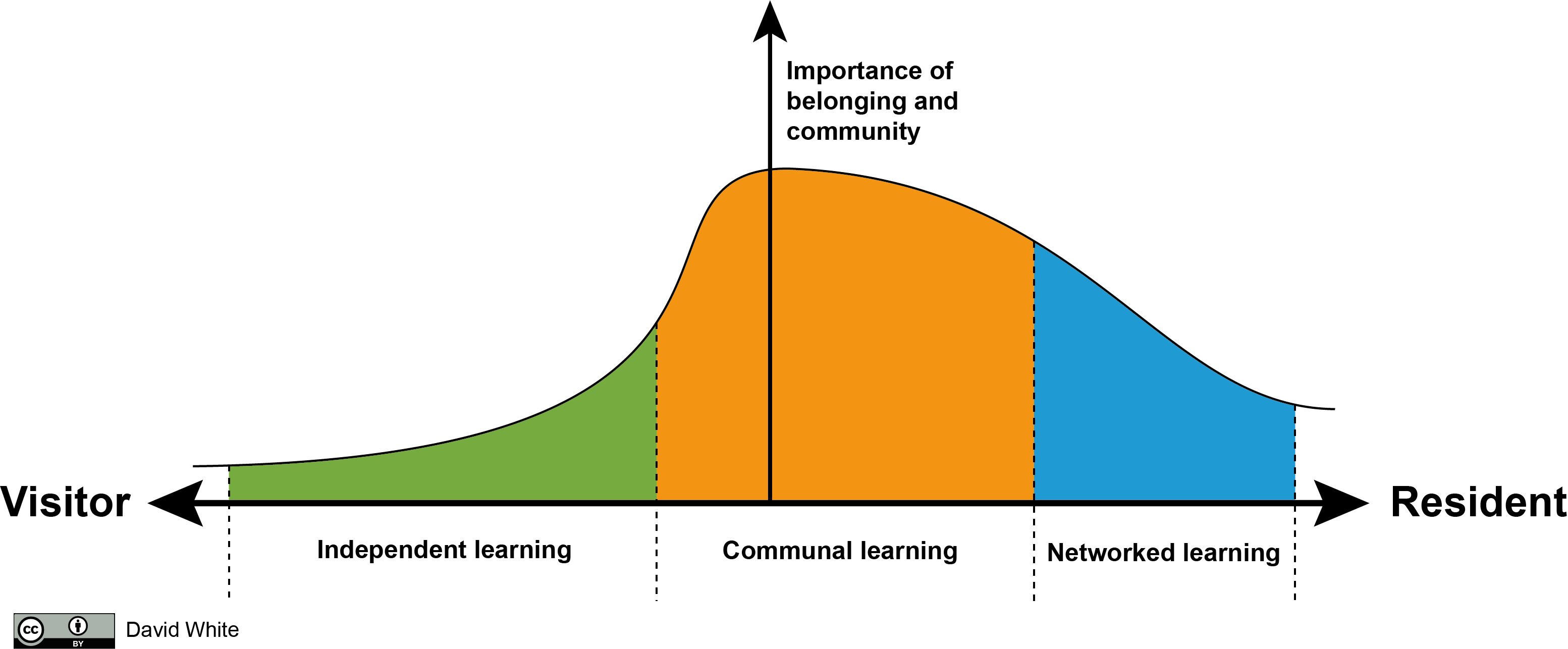
    A diagram of the Visitors and Residents continuum with a belonging and community curve mapped to it.
    Visitors and Residents, belonging and community mapping

    Modes of learning (Not learning styles…)

    We can trip over the language here so I’m not going to be too precious about terms, but let’s step through the diagram:

    Independent learning

    “Independent from what?” That’s always my question. Generally what we mean is “Learning when a member of teaching staff is not immediately present, or nearby”. This is a definition which responds to ‘contact hours’ as the underpinning principle of an educational offer and is therefore quite dangerous, especially when we consider online teaching and learning.

    It’s one of the reasons that asynchronous approaches get a bad press. In terms of belonging though, we can say that those who “Just want to learn what they need” and have the ability to learn without staff input are probably not looking to ‘belong’ because they don’t have the time or the need. Here flexibility and convenience far outstrips the value of belonging. We could go a far as to say that if belonging is inconvenient then flexibility is the antithesis of belonging. (which I offer here as more of a provocation than a solid statement)

    This is not to say that ‘independent’ always means ‘on your own’, which is why the belonging curve tilts up before the middle of the continuum. Self organised student study groups in various forms are a crucial part of most courses. There are no staff present, but there is a lot of learning happening and it still falls under this definition of ‘independent’.

    Independent blurs into communal where the belonging is student facilitated. 

    In this mode we don’t need to facilitate belonging or community but we do need to acknowledge the importance of student led communities and be responsive in other ways. The danger here is that we see ‘independent’ as ‘not needing support’. This is where the concept of ‘mattering’, as discussed by Peter Felten here,  is more important than the idea of belonging.

    Communal learning

    Key idea here is that the middle of the continuum represents engagement with ‘defined groups’. This is where we are expecting to be co-present with others and leave a social trace, but within a specific group rather than totally openly online. Members of the group will have a sense of the ‘audience’ for their contributions and some trust in shared values. They will probably also know at least some of the other members socially and/or professionally (we could look at the Dunbar Number as part of the definition here). This is why platforms such as WhatsApp suddenly became popular because they handed us back the ‘known group’ principle of privacy (on a social, not a data level) which was less exhausting than the constant maintenance of a Digital Identity or performative identity in other Social Media platforms.

    The concept of a student cohort and ‘safe-spaces’ within which to learn (digital or physical) neatly fits this definition of ‘defined group’ even though being a member of a cohort is not the same as being part of a community – that depends on how the course is run. 

    Courses often rely on a communal pedagogy, learning together, shared endeavour (or the blunt version: ‘group work’). This is my favourtie form of teaching and learning and one of the reasons I currently work at an Art and Design focused institution. This is where belonging and community become a necessary aspect of the learning, and dare I say becoming, process of learning. It’s totally possible to support this online, but online or in-buildings, it’s expensive (time commitment, staff time, use of space, complex feedback and assessment etc) and inconvenient, especially as it usually requires some synchronous moments. Basically, you have to turn up, be present, be engaged and be prepared to compromise and negotiate. All the difficult things. 

    In this mode we have to design learning with presence and belonging as headline principles.

    Networked learning

    At the Residential end of the continuum activity takes place in more open and visible spaces online. These are places where anyone can see your contributions without ‘membership’ being required in a social sense (although you might need a profile on a particular platform). For example, Tweets can be read by anyone, not just the people who follow you. Instagram works in a similar way and TikTok is the ultimate hyper networked, hyper-visible, communal-through-trends-not-social-connections platform right now.  

    In learning terms there is perhaps less of a need for belonging and community here and more of a need to be established-within-a-network. The distinction I’m making here between communal and networked needs unpicking further but I’d suggest that a lack of clarity in this area is what has caused confusion and some anxiety in ‘open’ courses. Networked learning can fall into a performative-clique-plus-audience mode, technically ‘open’ but actually exclusive and not really a community. 

    Perhaps in this mode we should not be obsessed with facilitating community and more focused on being inclusive.  

    Multiple authentics

    All of the above applies as much in residential education as it does in online. Just because students come to a building doesn’t mean that want to belong to a cohort or that they somehow automatically become part of a community. This doesn’t have to be a problem though, it’s about designing learning which is not always predicated on assumptions about our traditional, residential students (even if such a category really exists).  

    Sometimes at my institution we slide into thinking which implies that full, residential courses are the authentic way to learn and everything else is either geared relative to this or simply a pipeline into it.  We need to design on the basis that there are multiple authentic modes of learning for multiple communities of students. Not all of these require belonging and community but where they do we need to acknowledge that it’s hard work, time consuming, and that access-to-a-building or being-in-a-cohort is not a proxy for membership-of-a-community. 
  • Visitors & Residents – teaching during Coronavirus

    Prensky’s suspect notion of Digital Natives and Immigrants is predicated on levels of ‘innate’ comfort and skill with digital technology based on age. In contrast, the Digital Visitors and Residents idea is based on motivation-to-engage with networked technology.

    Coronavirus has given millions motivation-to-engage, no matted their age, as social contact and educational provision has become almost entirely online-only overnight. We are all becoming ‘skilled’ with networked tech incredibly quickly, not because we are ‘native’ to it but because we have an immediate and obvious need. Our social and professional lives have become a parade of audio/video meetings and shared documents.

    This highlights that the term  ‘social distancing’ does not account for the Web and is better described as ‘physical distancing’. Many of us are now more Resident online than ever before and are therefore highly social (if not more social) during the quarantine.

    Teaching during Coronavirus

    The abrupt need to move face-to-face education online can be mapped to the Visitor – Resident continuum. At my university we have produced a ‘Core practice guide’ which highlights the need for a balance of ‘content’ (Visitor) and ‘contact’ (Resident) for/with student groups. Just as with the Visitor – Resident continuum one mode is not ‘better’ than the other and any effective online educational provision will use a mix of both. The important factor, in terms of the design of teaching, is how we connect together what we are providing across these modes so that the elements (resources, fora, webinars, recordings)  build on each other and increase our student’s motivation-to-engage. 

    It’s not about the tech it’s about the teaching

    It is also important to note that, as highlighted by the Visitor and Resident mapping activity, the type of technology does not inherently foster a  particular mode-of-engagement. A poorly run online lecture (or webinar) will be less engaging for students than watching a recording or making use of some elegantly contextualised resources. My mantra is that if a synchronous (or ‘live’) piece of online teaching could have been a recording – from a student experience perspective – then it has little value beyond being an way-point in their week (see Eventedness).  

    Making online education engaging requires effective, well-structured , teaching way more than it does any specific digital platform. The most brilliant and fully-featured ‘webinar’ space will not counter a lack of framing activities and resources either side of the session. The same can principle be applied to text-chats, fora, quizzes etc. 

    If you like diagrams…

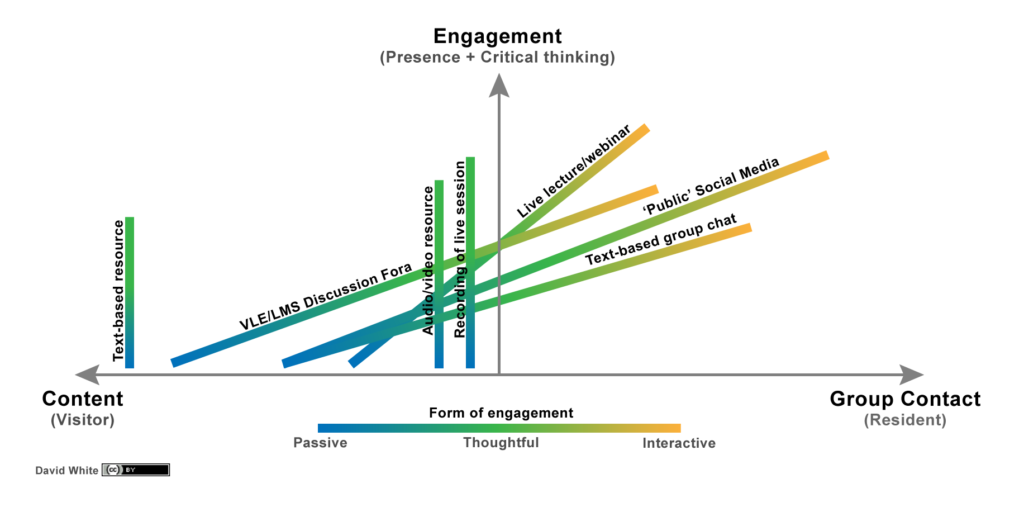
    The following illustrates this point diagrammatically by showing that particular genres of digital provide the potential for certain levels/modes of engagement but that higher levels of engagement rely on the design of our teaching more than on how ‘immediate’ the tech experience might be.

    The diagram is based on medium-to-large groups of students rather than small groups (less than 10) or one-to-one scenarios. Fostering engagement-at-scale is a central challenge for higher education and one which is crucial to consider as we transition to online teaching (and at any other time to be frank).

    Content – Contact for online teaching – CC: BY (click image for full sized version)

    I’m defining ‘Engagement’ as a mix of social presence and active/critical thinking. The mix is complex but important, as one without the other can lead to either noisy-but-unthinking moments or thoughtful-but-distancing experiences. We want our students to develop their thinking *and* feel a sense of belonging.

    Connecting it together

    Any single technology or mode will not be enough to engage a group over a period of time. This requires connecting together a set of modes with a clear articulation of how they flow into one another. At my university we are promoting the use of a combination of Moodle and Blackboard Collaborate Ultra as these can be combined to effectively cover a huge range of Content – Contact. For example: read/watch a resource > respond to a relevant question in an actively facilitated discussion forum > engage with ‘live’ discussion in a webinar which is framed around the themes arising from the forum > write a reflection on the themes and the overall process to be posted to the VLE/LMS (or create image/audio/video with accompanying written reflection).

    Fundamentally, one mode or tech is not ‘better’ than another. What is important is how we connect them as a learning narrative and how we communicate that narrative to foster engagement. This helps to ensure we provide opportunities which are mindful of the range of technical, geographical (time-zone), cognitive, social and emotional contexts/experiences of our students and teaching staff.

  • The horizon of self

    Through the Visitors and Residents work I am frequently involved in discussions around identity, especially in relation to online spaces. Often discussions that start with technology, move onto practice and then morph into questions of identity: How does my professional identity relate to my personal identity? How does my online identity relate to my offline identity? To what extent am I performing different identities? Which of these many dimensions is the most authentic or is that authenticity contextual? etc.  

    Horizon

    These types of questions are brought to the surface by our relationship with the digital because it provides a new mirror to hold up to ourselves. Going online in Resident modes is not unlike travel in this sense, we question who we are as we encounter new spaces,  forms of communication, modes of meaning and ways of being.

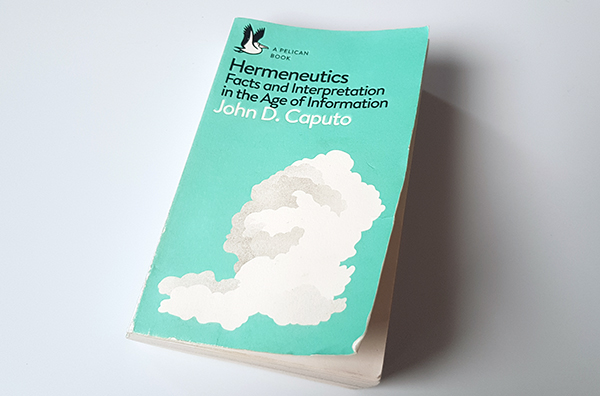
    I’ve always been happy to facilitate these discussions but I’ve not  taken a position on identity apart from making it clear that using the term ‘real’ (as in ‘real-life’ vs ‘digital’) is spectacularly unhelpful as generally when people use term ‘real’ casually they mean ‘something I’ve become normalized to’. My sensitivity to hard-edged distinctions around real/digital or authentic/fake is indicative of my belief in the importance of interpretation. This is why when a colleague gave me a book entitled “Hermeneutics, Facts and Interpretation in the Age of Information” by John D. Caputo I drank it in.


    Hermeneutics, Facts and Interpretation in the Age of Information – John D. Caputo

    Chapter 7 on ‘The Call of Justice and the Short Arm of the Law’ which explores a lecture given by Derrida in 1989 at the Cardozo Law School inspired me the most. It didn’t fire me up about the law or justice but rather the character of Derrida’s approach to Deconstruction. Where Derrida spoke of law and justice I could read identity and self. The more I mused on this the more helpful I’ve found it in describing a model of identity which is based on becoming-through-interpretation. So, to this end, I will inelegantly summarise a wafer of Derridean thinking and then extend this into a new, identity-based, context.

    The most important aspect of justice as described by Derrida, via Caputo, is that it is impossible and does not exist. Justice is unreachable but it yet it calls us to move towards it (Caputo likens this to a spectre or ghost), whereas the law is constructed and has force (and structures and physical components – courts, police, prisons etc).

    We hope to make just laws but will never attain a perfectly just legal system. Any attempts to respond to the call of justice require that we interpret law in each given situation or context. A law applied without interpretation is extremely likely to lead to an unjust outcome. Our attempts to be just exist between the deconstruction (or interpretation) of the law and the undeconstructable call of justice.

    We need the impossible to create a distance within which can deconstruct or interpret. (I recommend you read the chapter – I can’t do it justice here…)

    It struck me that the notion of the ‘self’ was much like Derrida’s positioning of justice. It calls to us like a ghost or a dream but it is contested and slips through our fingers as we attempt to define or describe it. Attempts to define self and being is the fuel of philosophy – as alluring as it is confounding.  Perhaps this is because, like justice, self is simply impossible and its power is in this undeconstructablity – a horizon we might travel towards but never reach. A journey we might take knowing we will never arrive.

    To extend this, identity becomes akin to Derrida’s depiction of the law, something which is constructed and has force within the world. If we run with this line of thinking then it is through interpretation of identity that we respond to the call of self. We can never fully arrive at our-selves but we can deconstruct our identities through interpretation, towards the self . I consider this process of continual deconstruction and reaching through interpretation, usually via dialogue, to be ‘becoming’.  

    As with justice and the law what becomes crucial within this conception of self and identity is the willingness to deconstruct or interpet. Damaging essentialization based on shoring-up (sure-ing up?) well worn binaries such as real/virtual, authentic/fake falls away as the ‘work’ of identity becomes interpretation, questioning and negotiation.

    This is in stark contrast to the view that we already somehow contain our true self, a self we must express through our identity. On this view we are constantly attempting to project our self into the world as an authentic identity. There is a kind of violence to this in which we fight external factors (institutions, individuals, society, culture etc)  that might repress our true self. In some cases, where individualism has reached its zenith, we are told that it is us who is repressing our own true self and are invited to unlock our real selves, usually via purchasing something. Certainly there is plenty of money being made via products that claim to help us to express, or be, the ‘real’ us on this model.

    Our digital environment also supports this model as within Social Media negotiation of identity through interpretive presence is commonly replaced by acknowledgement of essence. Collecting followers and likes authenticates and quantifies our existence without the need for deconstruction. We will not move any closer to the horizon of self if our sense of identity is based on validation through acknowledgement rather than engaging in dialogue and deconstruction. This then leads to a creeping alienation in which we constantly seek acknowledgement to secure our identity but make no progress toward self and feel increasingly ephemeral.

    Similarly we cannot reach towards self if the only people we connect with provide a homophilic mirror of our current identity state – this is a comforting form of identity stasis which, in conjunction with the need for essential acknowledgment, breeds polarisation. We inevitably bolster our ‘authentic’, internalised self through the constant re-establishment of what we are not, in a process of unbecoming.

    In my view then, agency is not the power to enforce our identity on the world but the conditions and desire that support us in deconstructing our identity towards self. This form of becoming is challenging, requires us to be vulnerable and is fraught with risk. Given this, the conditions become crucial and it is much less risky for those in a structurally privileged position, such as myself, to engage in identity deconstruction. I have many institutional safe-spaces I can retreat to if I ‘overreach’ towards self.

    In this regard there is much work to be done to move our institutions to places in which a diversity of identities can be negotiated. I understand why certain environments can only be engaged with through a forceful projection of self and identity, especially where individuals feel misunderstood, repressed or ignored. Those are the mono-culture environments which pretend to invite negotiation but which are merely looking for acceptance and assimilation.

    Those environments create conditions which breed polarisation and amplify individualism in a manner which extends, rather than interprets, difference – our identities become fixed and our horizons become walls we build. In astronomy there are no walls, we can see to the edges of the universe and glimpse our shared beginning. Through deconstruction of identity we travel towards a shared and connected horizon of self.

  • Arguing with the Digital Natives guy in four vexations

    Arguing with the Digital Natives guy in four vexations

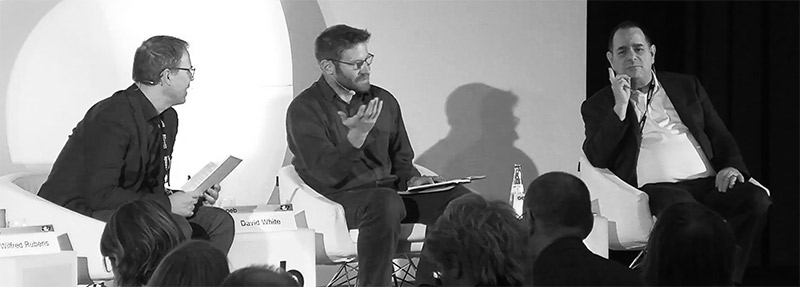
    This is difficult for me to write because I’m still tense about much of it. I have recently got one of those ‘health tracker’ watches and while reviewing the video of the session with Marc Prensky at Online Educa my heart rate did spiral upwards.

    The debate was a chaired, hour long session, between myself and Marc which promised to ‘go beyond’ metaphors to discuss the ‘realities’ of how education systems should respond to digital. In the end we didn’t discuss Visitors & Residents or Natives & Immigrants directly (something Marc was careful to avoid). However, our underlying educational ideologies were laid bare during the debate and effectively revealed the thinking behind our respective metaphors.

    A simple way to read the session is in cultural terms, as a colleague pointed out to me I had a European-style ‘critical thinking’ perspective while Marc has a ‘pioneering’ North American flavoured focus on ‘accomplishment’. If I was to put it bluntly, I characterised Marc as Libertarian while he characterised me as Elitist and an Ivory Tower academic.

    [embedyt] https://www.youtube.com/watch?v=cblSaK56AXQ[/embedyt]

    Having reviewed the video of the session I can see that Marc’s point of view was generally geared around schools level education rather than higher education. In fact, his framing of higher education approximated Oxbridge of 30 years ago (or now depending which course you are on).

    This is vexation number one: repeatedly being told by people that don’t teach that the education system is broken. Marc clearly has very little experience, or knowledge, of the majority of the higher education sector in the UK (in fact many of the speakers at Educa had little or no day-to-day experience of working in education institutions). Marc evidenced his lack of direct experience in a few comments:

    1. He described a form of group-based teaching as good idea, as if we don’t ALREADY DO THIS A LOT.
    2. He suggested we should do more project-based learning which is something WE ALREADY DO A LOT.
    3. He seemed to be under the impression that all we do is ‘think’, and teach students how to ‘think like us’, which he characterised as of little value, suggesting that it would be better if we thought less and did more.

    Vexation number two: implying that ‘thinking’ is elitist. Working on the basis that you are either thinking *or* doing is ridiculous, but I suspect Marc was alluding to ‘academic’ thinking AKA ‘not doing anything useful’ rather than the thinking required to DO THINGS(?). I believe that having learned some literacies at school it’s part of higher education’s responsibility facilitate students in extending their ability to think critically and question intelligently. That’s not to say that, as Marc suggested, I assume that incoming students don’t know how to think. However, don’t believe that we are all ‘naturally’ good at this (Excepting those who are so privileged they are never put in a position where their actions are called out an unthinking?). Most of us benefit from some teaching and some challenging in this area.

    So I take offence at the implication I’m elitist for holding the view that thinking is a good thing, especially as this is part of a process by which students can, I hope, reject or challenge dominant modes of thought and those who have taught them. I love a well reasoned argument from a student about why my views don’t stand up and I hope I’m open enough to take new ideas on board. (At one point Marc highlighted that I’d brought some notes with me to the session, as if this was somehow an elitist, academic move, rather than ‘being somewhat prepared’.)

    Vexation number three: the repeated use of terms like ‘effective’ and ‘successful’ with no frame of reference. As you would expect, the Digital Natives guy basically espoused a kind of ‘let the kids get on with it because they have the Web’ approach whereas I suggested that we need to teach critical thinking and facilitate a broadening worldview. Towards the end of the debate I gave a little speech about privilege, quoting Orwell: “All animals are born equal, but some are born more equal than others”. If our education systems can’t provide opportunities to those born ‘less equal’ then what’s the point? Obviously my problem with Marc’s position is it assumes a Libertarian equity of opportunity and runs on the basis that you just need to be your best, most individual, self and you will‘ succeed. It’s easy to see how Marc, having been through Harvard Business School, might promote this idea and how this would be lurking behind the Digital Natives stuff. It’s the old ‘being successful means being like me’ problem.

    Vexation number four: celebrating human doing over human being. For Marc, ‘success’ seemed to be about doing things to the world to ‘make it’ a better place, whereas I suggested notions of becoming and, I hope, being part of humanity. This is why I’m ok with the notion of, what is often described as, ‘learning for learning’s sake’ because I think it enriches us – it’s probably better described as ‘learning for our own sake’, and if we are active within our communities and beyond then ‘own sake’ means society as much as ourselves.

    How about we focus on becoming decent, thoughtful, human beings before confidently ‘fixing’ the world? Maybe I’m old fashioned, but I’m confident that concentrating on the former is more likely to improve the general state of affairs. Ultimately, Marc sees the Web, or the network, as a largely non-hierarchical location in which anyone with some gumption can achieve great things, as if the Web was some kind of neutral space in which the ‘good’ succeed and those that sink only have themselves to blame. This is effectively the mantra Silicon Valley hides behind.

    I hope that for those in the room our sharply opposing views led to a meaningful debate. I personally found it quite distressing but maybe I’m just not native enough to market-driven conference environments? 🙂

    Having said this, now I’ve had time to reflect I have to admit it’s been a useful process for me. I’ve learnt a lot and I value the opportunity to debate with people who hold differing views. After all, where is the challenge in only speaking to people who already agree with us? So, thanks for your time Marc, I can’t see us agreeing on much but I’d be up for round two if you are.

  • Visualising digital practices using V&R

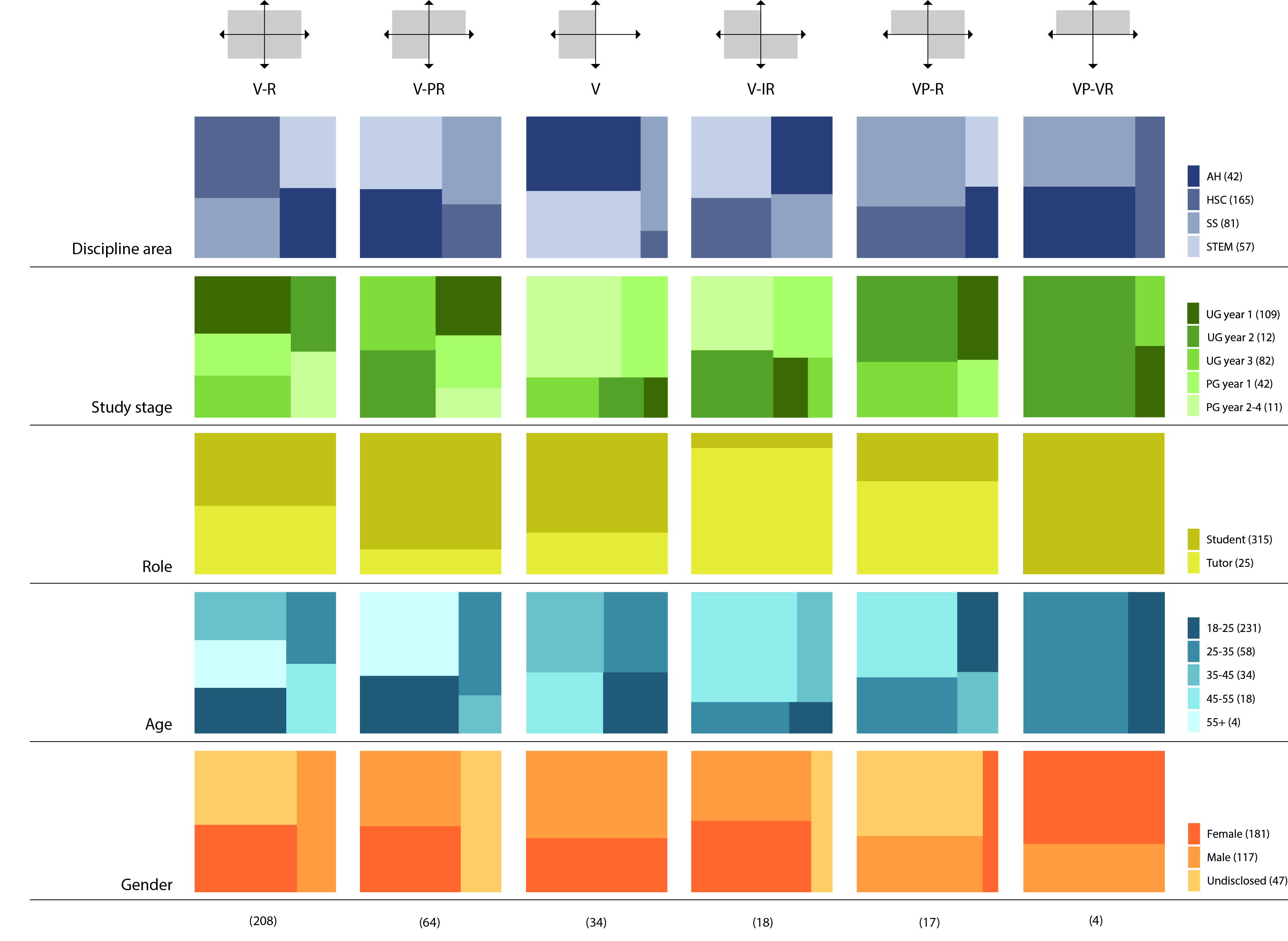
    Myself and Alison Le Cornu recently published “Using ‘Visitors and Residents’ to visualise digital practices” an open access paper reviewing the development of the Visitors and Residents idea. The paper describes the heritage of the V&R mapping process and details a visual pattern-based approach to clustering and analysing large groups of maps. This is a significant step as it expands the Visitors and Residents work beyond a discussion facilitating metaphor to a workable qualitative research instrument.

    At the heart of the paper is the presentation and analysis of data from a Higher Education Academy funded project which generated circa 400 V&R maps from staff and students at 18 higher education institutions from across the UK.

    From: Using ‘Visitors and Residents’ to visualise digital practices
    by David S. White and Alison Le Cornu.
    First Monday, Volume 22, Number 8 – 7 August 2017
    http://firstmonday.org/ojs/index.php/fm/article/view/7802/6515
    doi: http://dx.doi.org/10.5210/fm.v22i18.7802   – (Graphic design by Paul Tabak)

    I won’t rehash the description of the data collection and analysis here as that’s all in the paper, so do take a look if you are interested in using the V&R mapping as part of a qual data method.

    What’s rewarding is to have finally captured the narrative of the progression of the work from ‘a fun thing to do in a conference session’ to an innovative research instrument. Significantly, the Visitors and Residents narrative contains contributions from numerous friends and colleagues who have enriched the thinking and taken the work in new directions. For me this is a perfect example of the richness of working opening and posting CC licenced materials online for others to use and modify.

    I’m currently working with Ian Truelove on a version of the mapping which crosses the digital/physical space (locations) divide in teaching and learning. The mapping approach we are discussing includes ‘Independent’ and ‘Dependant’ for the vertical axis and the extension of Visitor and Resident metaphor into ‘hunter gatherer’ (Visitor) and ‘farmer’ (Resident). The plan is to use this with course teams to visualise and discuss how they provide ‘nutrition’ for students (and how they support students in developing their own, sustainable, forms of ‘nutrition’ – yes, this is a bit like the ‘give a man a fish – teach him to fish’ idea).

    The original description of V&R was largely based on ‘visibility’ or leaving a social trace. That doesn’t operate as well in physical environments where it is possible to be visible while in Visitor mode, for example, studying alone in the library. The hunter gatherer/farmer interpretation allows us to describe learner modes of engagement in both digital and physical environments.

    The vertical axis of Independent and Dependant draws out the important distinction between those times where teaching/technical/library staff are involved (this could be expressed as ‘contact’ time) and those times where students are working without direct input from staff. We have been careful to ensure that the digital/physical boundary is not tied to either axis as all modes of learning engagement can take place in either type of space.

    I’m keen to counter the idea that particular spaces (physical or digital) are intrinsically linked with a specific pedagogy. For example, while a lecture theatre does engender or encourage (partly through tradition) more didactic forms of teaching it can be used in many different ways (especially when digital spaces are incorporated into the face-to-face teaching). Similarly, Social Media as a genre of space does not mandate a particular form of dialogue or engagement. The new mapping process we are working on is designed to explore the relationship between spaces of all forms and modes of teaching and learning.

  • Visitors & Residents – navigate the mapping

    Myself, Donna Lanclos and Lawrie Phipps are delighted to release a facilitators guide and slides for running the Visitors and Residents mapping activities (a workshop format for reflecting on, and responding to, various forms of digital engagement). These resources were developed for the Jisc Digital Leaders Programme but can be edited and adapted for different audiences. For example, a version of the individual mapping activity could be run with Students and/or teaching staff while the group mapping activity could be adapted for course teams. This post from James Clay is a good example of how the mapping can be adapted.

    [sz-drive-embed type=”presentation” id=”17c_9HKxNwMEy0dFXNYtvpm2VLmRtDND-V1YCVLNIK0Y” width=”auto” height=”420″ delay=”1″ start=”false” loop=”false” /]
    ‘Vanilla’ version of the slides with detailed notes – designed to be edited and adapted. 

    The thinking captured in these resources has been developed over a few years and refined each time we have running the mapping activity. If you have experience of running workshops then the resources should give you what you need to facilitate a mapping session.

    I was once told that you had to be “Dave White” to run the discussion parts of the workshop so there is a large section in the guide which highlights themes arising from individuals maps that have been recurrent across workshops and how they can be constructively discussed. If I’m honest then the only mapping sessions that have proved challenging to run have been those with educationalists (if that’s the right term). They tend to enjoy deconstructing the principle of Visitors and Residents and the nature of the mapping rather than doing the mapping itself. I enjoy those discussions and have found them helpful in developing the work but time is limited in any workshop and sometimes you have to encourage people to get started on an activity and then discuss it’s pros and cons.

    One of the strengths of the workshop format is that it is not attempting to cajole participants towards a specific set of responses:

    This workshop will not hand any participant a bullet list of things to do. The intention is not to build skill sets, but to provide a space from which intentions and objectives around institutional policies can emerge. The list of things to do next will necessarily emerge from the participants, not be given by the facilitators.”

    This did vex someone who asked me “what do people learn in the workshop?”, to which I replied “It depends on who they are and what direction they want to take things”. In this sense the workshop format is completely in keeping with the designers pedagogical philosophy of providing the conditions for reflection and strategic thinking without being perspective about the ‘right’ way to do things.

    If you do run a Visitors and Residents mapping workshop then (if you feel moved) please let us know by using the #VandR tag in Twitter.

  • Education as Becoming

    In the last few talks I’ve given to teaching & learning and library folk I’ve spoken about my views on what I believe education should be at the start. Rather than gently constructing an argument for my ideology and meandering towards a slow reveal (assuming anyone would notice) I’ve opened with a few simple statements to provide a frame for the rest of the talk. This appears to work well as there is an honesty to it that I suspect people appreciate.

    My starting point is not new, it does not advocate smashing the system and it’s not a performance of liberal hand-wringing. I simply believe that education is a process of becoming.

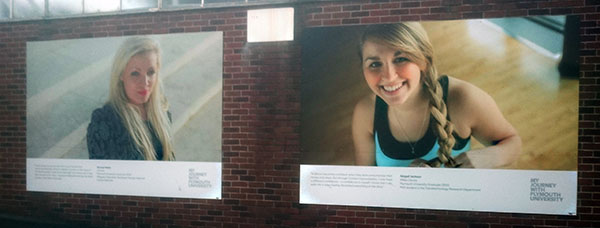
    This is a principle which then informs everything from curriculum design to the planning of physical spaces and the use of Social Media etc. Our undergrad students want to become one of those people that is hidden in the title of their course.

    A business student and a dance student as promoted by Plymouth University using simple identifiers
    A business student and a dance student as promoted by Plymouth University on an identity basis

    And this is a good thing. Students come out of school looking for simple identity hooks which is why the disciplines are such a powerful way of dividing up the world. However, once we have nurtured their disciplinary sense of self and taught some key intellectual tools we should encourage the questioning of overly neat identity associations. For me this is the bridge between undergraduate and post-graduate approaches. By the time students leave their undergraduate programmes they should be weaning themselves off simplistic, generic forms of identification and using what they have learned to develop their own, more complex, sense of self.

    Clearly the Resident Web is an excellent location for this process of becoming and revealing. More than that, the networked, anyone-can-publish, identity-rich side of the Web is in-of-itself amplifying the potential to ‘become’ in ways which are less aligned with specific institutions and disciplines. This is what we need to consider when designing curriculum and pedagogy underpinned by the notion of becoming in a post-digital environment.

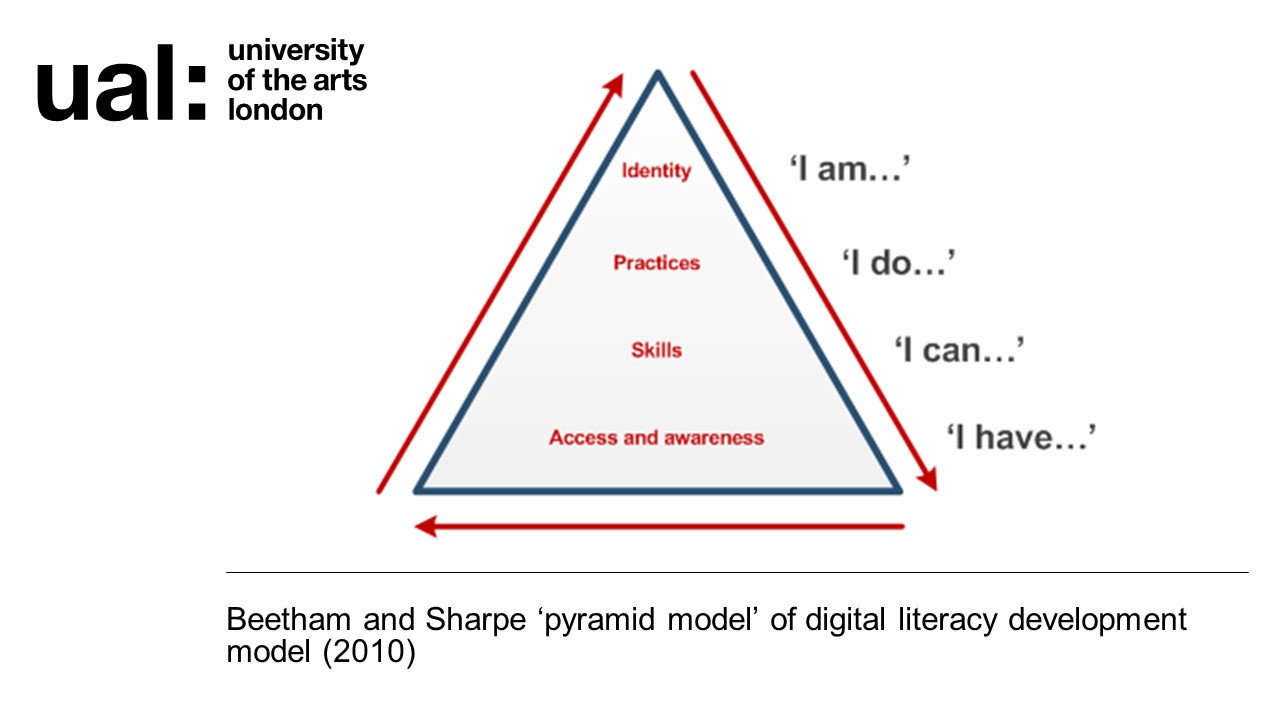
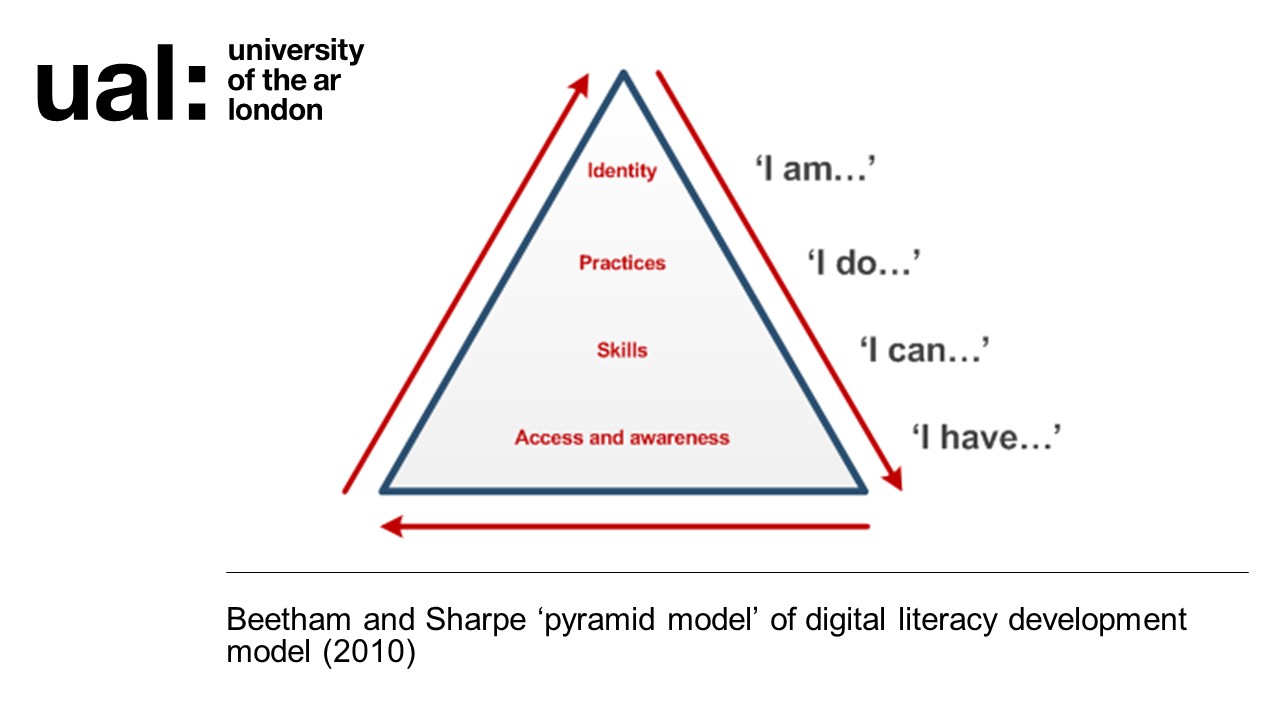
    We need to ensure that the trajectory of undergraduate programmes is towards the top of the triangle, not just because of the presence of the digital but because it is the direction needed to foster becoming.