Author: David White

  • Against intuitive technology

    “I want my technology to be intuitive” is a statement that has always irked me. Musing over why I can feel my eye twitching when I hear it I realised that ‘intuitive’ is a proxy for ‘I don’t want to think about the technology’. The assumption being that the tech is only there to facilitate at task. Presumably this task mirrors something the individual has done many times before in analogue form giving them the ability to intuit the process. For example, paying a bill or writing a report. “I don’t want the technology to get in the way of what I’m trying to achieve” being the sibling of the ‘intuitive’ comment.
    Baby with iPad
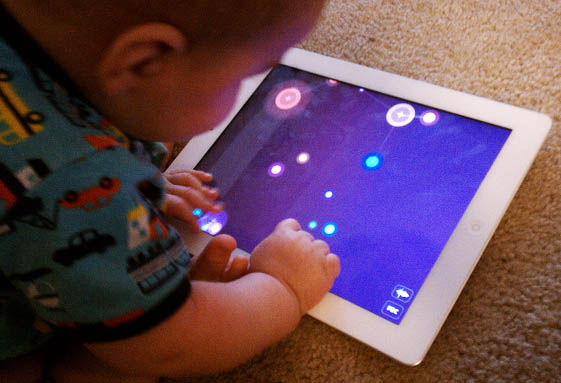
    Proof that bright lights are attractive to babies. (CC – lynnmarentette)

    What many call intuition in their lives is almost always something that has been learnt. Beyond basic responses, such as a baby throwing its arms out (the Moro reflex – although here I may have moved from intuition to instinct), much of what we think of as intuition is simply stuff-we-have-learned-and-then-forgotten-we-learned. Knowing that the Diskette symbol means ‘save’ is not intuitive, especially as the skeuomorphism of our icons slips a generation and becomes wholly abstract.  More fundamentally, a Diskette might be the symbol for ‘save’ but what does ‘save’ mean? It’s certainly not an intuitive concept in the non-physical milieu of the digital where we have to create our own mental maps of where information is located and how it’s curated.

    To my mind the most successful ‘intuitive’ aspect of contemporary technology is its ability to support modes of consumption. Adverts for the Kindle Fire phone show beautiful people using the technology to buy goods and services in a variety of ways which smoothly align to their beautiful lives. It’s hardly surprising that the dominant ideology of capitalism should be mirrored in the technology so successfully and received as ‘good design’ or ‘intuitive’ rather than ‘learnt’ or ‘programmed’.

    What does it mean when the technological process many find the most intuitive is buying something from Amazon or seeking out information using a search engine that primarily exists to target adverts? The same applies with individual production online, as for most this involves packaging their identity into neat slices for others to consume via Social Media.

    This is what comes to my mind when I’m asked why all technology isn’t more intuitive. For me learning the technology is part of the larger learning process. In an educational context there are many occasions when I don’t want the tech to be transparent, I want it to be questioned.

    In the creative sphere nobody complains that software such as Photoshop or Final Cut are complex and require tutorials and workshops to master. It’s recognised that they’re powerful tools which need to be understood before they can be harnessed or appropriated. For example, we know that if we don’t get to grips with Photoshop the result is a dumb replication of a particular aesthetic (or Instagram as it’s known).  Photographers and filmmakers don’t expect the technology they use to be intuitive, they expect to be powerful, requiring effort to learn and to bend it to produce the results they desire.

    It’s likely that this use of ‘intuitive’ in educational circles comes from writing being the predominant mode of production. Obviously as with any form of literacy writing must be learnt but the physical tools required to realise ideas in this mode are relatively simple. Bounce that into digital technology and you have MS Office Word which at its core is a straight reflection of the physical paradigm. This I suspect is where most people who demand ‘intuitive’ are coming from, they are not considering the possibility that some technologies operate in new paradigms that cannot be tenuously mapped back to existing practices. New modes of practice need to be developed in these cases. The manner in which technology can call us to question and adapt our practices by getting-in-the-way is the muse for much creativity and innovation.

    I don’t want technology to be ‘transparent’ – a bland tool which supports practices we already understand. I want it to be challenging, I want it to inspire by being unexpected, open enough to be appropriated in new ways by intelligent, engaged individuals. Learning the technology, learning how it can be appropriated, recontexualised,  disrupted, abused and used is part of the process of education not something that should be designed out.
  • Connection and anxiety

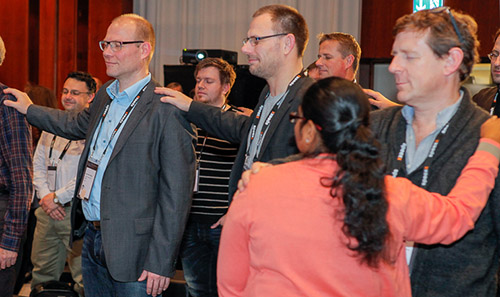
    As I hinted at in my (Re)humanising eLearning post I directed a group performance entitled “A performance of connection and anxiety” as part of my Spotlight Stage session at Online Educa. The audience played the part of first year undergraduates while I represented ‘the institution’ in all its various forms. This involved everyone standing up, putting their hand on the next person’s shoulder and closing their eyes (100+ people seemed surprisingly willing to enter into this piece of shared theater).

    Connection
    Photograph by David Ausserhofer, Mark Bollhorst and Maren Strehlau. All copyrights by ICWE GmbH. CC 2.0 Germany

    As I’d hoped this created a certain frisson in the room and when we remained silent for about 15 seconds that strange feeling of togetherness started to grow despite most of the audience being strangers to one other. I then circulated round the room ‘selecting’ individuals by tapping them on the shoulder while they had their eyes closed, representing the moments they might be ‘chosen’ or engaged with by your institution in some way.

    Discussing this with people afterwards some commented that they had hoped to be chosen but they didn’t know why as I hadn’t explained what the implications would be. Others hoped not to be chosen but overall there was a healthy tension in the room – I like to think of this as the ‘good’ form of anxiety.

    When I asked everyone to open their eyes and sit down if they hadn’t  been selected many people were looking around to see who the chosen few were. At this point I admitted that I hadn’t chosen anyone which fortunately got a laugh (possibly of relief :).

    Overall it did feel like we’d all shared in a specific moment of connection and one, as I outline in the original post, which worked between strangers because we were physically co-present. Gaining that sense of connection online requires more up-front identity work but I believe it’s crucial if we see the value of the digital as a place we can learn together.

    The three key areas I proposed for consideration to create connection online and rehumanise elearning were:

    1. Spaces
    Think of and use the digital as a series of spaces or places where individuals can be co-present and connected. (rather than just a mechanism to broadcast content)

    2. Eventedness
    Design in synchronous moments or ‘events’ online. This helps to create a feeling of belonging and that ‘I was there’ factor. The technology to support this is now pretty reliable.

    3. Conversation at scale
    Design mechanisms for discourse to take place at scale. Hashtags, commenting, shared postings, crowd-sourcing, editathons etc. This is the area which we are least adept at but I believe the technology is now in place to support conversation at scale if we can design our teaching to take advantage of it.

    All of the above are underpinned by individual’s developing an online presence and identity. Something which is central to almost all Digital Literacy frameworks but which we often don’t prioritise when supporting our students and/or staff.

  • (Re)humanising eLearning

    For my ‘Spotlight stage’ session at Online Educa (15:35 on Thursday 4th) I’m  exploring ‘Re-humanising eLearning’. This is a theme very much inspired by Catherine Cronin’s keynote at ALT-C this year in which she spoke, among other things, about the value of online identity and open practice.

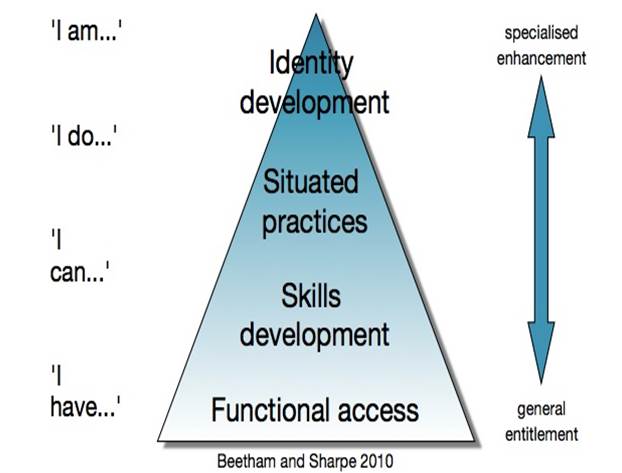
    When I’ve mentioned the theme of Re-humanising eLearning to colleagues many of them suggested that eLearning was never particularly ‘human’ in the first place. This is a reasonable, if disappointing, comment. Nevertheless, take a look at almost any Digital Literacy framework and it will have the distinctly human (in that it is about the ‘self’) concept of a Digital Identity highlighted in it somewhere. In my favourite framework/hierarchy from Helen Beetham and Rhona Sharpe Digital Identity is the apex of digital capability.

    Yet the primary experience and conception of eLearning for most learners is based around receiving a bunch of content that has been placed into a curricular structure somewhere online. No need for an identity in this scenario, just anonymously grab what you need to get your work done.

    In my session at Educa I’m going to highlight how the efficiency and flexibility of this impersonal form of eLearning risks holding students at arms length. This is especially the case those who have many calls on their time (work, childcare etc.) and can’t make it to face-to-face sessions or have chosen predominantly online forms of learning to fit around other activities.  In this scenario it’s crucial that the digital becomes a humane learning space in which a sense of ‘togetherness’ can grow.

    What interest me is how meeting in physical locations has an automatic feeling of togetherness built in, we feel we are sharing an experience without having to ‘know’ the other people in the room (a trip to the cinema is a good example of this). The very fact everyone has chosen to turn up to the event/session/lecture shows a common purpose. (I’m planning a little shared performance which involves the whole room in my Educa session to prove this point… See http://daveowhite.com/perfomance)

    Online it’s a different story, when we move to predominantly text based environments we have to project our identity before we can interact or feel a sense of connection. What good would Twitter or Facebook be if we didn’t know who was talking/posting, if the screen way just a series of sentences with no attribution?

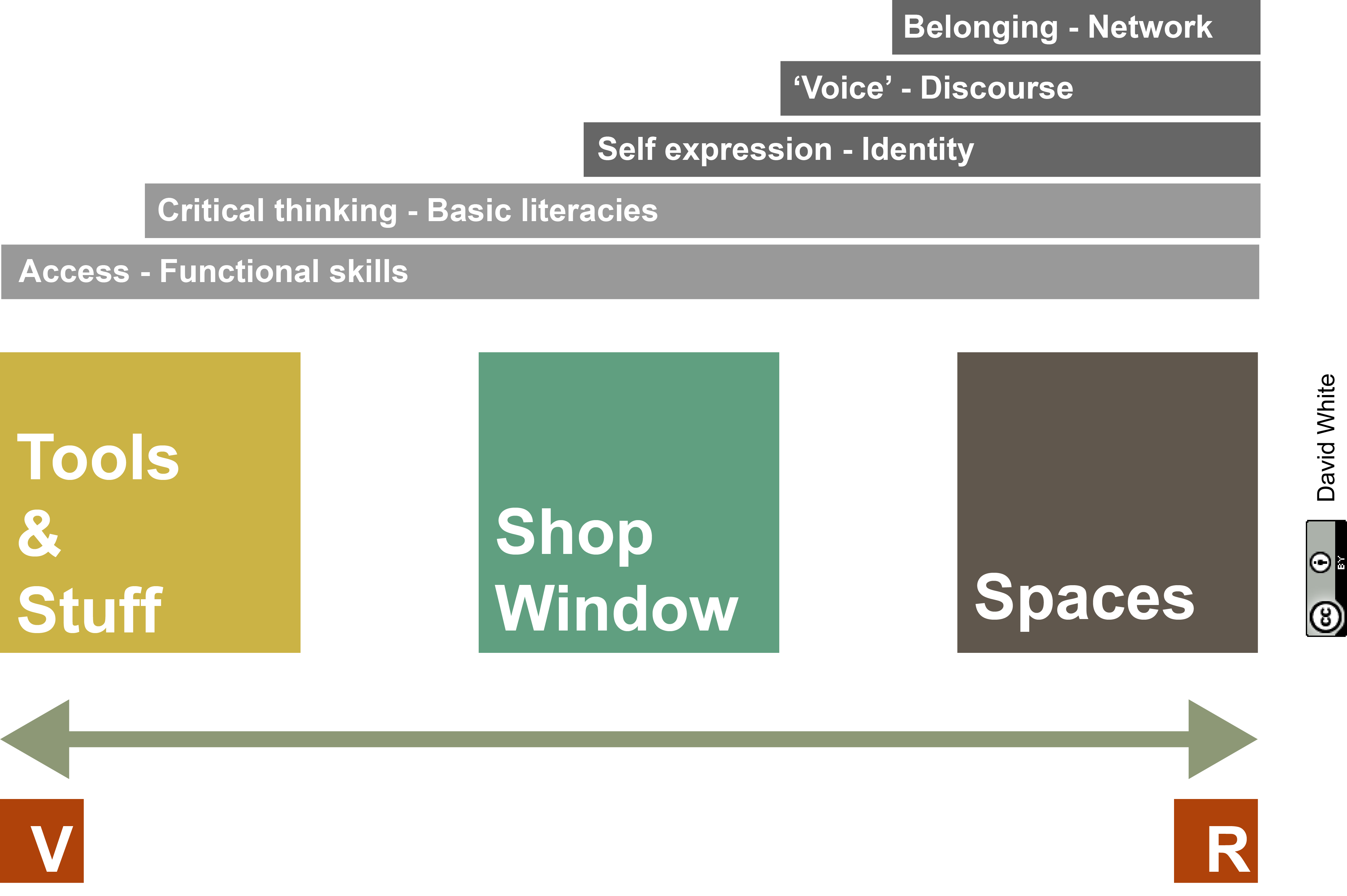
    Identity and self expression are writ large in my mapping of ‘digital capabilities’ on to my 3 category model of digital engagement (see Breaking down digital).

    I’m not sure I’ve captured everything I need to here but I’m confident that as soon as we move towards the Resident/Spaces end of the continuum we are engaging, however minimally, in forms of self-expression which leads to the projection of identity.  It could be argued that it works along these lines:

    Technology (and the people in it) fosters agency > forms of self-expression > formation of identity > increased agency > and so on…
    (note: should make this into a looping diagram)

    So in a digital context identity and self-expression are crucial to becoming and belonging, whereas in face-to-face scenarios some ‘togetherness’ can be felt without identity. Those who are fortunate enough to be able to regularity attend face-to-face sessions are likely to feel connected to their learning and their institution; to engender this online requires more explicit fostering of identity and expression.

    At this point we could switch ‘digital’ for ‘higher education’ and the principle still fits. The digital in this case is simply a mirror for what I believe to be the overall point of higher education – to encourage and challenge students to nurture their identities as legitimate participants within their field of study. They arrive with a delicate sense of who they are in the world and leave with purpose and a solid sense of self…

  • Lonely Natives?

    I stumbled across a piece by Lauren Laverne on the Guardian website this weekend in which she unquestioningly evoked the idea of Digital Natives and Immigrants (which appears to have been largely drawn from Michael Harris’s The End of Absence).

    “Anyone born after 1985 is a ‘digital native’”

    Alone
    CC – Lee Haywood https://www.flickr.com/photos/leehaywood/6563902327

    What interested me was that her interpretation of the concept was social rather than technical. Launching from her feeling that the best new music ‘sounds lonely’ inspite of the connectivity of the Web Lauren describes the manner in which the Web and Social Media have led to a generation that know little of solitude or unconnected moments. This is in contrast to her childhood in a pre-digital era in which she regularly experienced many moments of being ‘alone’. This, she claims, allowed for more reflection and perhaps an opportunity to build a sense of self in a way the Web has forced into cultural extinction.

    What intrigued me was that she in no way claimed that her generation used Social Media any less than ‘the kids’ or that the ‘the kids’ were any more adept than she was at living via digital means. The influence of the digital is being framed here as entirely social, not technical. This, for me, is more evidence that we are becoming Postdigital, wherein the digital permeates everything so the focus shifts back to the human. For example now that all phones are an anonymous slab of screen and ‘everyone’ owns one we can see past the tech to sociocultural effects. This is not to say that the drive of the ‘Natives’ argument isn’t unhelpful bunkum (As highlighted by Josie Fraser in a recent post) – beyond “kids naturally ‘get’ technology” classics include:

    1. Kids have lost the ability to concentrate
    2. Kids don’t know how to be alone
    3. Kids don’t know how to think deeply anymore
    4. Kids are incapable of reading more than a few sentences at a time
    5. Kids feel alienated, alone and confused
    6. Kids are losing their moral compass

    …because of the Web…

    Swap ‘Web’ with ‘comics’, ‘pop music’, ‘TV’, ‘videos’ or ‘videos games’ and these statements can be applied to the ‘youth’ generation at any point since 1945. Everyone loves a generation gap…

    The truth is that people like connecting to each other by any means possible so of course if there is an opportunity to feel that delicate sense of connection and belonging we will take it. That’s why the humble telephone became so popular and it’s why Social Media exists. Solitude is a subtle discipline and one which may need to be learnt now that it isn’t foisted upon us by a lack of connectivity. Even so, are older folk any better at taking timeout than the kids and was my generation any less alienated or distracted than today’s youngsters? I doubt it.

  • #Digitell Identity

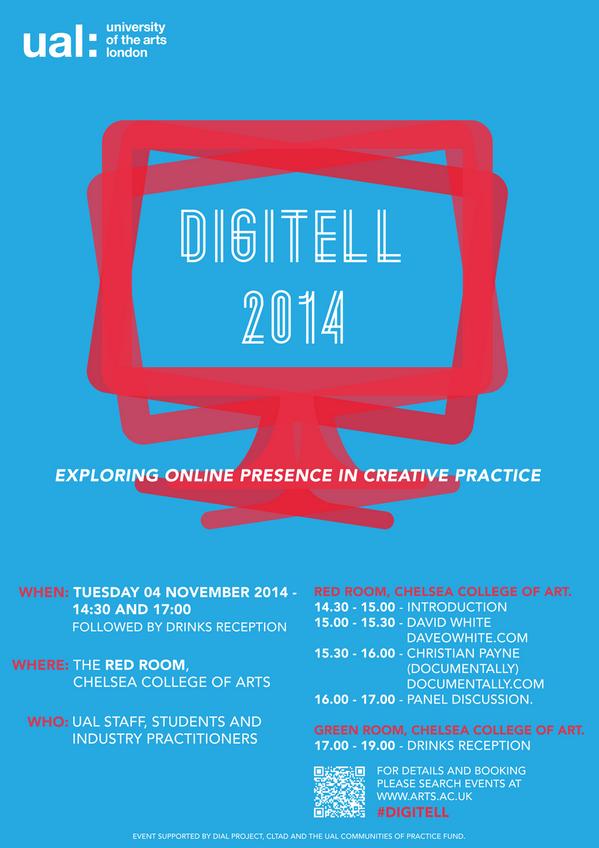
    It was lovely to be invited to speak alongside Christian Payne (@Documentally) at the Digitell symposium held at The University of the Arts London. The focus of the student run event was digital identity, one of the themes students had highlighted out of a community of practice supported by the Jisc funded ‘DIAL’ project and CLTAD.

    So I rolled up my thinking-sleeves and considered the way identity functions in the creative arts… The result was a talk which included Duchamp, Abramović and Banksy. Obviously it’s a complex subject and many have been lost down the rabbit-hole of identity but I gave it my best shot.

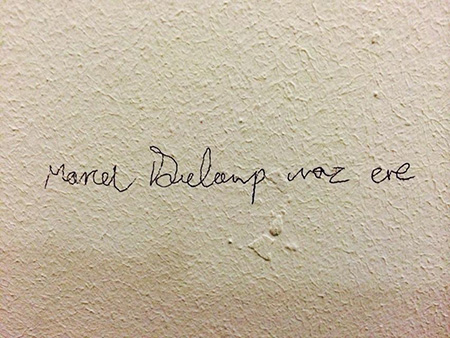
    Marcel was ere
    Found by @otheragent in the toilets at Chelsea college of art during digitell.

    With Fountain Duchamp shifted the emphasis away from the artist as sole generator of meaning but the effect of this move to the conceptual appears to have put more rather than less focus on the identity of the artist. If the art is a found object we want to know even more about what the artist was thinking and ‘who they are’. The work/piece and the identity of the artist are inextricably linked. Abramović’s The Artist is Present is the absolute extreme of this, she is both her ‘self’ and a found object. I finished this section of the talk by pointing out that a Banksy piece is valuable because of its attachment to ‘Bansky’ as an identity even though he/she is anonymous. Even when the identity of the creator is not known it is still  a powerful influence on the way we interpret and receive the work.

    My overall point here is that people are fascinated by people and most work, artistic or otherwise, is an expression of identity in some form. To my mind ‘identity’ is a proxy for ‘humanness’.

    In digital contexts I suggested that there are two major ways of realising an identity online:

    1. Identity embodied through works (Abramović being the most pointed example).

    Rather than being present directly online in social media or similar spaces individuals can express themselves through objects/work they have created. This is where the notion of the Web as a ‘Shop Window’ works well (see my Breaking Down Digital post). This form of online identity only functions when the work is created in an ‘I made this’ mode. Obviously this is closely aligned with the creative arts but I’d argue that anyone who has written an academic paper for example is doing the same thing. Our online identity is the sum of what we post and what is posted about us. This includes anything that has our name/pseudonym linked to it. The significant point here is that there is little desire for visible discourse online around the work by those posting it. The way to connect is likely to be ‘email me if you are interested’ or similar.

    1. Identity expressed through discourse

    This is where the Web is a series of spaces where we can be co-present with others, where thoughts are expressed with the expectation of response. Identity in this mode is more directly linked to a notion of the individual’s persona and presence rather than mediated or expressed through ‘finished’ work. This is likely to involve real-time or nearly-real-time discourse and connection with those around them. This is the highly Resident form of online identity of which Christian Payne was a great example. While identity embodied via work is likely to be focused on finding an audience identity expressed through discourse it likely to be about building networks and communities.

    An interesting overlap between these forms of identity is the opportunity to reveal aspects of the process involved in heading towards a finished piece of work and seek comment/input.  This is one of the most powerful and potentially rewarding ways of operating and being present online and acts as a good transition between ‘Shop Window’ and more Resident forms of engagement.

    I finished by suggesting that one of the advantages of a digital identity is that we can shape, nurture and control it to a certain extent. We can decide who-we-are online but only if we have a clear idea of what we are trying to achieve.  Christian then went on to challenge this perspective by describing how his online identity was owned/mediated  by the people who engage with him – he didn’t control the interpretation of his identity. (a statement which @otheragent pointed out echoes the notion of the art coefficient — the difference between what the artist intended and how the world interprets it)

    In the panel session we went on to discuss a broad range of topics including authenticity and value. What interested me most in the discussion was that while Christian felt authenticity was important in online identity he does chose what to post and what not to post, thereby controlling his identity with great nuance without necessarily being inauthentic. Personally I’m not sure what authenticity is but that’s a different rabbit hole…

    Thanks to Kimberly Cunningham, Joe Easeman and Chris Follows for running such great event.

    Digitell B1NQm8YIQAE0wdM

  • Think Less – Find More

    This is an idea I’ve been musing over for a while and regularly encounter in different contexts. The phrase ‘Think Less – Find More’ is my suggested strap line for Google search as it’s essentially what they are selling. Obviously this isn’t how they market their search service but it is in essence the message they are giving to users. The evolution from keyword to natural language searching and the increasing use of user data to tailor results is part of a drive towards answering (in part) your information ‘needs’ before you even know you have them (I’m thinking of Google Now here).

    Think
    CC – https://www.flickr.com/photos/erikeckel/2133261517

    In the Visitors and Residents research project one of the questions we asked participants (students ranging from late-stage secondary school all the way through university) was “If you had a magic wand what would be the ideal thing you’d want to help you learn”. A common answer could be characterised as “Something which highlighted the best information and the right answers”.  For example one student described a library type scenario in which the most useful books would glow in response to a question.

    Unknowingly to our participants what many of these responses boiled down to was “I’d like Google to work perfectly” by which they meant that the top search results would be ‘correct’ so they wouldn’t have to spend time evaluating them or cross checking. So what we might describe as the process of research (evaluating and synthesising a range of sources into a cogent narrative or argument) they were thinking of as ‘what you have to do because the technology doesn’t quite work properly yet’. They had been sold Think Less – Find More.

    I’m not saying that Google is evil or that these students were misguided, my point is that this is the culture we need to respond to in education.  Our pedagogy is still based in Dewey Decimal times while our students (and staff) are actually operating in a radically different knowledge environment. If we take into account the Think Less – Find More culture shift this is a huge opportunity for us as educators. Google allows us to shift from knowledge transfer mode and concentrate on helping students to develop their ability to think. How we managed to create an education system which doesn’t have this as its central tenant is a mystery to me…

    If we redesign teaching incorporating the Web we will be nurturing agile and powerful thinkers who can build on the power of abundant information rather than leaving them to worry that going online is tantamount to ‘cheating’.


    I talk about Think-Less Find More and ‘Currencies of Credibility’ in this video:

  • Breaking down digital

    I was delighted to be asked to keynote at the Designs on eLearning conference last month. It’s run by my group based at UAL and Penn State with a different host institution each year. This time it was Texas State with Claudia Roeschmann et al doing an excellent job bringing us all together.

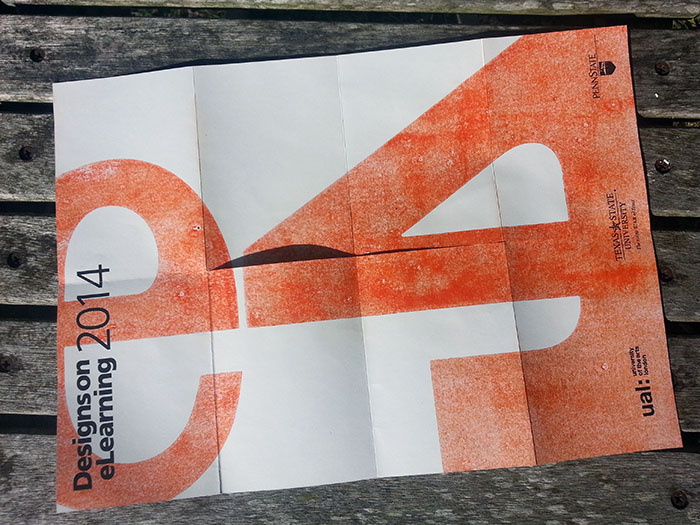
    DeL
    One of the various designs in the DeL mini-programme booklets,

    Part of my job as Head of Technology Enhanced Learning is to develop institutional strategies around digital and learning so I thought the DeL keynote would be a great chance to propose a simple way of setting out the territory:

    ‘Digital’ is too broad a term to be useful now but it is still an area which is ‘different’ enough in the mind of institutions to be dealt with as a distinct entity. Whether this is a healthy approach is debatable as ‘digital’ and ‘technology’ tends to be defined as anything-that-is-new or anything-we-don’t-quite-know-how-to-use-yet. For example, technology that has become totally embedded stops being thought of as tech; email, texting, Googling etc. It’s not that we don’t know that it’s digital we just don’t discuss it in strategic terms because ‘everybody does it’. That tends to mean that digital strategies point towards incorporating the new without focusing on the better use of the mundane.

    (The term ‘mundane technology’ was brought up by Jo Morisson from UAL who pointed out that smartphones are now ‘mundane’ but are integral to students day-to-day learning and creative practices i.e. the fundamental incorporation of the digital into practice tends to be around the use of ‘boring’, not-new, tech)

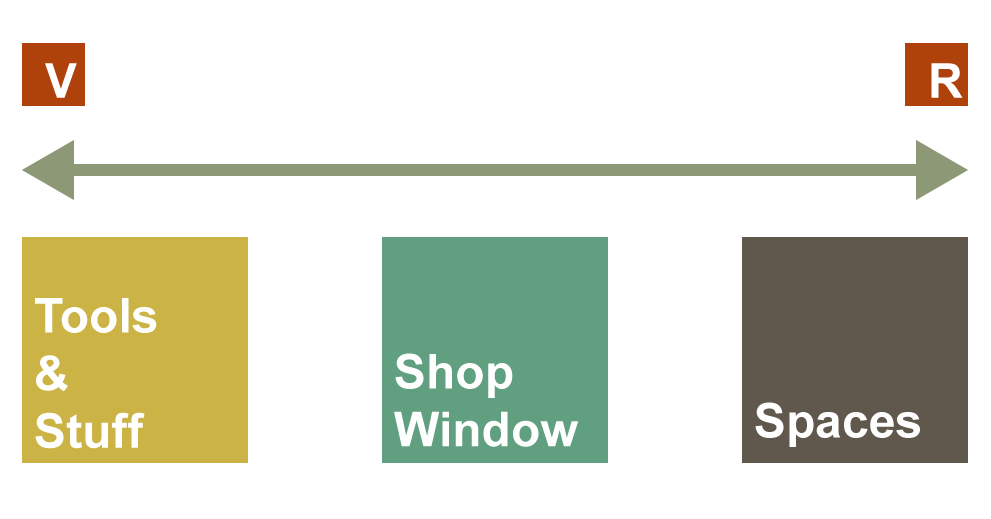
    To attempt to break down the digital into manageable areas I suggested the following ‘practice boxes’ or categories which split the manner in which we use technology into three sections. This provides a very simple framework for discussions about where and how practice intersects with, or resides within, the digital. My Visitors and Residents framework underpins this approach which means that the boxes build on motivation-to-engage rather than the functional affordances of the technology (something which can be considered after you’ve decided what it is you are trying to achieve).

    3 digital-practice boxes on the V&R continuum (CC attribution only)
    3 digital-practice boxes on the V&R continuum (CC attribution only)

    From left to right:

    ‘Tools and Stuff’ – This is the predominant institutional perception of what digital technology is – a series of tools that help to make existing practices more efficient or better quality. It also tends to be students main expectation of the digital services their institution will provide. ‘Give me access to the right tools (including the Web) and access to digital content (stuff) that will help me get through my course. This was one of the key findings from or recent work on The Digital Student project for Jisc. No social trace is left in this mode which is mainly about information seeking, and non-visible production & consumption.

    ‘Shop Window’ – This is a shift from Tools and Stuff towards using the Web as a place for publication and dissemination – the look-at-what-I-have-created motivation which is essentially using the Web as a means of distribution for self-generated content. This is institutions and individuals in broadcast mode and while work that is being presented might be ascribed to the creator of that work it is not necessarily connected to a persona as such beyond a name or a brand. The Web becomes a location to promote the best of our completed work with the actual creative or intellectual practice taking place offline or in non-visible tools.

    ‘Spaces’ – This is where the digital (mainly the Web) becomes a series of spaces or places in which we enact our practice. We go to these spaces to be present with others in some form. This could be within private groups or openly online. So the Web becomes the location where we develop work and thinking in a ‘networked’ or communal manner. This involves individuals operating via (or being embodied within) a digital identity of some form which might be a simple projection of self or could be a deliberately disassociated, managed or pseudonymous persona. (This gets philosophical very quickly but a simple version would be an individual being in ‘student-mode’ when in certain digital spaces). I’ve broken this category into three sections:

    1. Using digital spaces to communally or collaboratively create work. For example, collaborative editing of Google doc or using an online whiteboard/sketching platform to build work in groups. This type of activity could be ‘live’ or asynchronous but the closer to live it is the more the digital will feel like a space rather than a tool.
    1. Discourse around artifacts. – This is the most common form of activity within this category and is possibly the most broadly relevant in an educational context. I’m most interested in forms of discourse which influence the evolution of work, for example a constructive discussion in the comments on a blog post which leads to the original author refining their ideas. It could also be the discourse of a group negotiating the direction of future activities and posting iterations of work which is developed outside of the digital space in which the discussion is taking place. Obviously material that is posted in Shop Window mode can become the focus for discourse with the possibility of recontextualisition or remixing.
    1. Critique or re-appropriation of digital spaces – this one is more specific to Art & Design but important nevertheless. The digital is a space that should be questioned a deconstructed as a place where society resides and operates. This is something that the creative arts need to be doing if they wish to be a relevant voice. I was disappointed with the recent Digital Revolution exhibition at the Barbican which made no attempt to deconstruct the digital in this manner and simply presented a parade of amusing and entertaining digital bits and bobs. In an age of ‘elegant digital consumption’ Art & Design needs to re-present the Digital through a critical and questioning lens.

    ——

    What’s interesting is how the pedagogy we use can shifts teaching practice from Shop Window to Spaces within given platforms. For example at UAL both our blogging (WordPress) and our ePortfolio (Mahara) platforms can be used in both modes depending on the teaching approach. It’s even possible to gently transition from Shop Window to Spaces within these platforms over time which has enormous potential for supporting students in developing their practice and in building professional/practice based online personas.

    My hope is that the 3 categories will frame conversations within and beyond UAL and break down the ‘digital’ in a useful non-tech-deterministic manner.