Virtuous, human-centered, intentions can quickly be co-opted by systems and hierarchies to more instrumental ends. It is common to hear of organisations populated by ‘good people’ that nevertheless perpetuate negative or oppressive practices because the institution, or broader environment, demands it.
This twist is something I explored at OER19 through the notion of ‘Openness as a performance of surplus’. Open Educational Practices are generally thought of as an antidote to the traditional hierarchical gate-keeping of knowledge and opportunity. They are seen as a way of using digital networks to counter ‘standard’ institutional modes.This is all to the good but only institutions with enough surplus can ‘generously’ be open at scale. If we consider the big players in Open Education then it’s perhaps no surprise that they tend to be high status and wealthy institutions (I’m thinking of the institutions behind some of the major MOOC platforms for example).
This is not to say that there aren’t good intentions or effects in ‘massive’ or institutional-level approaches to openness, it’s more a call to be alert to the risk that these intentions can get subsumed by agendas around status and profile – they can quickly be drawn back into the business ideology they (in theory) attempt to circumvent.
The Big Moka approach to generosity
In the OER19 session I explored how generosity can hide poor intentions through the story of Ongka’s Big Moka, an ethnographic film from the 70s I was shown as an undergrad*. The film follows Ongka, a leader within the Kawelka people in Papua New Guinea, as he attempts to collect together enough pigs and other items of value to put on a successful Moka event. In the ceremony Ongka gifts all that he has amassed to the ‘big man’ of a neighbouring community. Ongka’s aim is to give gifts of a greater value than he received in the last Moka and thus demonstrate, through generosity, that he is the ‘bigger man’. As Ongka says when he is successful:
“Now that I have given you these things, I have won. I have knocked you down by giving so much.”
Ongka
I worry that this is how the values of Open Educational Practice are twisted when institutionalised and scaled. A sincere generosity becomes warped into a performance of surplus or power which risks perpetuating digital forms of colonialism.
Who cares?
The danger of these twists is something myself and Bonnie Stewart want to explore in the context of ‘Care’ at OER20. In the workshop we are asking if open forms of pedagogy can help to scale care. The workshop is shaped by our concern that care is usually framed through the development of relationships – it’s a social process. Given this, it’s important to consider how care might work in massified education systems.
“On all fronts within higher ed the responsibility to respond with care converges on front-line teaching staff who may be oxymoronically required to offer emotional labour within ambivalent or uncaring structures, creating pedagogical commitments which may not be sustainable, or may foster feelings of inadequacy (Bryant, Lanclos, and White, 2019). What do we achieve if only those who are privileged enough to have few students, or an abundance of time, are in an actual position to invest in an ethic of care?”
OER20 workshop submission
Technology doesn’t care
Many of us are concerned that technology is being proposed as the ‘solution’ to care-at-scale. With terms such as ‘personalisation’ and ‘predictive analytics’ often being used in a way which implies that the tech can take the strain as long as we feed it enough data. This is why the subject of care-at-scale within education is so important to discuss. Especially where it risks becoming a technologically supported institutionalised asset which we have to then build safe, human-centred, spaces of authentic care outside of (or to hide from it).
I think it’s fair to say that myself and Bonnie are not convinced that open pedagogy can help to scale care, or even if ‘scaling care’ is a valid idea. What we are sure of is that this is a discussion that needs to take place, especially in education systems where, despite the promise of technology, the burden of care is often with overworked members of staff in precarious roles.
*Part of Granada Television’s Disappearing World Series which ran from 1969-1993. It was first aired in the UK on 11 December 1974 https://en.wikipedia.org/wiki/Ongka%27s_Big_Moka I studied on a ‘Time-Based Media’ course which was developed from an ethnographic film making course. As such, key academics were Anthropologists interested in how digital technology opened up new modes of storytelling and narrative. It was an excellent course.
Over a decade ago, I took a home brewed virtual ethnography approach to a project looking at communal and cooperative player behaviour in World of Warcraft. It appeared to me that the teamwork and sense of belonging in the game was exactly what we were trying to foster in online learning.
The method I used was to sit with a player as they gamed, asking the occasional question while I set-up screen recording software. I then left the hard-drive with them and asked them to record any moments that they thought were significant over a period of about a week. I picked up the recordings and made notes as I watched them. Then I went back to the player with specific questions about aspects of the play and the dynamics of the gaming community I needed interpreting. It worked well and led to my thinking on ‘Social Capital in the Pursuit of Slaying Dragons’.
Feeling very ‘alt’ ( John K CC BY-NC-SA)
In the world and of the world
What was clear was that the players were extremely present in the game world, as embodied by their player avatars – they weren’t controlling a character from afar, they were within the world when they were gaming. The game was a space in which they were co-present, which is one of the reasons that an ethnographic approach worked. This principle influenced much of my subsequent work and I find it useful when considering the notion of digital fluency. In essence, you can’t understand the modes-of-engagement of a space by only learning it’s technical functionality as if it were a tool – you need to understand how it works as a social space. A simple example is Twitter – learning about ‘at’ replies, retweets and direct messages doesn’t tune you into the culture or discourse of the network of co-present individuals. You completely miss the role and value of Resident-mode platforms if you only consider how it works in abstracted, technical, terms.
So when it comes to teaching about the potential role and value of Resident online spaces I tend to take a digital fieldwork approach which draws on this ethnographic thinking. There are usually decent guides on the basics of online platforms you can point people too so, beyond this, what becomes important is the fieldwork brief which provides a motivation to engage with the dialogue and the culture of the space. This is what I had in mind when I designed the digital fieldwork activities which we used as part of the Teaching Complexity seminar series.
Digital Fieldwork activities
The activities range from simply appearing in a Resident space (for those that have never operated in this mode) through to experimenting with an alternative identity or faking out a social media platform. The six activities come with a short video intro from me as explaining the context for the approach is extremely important. This is especially the case for the activities which involve experimenting with identity as it’s not about tricking anyone, so participants need to be sensitive in the way they present themselves and connect.
2min intro to the activities
The identity based activities are inherently self-reflexive as they encourage participants to not be ‘themselves’ – this creates contrasts which can be reflected upon. In our daily engagement with Resident online spaces we will struggle to ‘see’ how the platform is influencing us because we are generally connected to like-minded, similar people and are therefore focused on the substance of those relationships rather than on the structure or culture of the environment.
This is similar to the anthropological principle that it’s difficult to see our own culture because we are normalised to it, which is why when we travel we gain insights through the contrast with other cultures. Taking on an alternative identity online is the equivalent of going ‘abroad’. The same Social Media platform is many different places depending on who you appear to be and how the platform encourages you to build your network based on your personal characteristics (age, gender, location, ethnicity, and anything else it can glean from your data)
My Instagram experience with an alt identity
A good example of this in the digital fieldwork was my own experience of the ‘Try on a New Identity’ activity. I started an Instagram account (having not had one before) as an alternative persona and began by following profiles/accounts suggested by the platform. The result was extremely informative. I gained an insight into the predominant aesthetic (in terms of fashion and ‘look’) of the platform and found just how much more sophisticated Social Media had become in shaping connections since I last ‘started from scratch’ in Twitter over a decade ago. Because I was an alternate persona it was extremely obvious why Instagram was throwing certain things at me based on my apparent age, location and gender.
It was now clear to me how the platform might cause anxiety through the pressure to conform to a very particular body image, mode-of-speech and lifestyle. It was also clear that various forms of authenticity were being performed which appeared to shift as accounts became more popular (the I’m-so-popular-I-can-now-reveal-the-real-me effect). Lastly, I was shocked that despite certain flags from the platform it was impossible to tell the difference between a person and a brand. I didn’t know when I was being sold something and, in some senses, everyone was selling ‘self’.
For me it was a distressing window into the convergence of self/product/brand which I often hear discussed but hadn’t seen so directly. The experience gave me a real insight into one of the potential reasons why our students can feel anxious about the online environment. Instagram implies that everyone can be famous but only by conforming to very particular ways-of-being (or performed ways-of-being). Obviously I had experienced a very limited and, in many ways, naive window into Instagram, which is what I had set out to do. There a many positive aspects to engaging with the platform which I didn’t experience because of the route I had taken.
Caution
My advice on approaching the identity related activities
To be clear (and in keeping with my own advice on the fieldwork) I was careful to only like posts and never commented or got into conversation. I didn’t gain access to anything that wasn’t already openly visible on the Web. I also only ran the account for a couple of weeks and it’s now mothballed. The activities are not designed to be used as research and as you can see I’ve been totally non specific even in this reflection. The persona I chose was not special, famous or someone anyone could have hoped to gain something from. I wouldn’t claim any persona is ‘neutral’ but I tried to be as boring as possible.
Reflections from participants
You can read some participants’ reflections on the digital fieldwork activities on the Teaching Complexity website. One of the most encouraging aspects of the approach for me was the depth of discussion generated by participants simply considering, but not doing, the activities. There was much discussion and reflection in the online sessions from people exploring why certain activities made them feel uncomfortable and the implications this might have for students who would be navigating similar choices. Ultimately, the activities are a useful prompt to generate thinking about how our identities are being used, and possibly abused, online and how this is now inextricable from the overall student experience.
I still remember the taboo breaking promise of stickers on CDs at Woolworths which said ‘Parental Advisory – Explicit Lyrics’. These days the tag on Spotify songs simply says ‘Explicit’ which a small part of my mind responds to as: ‘it’s nice they are being clear about what they have to say’ – and, in a way, they are being really clear…
What do we assume is obvious?
This idea of being explicit keeps reappearing at work. Not in the sweary way but in being clear, questioning what remains implicit and the confusion this can cause for students. I was encouraged to start thinking about this by a casual comment in Emily Nordmann’s work on supporting Lecture Capture. She has published some helpful research which highlights the need to explain to students (and staff) that recorded lectures should be used as supplemental to attending ‘live’. Accompanying the research are guides for students explaining how best to incorporate the use of recorded lectures into their independent learning strategies.
The point being, that unless these strategies are explicitly stated, students are likely to make assumptions about the reasons why the recordings exist and how they might be used (usually based on not being able to attend lectures rather than on more positive, long-term, learning strategies). When highlighting the need to be explicit about the use of recordings Nordmann asked if we ever explain to students what the value of attending lectures face-to-face is – or do we simply assume it’s obvious?
This facinanted me because I suspect we say it’s important to attend, but might not explain why it’s important to attend in terms of learning strategies. I work at a university where there are no marks awarded for attendance (or, let’s be honest, no marks removed for not attending) so if it’s not clear what the value of attending is in terms of learning, why would you? Information is now abundant and if there is a recording, what’s the point of being there ‘live’?
Is our model of ‘university’ relevant?
What’s significant is that elements of the process/practice of education which remain implicit point to aspects of the institution which we are culturally normalised to. We might not explain what the learning-value of lectures are because lectures are a constituent part of what we tacitly hold to be ‘university’. Unfortunately, this tacit understanding tends to be held by staff who hold a model of the institution which may have been constructed before information and recording were as abundant. In contrast, students, especially incoming students, might have more of a pop culture model of the institution based on media portrayals of ‘university’. So, students could begin term attending lectures because ‘that’s what you do at university’ but then fall away because they can’t identify the value of attending in terms of learning. The cultural impulse to attend only lasts for so long before getting on the bus seems like a lot of effort when you can YouTube-Wikipedia-VLE-ask-your-friends-on-Facebook your way through.
This then creates a dangerous spiral in which the introduction of new technology such as Lecture Capture is seen as a threat to a model of ‘university’ which is held impicitly and is more cultural than it is educational. Perhaps students who are more focused on learning than ‘doing university’ as a broad, cultural rite-of-passage find this bemusing. Our response should be to be more explicit. If we can’t, or don’t, explicitly describe to students what the learning value of a particular mode of teaching is then students are likely to disengage.
Are we anxious about tech or protective of our model of university?
The disconnect in expectations can lead to claims that students don’t understand how to study or aren’t willing to put the effort in when they might have developed extremely effective independent learning strategies which simply don’t intersect with the tacit model of ‘doing university’ the institution operates on.
I’m not denigrating the learning-value of lectures as a mode of teaching here and we all know that quality and approach varies. I’m using lectures as an example of a practice central to our idea of what a university is and is therefore in danger of not being explained. Other examples could include: using the library, group work, the value of non tactical learning (not learning to the test), the value of ‘research’ beyond Wikipedia and YouTube etc. We need to be explicit about the value of all of these and more.
It’s interesting that the learning-value of new Digital Learning approaches is always closely scrutinized because it has not yet been mapped into our (staff) notion of ‘university’. While, on the other hand, the anxiety about new approaches tends to be based more on how they might damage relatively un-critiqued notions of ‘university’ rather than on what the value might be to students.
Students’ not comprehending the value of engaging in certain ways is more likely to be a failure in our teaching than their willingness to learn (especially if we create a culture in which success becomes exclusively about marks and credentialization). The question we have to ask is if what we provide as ‘university’ goes beyond the value of what our students can engage with outside of our formal offer.
One of the highlights of last year was designing and running a series of open, online seminars with our online Visiting Fellow, Dr Bonnie Stewart. The ‘Teaching Complexity’ series was 100% open, in the sense that anyone with a connection to the Web could attend for free. The territory the seminars explored was the complexity of the digital environment we now teach in and how we might respond.
The topics covered within the seminars all responded to the opportunities and challenges of the networked environment. A common theme being how to counter the creep of polarisation and support a diversity of voices within digital spaces.
One advantage of the seminars being open is that all of the materials (slides, recordings, comments etc) are available at the Teaching Complexity website which I created using our blogging platform. I’ve included a list of the seminars at the end of the post and know that quite a few people caught-up with them this way after the live ‘event’.
The motivation to run the seminars was two fold:
Understanding the new teaching environment
Responding to the complexity of the Web as a teaching and learning environment is an important topic to discuss. I now work on the principle that ‘All Courses are Blended Courses’ as I’d argue that any student, on any course, will spend significant amounts of time online. Some of that time will be spent discussing, or negotiating, the course with peers even were there is no, formal, online aspect to the curriculum. You’d be hard pressed to find a student who isn’t keen to develop their ability to navigate the Web for study or to make contacts which might lead to work. The Digital Creative Attributes we developed at UAL are a reflection of this but I realised that while I had clear principles in mind as we developed the DCAF I had not provided many examples of what a good response to the DCAF might look like in design terms. Hence Teaching Complexity.
A good example of open practice
It was clear that for some the Open Practice Values I introduced at UAL caused some confusion. I personally see my approach here as a failure of communication on my part with some useful institutional lessons learned. I spend quite a lot of time considering open approaches and feel part of a community of open practitioners, so I underestimated how alien this line of thinking can be to people who are mainly (and rightly) focused on keeping the wheels of the university turning. When I presented the Principles at committee they split the room, with some immediately seeing the relevance (both in the manner in which the university could connect outwards and in the way our colleges could collaborate more closely) and some clearly worried that this would be yet another, distinct, layer of work which would detract rather than enhance, day-to-day teaching (A dis-integrated view of Open Practice). Given this, the Teaching Complexity Seminars were my ‘Show not Tell’ example of what teaching which embodies the Open Practice Values can look like. ——————————————————-
Attendance and feedback
We had between 50-100 participants at each of the main seminars and more will have caught up with the recordings later. Those that responded to the evaluation questionnaire were mainly teaching staff, in roles overseeing or enhancing teaching or people involved in staff development of different forms. People attended from across the globe with the main locations being Europe and North America. Having been involved in this type of teaching quite regularly I’ve become a little blase about the geography involved and have to remind myself how incredible it is that we can facilitate these kinds of international moments so easily.
The feedback was almost universally positive and at times effusive. A number of participants commented that they have very little staff development opportunities at their institution so the seminars provided a rare moment for them to consider and discuss themes which were unlikely to appear in the normal flow of their work. I feel that working in an open mode is integral to my work, especially as I represent a large institution with the capacity to be outward facing. Given that, I hadn’t thought of the seminars as ‘generous’, but this is how many participants respond to them. Overall I would have liked to have seen more people from my own institution at the seminars but UAL tends to be attracted by creative arts rather than teaching themes. I need to put some more thought into how best to describe opportunities like this in a manner which resonates at home as it were.
Some key points I took away from the seminars:
Be explicit
Given that anyone could turn-up and type in a name of their choice there was always a risk that someone could be disruptive with no cost to themselves. My view is that this would be extremely unlikely unless the topic under discussion is contentious or the facilitator is particularly famous/notorious. I equate this to Wikipedia vandalism – yes, the articles on Trump, Iran or Transgender are likely to be the focus of edit wars and vandalism but articles on Contructivism or John Dewey are unlikely to get messed with, because where’s the fun in that? The Teaching Complexity seminars definitely fell into the latter category – as would most teaching scenarios. Even so, I made sure to introduce every seminar with a brief and friendly talk about the social contract of the space. We were there to explore complex themes through mutually supportive discussion. I also highlighted that the sessions were being recorded and would be made openly available. This, I felt, gave me the right to remove people from the room if they stepped outside of these bounds. We never came close to anyone breaking the trust of the room but I still think it’s worthwhile being explicit about social and collaborative expectations. If you’re upfront about this then any disruptive individual is, in some ways, excommunicating themselves through their actions and you mitigate being placed into a ‘policing behaviour’ role as it’s likely there will be, post-event, group consensus on removing people.
Is anybody with me?
Small moments of sharing go a long way in creating a sense of belonging online. For example, we would sometimes ask what the temperature was at participant’s locations with a notional prize for the highest and lowest (the range was always spectacular). The ‘live slides’ where everyone could write (or scrawl) a response to a question on screen on the whiteboard gave a powerful sense of being in the same, communal, space. In webinar type spaces like the one we were using it’s crucial for people to get a sense that they are co-present with others. This does not come for ‘free’ as it does in face-to-face environments, so these small moments of sharing become very important. The risk of people moving slides, drawing all over the screen or accidentally un-muting their mic at a random moment was more than balanced out by the inclusive atmosphere that giving people these options supported (we did have a few strange moments but they were all harmless). Giving everyone ‘moderator’ status by default was a good way of subverting the didactic design principle of the platform we were using (Blackboard Collaborate Ultra).
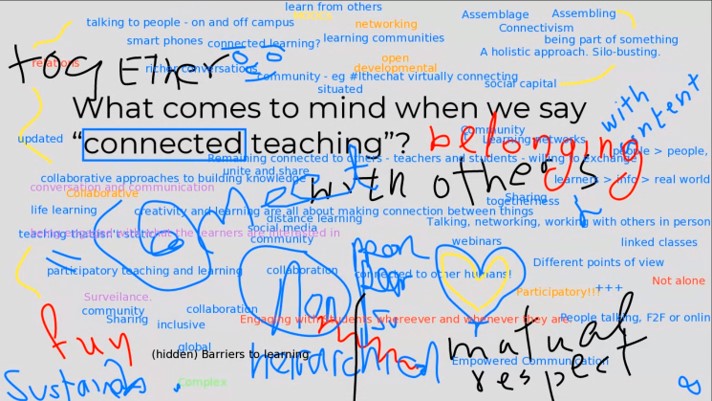
A favourite moment for me was when Dave Cormier asked people to play with the whiteboard while we waited to get started. This is the result:
This is a good example of responses to a ‘live slide’ question. One of the interesting aspects of this is how people started to highlight or draw around answers they felt were important as the seminars progressed. The messiness here creates a friendly atmosphere which somewhat counters the slightly sterile and inhuman feeling of the default webinar platform.
I also very much enjoyed how quickly somebody (in about 5 seconds…) wrote ‘Moms Spaghetti’ on the following slide (see the ‘classic memes’ section of pop-culture…).
Please talk while I’m talking
Building on the point above, I’m a huge fan of encouraging people to use the text chat while the seminar is in progress. Actually getting this going requires some facilitation in itself which is why all of the sessions would have a lead facilitator and a kind of support facilitator who could give some momentum to the chat and highlight interesting questions. When you have 50 or more people the chat can get quite lively and really helps the facilitators by giving a live indication of how well they are connecting with the group. All the facilitators for the seminars were experienced in speaking online so could respond to the chat as the seminar progressed. This is one of the distinct advantages of the online space over the face-to-face as it allows sessions to be discussed in the moment – it erodes the ‘expert broadcast’ aspect of online teaching in a very pleasing way.
If it could have been a video, you’re doing it wrong
I have a general rule of thumb that if, on reflection, a synchronous online event could have been a YouTube video then you have got the approach wrong. Why turn up ‘live’ if there is no interaction? Even though I was vocal about this in the planning stages, a few of the sessions had long sections of ‘just talk’. What I’ve subsequently realised is that these sessions were not actually all that long but that our concentration threshold is somewhat shorter in a webinar room than in a physical room. Some of that is to do with there being less to look at – less, or no, physical presence. It is also to do with the culture of the space, by which I mean that when we are in front of our laptops we are used to interacting quite often unless we are in ‘Netflix mode’. The differing socio-cultural expectations of online vs face-to-face are probably more of a factor than the notion of a concentration threshold as, by my estimate, it’s acceptable to speak for at least 20 minutes with no interaction face-to-face but this is probably reduced to around 7 minutes online. Beyond 7 minutes I suspect we start going into Netflix mode or getting distracted by the other tabs we have open.
Be clear it’s not about absorbing everything
Speaking to a couple of UAL colleagues in the following weeks I discovered that the seminars had been quite overwhelming for them, with ‘a lot going on’ at the same time (i.e. the facilitator speaking, parallel text chat, whiteboard interactions, voting and Tweeting). It was a useful reminder to me that I personally enjoy navigating, and reflecting on, multiple channels simultaneously but that this is not the case for everyone. So, perhaps my 7min threshold is too short and people need longer periods of ‘broadcast’ mode to be able to take in new topics. Overall I suspect the biggest cognitive shift for many is paying attention to the speaker while simultaneously keeping up with the text chat. That would certainly be overwhelming if you felt you had to take every detail in, so a message at the start explaining that the aim is not to absorb everything that’s happening on screen might help. ————————-
Learning from the seminars
The substance of the Teaching Complexity seminars was extremely interesting with sessions like Inclusive Spaces exploring ideas which are often not considered in digital contexts. Commonly the notion of ‘innovation’, which is often attached to digital approaches, avoids difficult thinking around inclusion and exclusion by implying that it’s going to change the way we interact so the problem simply won’t exist and therefore does not need to be confronted…
Beyond the ‘content’ of the seminars, I will be incorporating what I’ve learnt about the format of the sessions (the modes of interaction) into future work. This includes a project which is looking at transcultural arts education across an international partnership of arts schools and the development of more sophisticated ‘hybrid’ events which take place face-to-face and online in parallel.
A couple of months ago I joined a running club and discovered two things:
Running is quite hard
I can’t explain my job to anyone at the running club
This forced me to ask ‘what am I?’ (professionally) – this is a reflection on that question partly for myself after a busy year but also because I often see the Higher Education sector struggling to frame and locate Head of Digital Learning (or similar) roles.
A spectacular looking (but not painful) injury sustained in during a ‘social run’…
Sometimes Digital Learning is just attached to a senior academic post which doesn’t account for the size of the territory or sheer amount of work involved. In other places it is positioned as a kind of soft IT role which makes it difficult to get away from a technocentric approach.
There is a strong theme of ‘Technology Won’t Save Us’ running through my professional community and I agree this. Nevertheless, UK Higher Ed is a massified system which requires technology to manage scale while, hopefully, being mindful that the tech is not in-if-itself the practice of education (despite what anyone says about learner analytics or AI etc I believe that teaching is human-centric – our students demand more contact time not ‘cleverer tech’).
The idea that technology will ‘solve’ the messiness of being human resonates with what Haraway claims is an obsession with our own extinction at the hands of the technology we have created. This is why we get a cheap thrill from those Boston Dynamics videos of robots opening doors and jumping over boxes which are so carefully constructed to play to our extinction fetish.
Fortunately I work at an institution which isn’t attempting to eradicate our own humanity in the service of efficiency, wealth or security. I’d say in the creative arts we try to do the opposite, as evidenced by this short video on Ambiguity by Prof Susan Orr (my boss).
It’s crucial for me that my role and my team is within our Teaching and Learning group as it gives me the opportunity to position technology in the context of ambiguity and complexity rather than as something which solves ‘problems’. This has allowed me to bridge what can sometime be an academic/tech divide and create the Digital Learning Transformation Group which includes our CIO, Deans of Academic Planning our Associate Deans Teaching & Learning and a cross section of digital and ‘elearning’ roles. I’m not sure how I would have brought together a group with this mix of roles in it if I wasn’t able (structurally) to travel laterally across the institution. (It also helps that I’m a member of our main Learning and Teaching committee and Academic Board so senior management are aware of my work.) As a group we are developing, and responding to, various digital strategies from our colleges and central services.
Despite always been asked to ‘get the screen working’ wherever I go I’m not always thought of as the ‘digital guy’ (I do almost always get the screen to work which probably doesn’t help). I do oversee our main Digital Learning platforms which is a big operational responsibility but there is a recognition that ‘making the platforms work’ and ‘Teaching & learning’ are related but not the same.
Introducing the Digital Creative Attributes Framework has been positive and it’s beginning to become an embedded part of the curriculum design process. What you will notice about the framework is that it’s based on practices, not skills or specific tech. As such it accounts for the diversity of contexts and courses across the university and avoids ‘selling’ technology. Again, I believe it’s my location within Teaching and Learning which has allowed me to represent the richness (and complexity) of digital practices in the framework.
Navigating complexity has been a key theme for me this year. It was the focus of my keynote for the LILAC information literacy keynote and has been an important element of my teaching around UAL (MA Fine Art & Digital, MA Innovation Management, PgCert Academic Practice and MA Applied Imagination in the Creative Industries).
Those that offer simplicity and narrow worldviews are still in ascendancy. More than ever we need to acknowledge complexity and equip our students to respond to super-complex environments. This is something I have been considering and writing about in the background this year in a piece (essay? start of a book?) with the working title of ‘Encoding Beliefs’. Technologists imply that ‘everything’ can be captured and that once this task is done ‘everything’ will be known:
“Hiding within this deep current is a belief that once everything is captured and correct we can free ourselves from moral responsibility – all will be revealed and all behaviour will become rational, fair and ethical as a result. This hope is driven by a reaction to the supercomplexity which the digital has both created and revealed. The connectivity and computational power of the digital has outstripped our ability to comprehend the complexity of the world it has exposed.”
This digital omniscience is a secular form of faith which I find extremely interesting and is at the root of the “Technology will/won’t save us” contention. It’s a line of thought I hope to develop further in 2019.
Securing a Visiting Fellowship for Bonnie Stewart this year has been a real boon as she is helping me to develop links between a number of broad ideas and Teaching and Learning practice. The first fruits of this are the Teaching Complexity series of free, open, online seminars which we have co-curated and start in January 2019. These are a show-not-tell example of the kind of Open Educational Practice I want to encourage and support at my institution. Over the last few months I have become increasingly convinced that open values are crucial in responding to complexity and also an important ideological framing when re-imagining the university in the digital or networked era.
‘Complexity’ – an illustration CC-BY-NC-ND Katharine Dwyer
Over 2018 I have also enjoyed working with other institutions which are interested in learning from our experience (expertise?) in Teaching and Learning. The scale of UAL gives us the capacity to develop Teaching and Learning as a creative practice in it’s own right to an extent that many creative art and design institutions would struggle to respond to. As such this year I was invited to the Bezalel School of Art and Design and the University of the Arts Helsinki to help them design strategic approaches to the support of teaching practice across their institutions. The challenges in teaching art and design appear to be similar the world over and it’s great to share our successes and failures.
Looking at the length of this post I think I’ve just demonstrated again that I’m not very good at explaining what I do. Having said that, the process of writing has helped me to see some strong themes emerging across my work which has been obfuscated by busyness.
What I will say is that digital-is-the-university, it’s a teaching and knowledge space that is now just as important as our physical spaces. As such any Head of Digital Learning role has to be connected into the heart of the institution. This is not an area which can be ‘added-in’ after academic or operational plans have been made. I took this job because it was located within Teaching & Learning and, while it’s been bumpy at times, I can now say with confidence that my institution has embraced Digital Learning as distinct from ‘Digital’. This is encouraging for me and will help the university develop in ways which support staff and students without pretending education is a ‘problem technology can solve’.
Universities are caught between network and hierarchy. We are institutions which work at scale, supporting, scaffolding and ranking students – awarding degrees, undertaking research and maintaining quality. All of this requires a hierarchical structure and approach. And yet, as institutions, we recognize the value of the network; of connected, collaborative and interdisciplinary modes of learning and working. We acknowledge that complex and super-complex challenges (the kind of challenges we claim our sector can help with – equipping graduates for uncertain futures, aging populations, climate change, the effects of globalization etc) can only be responded to by operating in a connected manner which deliberately extends beyond the borders of disciplines and our immediate communities. There is also a recognition that networked and connected modes of working and being are of value to staff and students in ways which can confer new forms of prestige on the institution.
In my role of Head of Digital Learning at the University of the Arts London I’ve been asked what the ‘vision’ is for the institution in a networked, globalized environment? I frame this as ‘how do we best operate as hierarchy and network?”. This is fundamentally challenging as ‘institutionalizing’ networked modes inherently turns them into hierarchies and thereby kills them. What is required is not the operationalizing of networked approaches but a clear statement of the ‘networked’ values that the institution supports, but importantly, does not seek to ‘own’.
These values fall under the banner of ‘openness’ which is a theme I started pursuing in a Teaching and Learning context but which I now see as a principle which reifies emergent responses to the network across key areas which constitute the university: Teaching & learning, Research and Knowledge Exchange. I believe it’s important for the institution to ascribe to these values at the highest possible level to establish a clear ideology which influences the character of the institution and the practical outworking of ‘openness’ in a myriad of ways.
In consultation with colleagues at UAL, and with support from Catherine Cronin, I have been leading on the development of Open Practice Principles here at UAL. These are still developing and require further consultation. They will also require the support of senior staff if they are to become institutional values (beyond the context of ‘innovative’ teaching and learning). In the spirit of the values themselves I’m posting the draft principles here for comment. I hope this will encourage others to take this route and will help me to connect with people who have already developed (and embedded) institutional values of this kind.
Open Practice at the University of the Arts London:
Makes teaching, learning and research visible and accessible
Collectively creates knowledge and practices
Connects a diversity of voices
Reaches beyond subject and organizational borders
Manages risk in open and public contexts
Develops digital attributes and identities
As I mentioned, at this stage these are merely proposed values. What is important at this point is that they establish a constructive and open institutional ideology towards the network which can be translated into operational support for openness in a manner which respects the need for diversity of practice and accepts non-hierarchical forms of risk (i.e. it does not try to mitigate networked forms of risk by subsuming networked and open practice into hierarchical systems of quality and control). They also need to be succinct and in a form which can be interpreted into a variety of contexts. At UAL I’m confident that these values will encourage positive sharing of practice which already takes place ‘under the radar’. They will also give some confidence that the institution will support staff if things-go-wrong when working openly.
Clearly these values will require case-studies, guides and policy in given contexts. In practice, much of the policy is already there an simply needs the equivalent of ‘this also applies in digital spaces’ added to it (I’m thinking of bullying, harassment, codes-of-conduct etc). I have already drafted a number of illustrations-of-practice under each value from a Teaching and Learning perspective but what’s important is to start with the values ‘at the top’ as it were and not to work in the hope that institutionally scattered examples of openness will naturally percolate into the psychology of the institution. One area where it’s possible to see the impact of high level values of this kind is in aspects of the Research Excellence Framework in the UK , I’d like to see the same happen with teaching via Teaching Excellence Framework too.
In the short term, we will be embodying these values through our free, open, online seminar series entitled ‘Teaching Complexity’ #techcomUAL which will run from Jan – March 2019. The seminars will: “…explore how open and creative approaches to teaching and learning can help students navigate the complexity of higher education and the digital environment.” The series is co-curated by myself and Bonnie Stewart in her role as Visiting Fellow at UAL. The facilitators for the sessions include some of the most interesting and innovative voices in open educational practice so do come along to all, or any, of the seminars.
One weakness of a ‘graduate attributes’ approach for student development is that it looks lovely in strategy documents but can be difficult to respond to on a day-to-day basis, especially in digital contexts. For example, a graduate attribute that talks about students becoming ‘agile connectors’ sounds positive but how does a course leader respond to that when designing curriculum? They might have a sense of what agile connecting looks like in their discipline but add digital to the mix and it suddenly they are casting about for the latest app or platform as a placeholder for teaching practice. Unfortunately, this fuels a demand for a more ‘skills focused’ approach in which a list of this week’s popular technologies is drawn up with advice on what it can be ‘used for’. With the best will in the world this approach always puts the tech before the teaching and course leaders feel a pressure to ‘introduce technology’ to ‘keep up’.
So, we often end up with the macro of ‘attributes’ and the micro of the tech-list. What is missing is a ‘meso’, or middle level, connecting the two. Connecting high-level aspirations through to practical activity is the principle behind the Digital Creative Attributes we have developed at the University of the Arts London. These are an extension of the Creative Attributes Framework at the UAL which lays out nine key attribute areas in three groups. The Digital Creative Attributes Framework (rather pleasingly the ‘D-CAF’) is a digital expression on the CAF, not a whole new framework. It provides a meso layer of digital practices for courses to build on or map to.
There are four significant advantages to this approach:
DCAF practices are stable. Digital platforms, apps and software might change but the practices we require to thrive in the digital environment remain the same.
DCAF is not discipline specific so each group can contextualise relevant practices in a manner which makes sense for them.
DCAF can be used to articulate current curriculum in digital-practice terms. It’s not a list of ‘things you haven’t managed to include’ but a framework which can highlight to students the value of engaging in the curriculum in certain ways.
DCAF provides a shared language which works for staff, students and the creative industries.
The last point was extremely important to me because I’ve been in too many meetings where the lack of a shared language around digital has seriously disrupted meaningful progress. Essentially, when we say the word ‘digital’ in an institutional context everyone thinks of different things and wants to set different priorities. The tech folk call for more kit, senior folk want a clear ‘vision’ and everyone else just wants some support and guidance. Saying ‘let’s talk about digital’ is the same as saying ‘let’s talk about the university’ both these topics are far too big and neither of them can be ‘solved’.
The DCAF is designed to focus these discussions around a set of practices we know the students want/need to develop. It respects the importance of disciplinary context and avoids the techno-solutionist trap.
We have released the DCAF under a Creative Commons licence to open it out to all. It gives a good insight into the digital practices which underpin creative working and as such is relevant to anyone taking a creative approach to teaching and learning.