Category: Uncategorized

  • Concentrated Art School

    Is it possible to run an entire Art School style ‘journey’ in 25 minutes? 

    Slide with a picture of cheap (concentrated) orange juice next to a picture of expensive orange juice. The expensive juice has been crossed out.
    Concentrated Art School (not made from fresh oranges)

    (Side note: this post lays out and reflects on a 25 minute activity which took around one and a half hours to design and prep. I’m mildly overwhelmed (whelmed?) by how much is ‘under the bonnet’ of a process like this. It’s a useful reminder of how rich and nuanced an arts education approach can be and how the work produced is only a tiny aspect of what is going on. i.e. I didn’t realise quite how much was implicit until I wrote this up.)

    I was asked to ‘fill’ 25 minutes at our recent team awayday and thought it would be a fun challenge to take the team through the ups and downs of a mini creative education journey from start to finish. The team is working with our colleges to develop fully online Post Grad courses. We are providing recruitment, marketing, design and production, and academic strategy to develop this fully online portfolio. 

    Given the functions within the team, many people don’t have direct experience of creative arts education, so I wanted them to get a sense of ‘not knowing’ and creative risk which are inherent in our project-based pedagogies. Ultimately the process was about producing creative work in-the-open in a context with is no specific ‘correct’ answer but where some groups will get higher marks than others. 

    The work produced in this session is a the end of this post, but hopefully you will see that the work embodies only a small portion of what was experienced.

    The key elements I wanted the room to experience included:

    • Negotiating within a small group (which might include people you don’t know very well)
    • Interpreting an open creative brief (including considering how your work relates to two Learning Outcomes)
    • Making creative work, knowing you are going to be assessed and that grades will be visible to all
    • Working in the open, making work-in-progress visible
    • Working with limited materials
    • Interpreting work in the context of an open brief to award marks/grades

    The process

    In this case we were all in the same physical room which probably helped given the limited time but there are plenty of ways, with a few tweaks, that this activity could be run online (For example, a bit of online break-out group wrangling and a shared Miro board with visual sections for each group).

    The room was already laid out so that people were in groups of 4 or 5 around tables. Handily for me these groups had been designed so that members of the team who might not normally work closely together got to meet each other. i.e. Perfect mixed teams, which are crucial for this kind of activity and are time consuming to design. I am very wary of the “form teams of 4 or 5” instruction as you will always get divisive forms of homophony. For example, in this room it would have been comfortable for people to group by levels of seniority.


    1. Introduction / framing

    I explained that this was called ‘Concentrated’ Art School for the following reasons:

    1. This was taking the essence of University of the Arts London pedagogy and concentrating it down to an almost ridiculous extent. If UAL is freshly squeezed orange juice then this process was more like concentrated orange juice made from dehydrated powder. It has similarities but is not anywhere near as good.
    2. We had very limited time so everyone would need to concentrate. 
    Roles

    I then asked one person from each group to act as a tutor and move over to the side of the room and made it clear that the work would be being marked as part of the activity. This gave me 5 tutors.


    2. The brief and the template

    I thin introduced the brief but didn’t explain it in any detail. What people had to go on is what you see here:

    The slide that outline the brief (this is all in the text below this image)
    The Brief

    The brief refers to a simple A4 template which was on each table and split into three areas

    • Names (So work was attached to people in a visible manner)
    • Work (The core output or ‘realised’ work)
    • Why (Articulating the thinking in the work)

    For the sake of accessibility/readability here is the brief in text. (The first version of the brief I showed was in French to make the point that many of our students are operating in an additional language. Half the room didn’t baulk at this as I could see them translating the best they could.)

    The Brief:

    In the NAMES area
    Write your names

    In the WORK area

    • Respond to the term “Change”
    • You can use the items in your envelope or anything else you can find
    • You must not write in the WORK area


    In the WHY area

    Describe why your work is what it is in one sentence

    You will be marked in the context of the following Learning Outcomes
    LO1: You will be able to visualise themes and ideas through your creative practice [Realisation]

    LO2: You will be able to explain and justify your chosen creative approach [Communication]
    The items in square brackets refer to the relevant part of the UAL assessment criteria.

    3. Activity

    Each table had an envelope of materials they could use to respond to the brief. These were deliberately playful/ridiculous and included a small packet of Haribo sweets, various stickers, a felt-tip pen and, of course, some googly eyes.

    They had 10 minutes to respond to the brief.

    4. Tutors

    While the groups were working I spoke to the group of tutors. I gave each tutor a strip of 6 star stickers and said they could award marks by putting these stickers on the work they felt best responded to the brief and learning outcomes. I suggested that they could, if they wanted to, give and single piece of work multiple stars.

    I suggested that they could confer on how best to do this and/or have a wander round the room and see how the work was progressing. They all opted to wander and appeared to enjoy the role, casting a curious eye over the groups and occasionally asking questions.

    5. Marking

    After 10 minutes I asked the groups to stop working, and move away from their tables so that the tutors could mark the work. I asked the working groups to discuss how the process was making them feel. 

    I allowed around 10 minutes for this part of the process.

    6. Discussion

    I knew we didn’t have time for discussion so I wrapped up with a couple of reflections and suggested that people might want to chat about the activity over lunch. 


    Interesting things that happened

    Firstly, everyone undertook this in the spirit that was intended and it was quite jolly, but there was a strong competitive air too, way stronger than I expected. Every group produced something and there was significant variation in the work conceptually. 

    Some groups were better at getting going and figuring out a response than others. The specific dynamics and atmosphere of the groups varied a lot.

    One tutor asked me if the brief allowed groups to draw in the work area (e.g. arrows etc.). I asked what they thought and we agreed that drawing was probably ok. 

    People really want to see each other’s work

    The biggest unexpected happening (although in hindsight I shouldn’t have been surprised) was that when I asked the groups to move away from their tables for the marking process everyone ignored me and immediately started to wander round the room looking at everyone else’s work.

    I suspect this is where most of the learning and critical reflection took place during the activity. There was a palpable engaged (but still jolly) atmosphere and quite a bit of discussion. In effect, the ‘student’ groups were weighing up the work for themselves in a similar process to the tutors, they just didn’t have any stars to handout. 

    Grading is not much fun

    The tutors did appear to enjoy the process of attributing stars but then there wasn’t too much at stake. However, the vibe of the group that got the most starts was definitely more upbeat than the group that got the least. Even in a frivolous environment nobody wants to come ‘last’. As the lead for the activity I felt slightly awkward about this. I was more bothered about it than I had expected to be.

    The direct approach takes the lead when there is limited time

    The piece awarded the most stars was the most prosaic and least conceptual response to the brief. It told a little story and was easy to understand. I also suspect there was some confirmation bias amongst the tutors which led to a clustering of stars. The group that were awarded the most stars also gave off confident vibes and were most noisy during the activity. Did appearing to have a good time imply they were making good work? (I didn’t think their work was the strongest, just the most direct).

    Winning?

    Later that day a member of the group which was awarded the most stars asked me, in a playful manner, what they got for winning. I questioned if getting the most stars was winning but was interested in this idea that you could ‘win’ at this kind of activity.


    Creative arts education is playful, difficult, and demands everyone involved makes themselves vulnerable

    My agenda here was to run an activity in which everyone was likely to feel a little vulnerable in some way. The open brief, the group work, and most of all working visibly are all pretty standard creative arts pedagogy. It’s useful for everyone working in our team to have a sense of what creative risk feels like and the way this plays out for staff as well as students (For example, marking is also a creative/interpretive process with its own risks). 

    The biggest implication for me was the desire people had to see each other’s work. Something which is hard-wired into a physical studio environment but which we have to deliberately build-in to an online course. It’s risky working in the open but it’s also where most of the learning happens.

    Process and critical reflection is more important than the thing you make

    The fact that the materials being used were gummi bears and googly eyes might have kept things light but it didn’t make much difference to the overall process. That is to say that had I given groups oil paints or Lego, the results relative to the brief would probably have been similar. But this is a reflection of my ‘There is no such thing as a good picture of a horse’ thinking and I could be wrong. There is such a thing as technical skill and process which I didn’t attempt to approach in this activity.

    What would I do differently?

    If I had a bit more time I’d have a second phase to the activity after a break and facilitate some structured reflection and feedback. I would have liked participants to have the chance to talk about the personal affect of the activity whereas they mainly got immersed directly and didn’t have the time to stand back. Despite process and reflection being paramount, this activity reminded me that it’s difficult to not become obsessed with the artefact being produced.

    While there was no formal feedback from those involved I was in the position of participant-researcher and did get a good sense of what was going on. (I’ve run enough of these kinds of activities to be able to step back from ‘will this work?’ fears and pay attention to ‘what is happening and what does it mean?’. Some of this comes from experiencing sessions going slightly ‘wrong’ but actually being better for it. It’s better to follow where it’s going than to obsess over your original plan.)

    Personal note

    The core of the brief comes from an activity we were asked to do in my GCSE English class many, many, years ago. We were each given a small square of paper and asked to respond to the word ‘change’. I have no idea where this activity came from or why we did it. Our English/Drama teacher was quite eccentric in the way teachers used to be when schools were less professionalised and might have simply been entertaining himself.

    I wrote a limp, dictionary style, definition on the paper along the lines of “Change is when something is different from what it was before”. I still clearly remember thinking about this a lot afterward and regretting that I hadn’t ripped a corner off the blank square of paper and handed it back. I have no memory of this activity ever being fed back on or mentioned in class ever again. It’s possible this was a pivotal moment for me. A realisation that it was possible and meaningful to go beyond a immediate ‘rational’ or practical response. There was something deeper which could be said by thinking and acting outside of the structures we had been taught.

    To test of my own activity for our awayday I thought about how I would respond to the brief. I’d probably rip the Work section of the A4 template into about 20 rough pieces and scatter them across the table. In the Why section I’d put “You tell me”. I’m fairly confident that any group I was in would get me to back off on this idea but who knows? Maybe this whole thing was me looking to redeem my own, unimaginative, 16 year-old self?

    The work produced

  • Blame Descartes: why the way we work online is difficult to describe.

    During Covid lockdowns I wrote about the need for presence not contact hours. This was a simple way of rewiring thinking about teaching which explained why moving in-building approaches online felt so exhausting. 

    Recently I’ve been looking more directly at how we employ academic staff for teaching in the UK and the way in which this obscures one of the key ways we work online. This problem extends well beyond academic roles into all types of strategic and operational work.

    Being in a room with students

    The simple version is that we define ‘teaching’ as being in a room with students at a specific time and ‘teaching related activity’ as preparing to be in that room and/or marking student work. Digging deeper and discussing this with colleagues it became clear that the implication of ‘being in a room’ fell into two major categories, or two modes of activity:

    1. Delivering material (The traditional lecture)
    2. Facilitating dialogue (Q&A, seminar, tutorial)

    These two could be in any ratio or mixture, for example a lecture might be ‘interactive’ or a tutor might share useful insights in a seminar. The point being (as far as I understand it) that there is a two way thing going on. This exchange might be as simple as ‘being able to see students and them being able to see the tutor’ or it could be in the form of discussion and debate. I work at a specialist creative arts institution so we also have supervised studio time and crits which fall into the dialogue category because it’s assumed that staff/faculty will be discussing the development of work with students in-the-room. This is what constitutes ‘teaching’ as described contractually. Interestingly, feedback is not defined as teaching because it is a one way process, assumed to be in text form and therefore, alongside marking, sits outside ‘teaching’.

    Difficult mapping

    The reason this construction of teaching and not teaching is important is because it erases, or fails to see, a significant mode of interaction which has emerged with the digital environment. In short, asynchronous activity cannot be defined as teaching within this model. This is not to say that this type of teaching is always not recognised or paid for, it’s more that it’s difficult to acknowledge and define using a model which predates its existence.  

    It’s difficult to map asynchronous activity back into this model because:

    1. You are not in the same physical room as students.
    2. Most people appear to not understand asynchronous exchange as dialogue.

    I now see why there was such a desperate attempt during lockdowns to make the online environment into a ‘mirror’ of the physical rooms that in-building teaching took place in. The reason so many people insisted on so much synchronous teaching online wasn’t entirely because we didn’t know any better, it was also because unless we were in a room (or as close to this as possible) with students what we were doing couldn’t be teaching. 

    The tempo of consecutive exchange

    The dialogue point is more nuanced. This appears to come down to how long the gap between statements is, or the tempo of consecutive exchange. Unless it’s close to immediate then it doesn’t seem to count as dialogue. For example, is a discussion in an online forum which takes place over a week a form of dialogue? Is a succession of text comments about a piece of work on a Miro board dialogue? Personally I think it is. It also has the advantage of a certain type of flexibility for all involved. However, our current model of teaching would not register this. It would perhaps be seen as some kind of sequential ‘feedback’ or a collection of one way statements. 

    Text vs speech

    There is another distinction here which comes into play and that is the difference between spoken and text-based forms of exchange. Our formal definition of teaching appears to favour the spoken word as exchange. My sense is that this is because historically we were either talking to each other ‘in the same place and same moment’ or exchanging letters. This is not to say that epistolic approaches are not valued, it’s more that they are seen as a form of academic exchange and not as teaching. 

    There are many examples of teaching-via-letters but these tend to be on a one-to-many basis (much of the New Testament or correspondence courses being good examples) and it’s probably the one-to-one tradition of letter writing which frames it outside of teaching. It’s also possible that this is where teaching shades into supervision, as academic supervision tends to assume one-to-one.

    Not quite real time

    A long time ago I claimed that the future is ‘not quite real time’. Here I was highlighting that the web had ushered in new forms of text-based communication which were not necessary in the same place and in the same moment, nor were they strictly epistolic. Discussion forums, instant messaging, posting on Social Media. None of these fall into our well worn categories of exchange. 

    This is explored by Stewart in her insightful ‘Collapsed publics: Orality, literacy, and vulnerability in academic Twitter’ where she draws on ‘Orality and literacy: The technologizing of the word’ by Ong to propose that Twitter could be encountered, or used, both as a kind of oral dialogue, or as a literary form. It is variously interpreted as both of these because we haven’t yet developed a third category. 

    This causes no end of problems as in any given moment text posted in Social Media, what I’m calling ‘consecutive exchange’ can be thought of as ‘just chat’ or as a published work. This is also the reason why we can’t agree on what constitutes acceptable email practice. Is email a letter or is it a conversation, is it a discussion or is it a formal documenting of agreements? Email is a good example of consecutive exchange in that it fall between these definitions.

    We have not culturally adapted to the idea that text can be dialogue or that dialogue can be text. Or, perhaps, we have not yet managed to institutionalize this idea because our institutions are built on the strict demarcation of published/recorded vs chat/informal.

    Venn diagram. Two circles 'Epistolic' and 'Dialogic', with 'Asynch Online Exchange' in the overlapping space.
    This crossover space is not yet institutionally understood.

    It’s all a bit new

    So despite the fact that we spend much of our time working and learning in this hinterland oral/published mode, we haven’t found a good way of describing it. This seems fair given that, as a mode of exchange, it emerged rapidly and very recently. However, it does make it difficult to account for asynchronous (we are moving to the term ‘Guided’ in our model) forms of teaching and learning.

    Right now, it means I have to pretend that one of our most valuable forms of teaching is actually an indistinct mix of ‘teaching’ and ‘prep’. That’s fine for now if it’s used as ‘talking with students via text’ (teaching) and ‘considering and reflecting on student work in progress’ (prep). Effectively I still have to slice up all consecutive or asynchronous work into a version of either epistolic or dialogic rather than claiming consecutive exchange is a category in it’s own right, one which gives both staff and students significant of agency over when and how they engage.

    I’m going to blame Descartes for all this complexity as mind-body duality seems to be behind it. What’s the difference between thinking about work and doing work? When it comes to teaching, and many other types of work, I don’t think there is a difference. I’d go as far as to say that defining work in these terms is a category error. This unhelpful duality amplifies our inability to define not-quite-real-time forms of text based exchange as dialogue and erases a key mode of work from our institutional consciousness. No wonder we feel overstretched when much of the work we do is difficult to account for.

  • Digitally Enhanced Blended Learning report

    This week I was on a panel hosted at the House of Lords to discuss the launch of the Digitally Enhanced Blended Learning report. The research is from the Higher Education Commission, written by Alyson Hwang.

    Close up of red and green wallpaper with an heraldic pattern
    Very House of Lords wallpaper

    The report’s research heritage has its roots in scrutiny of online learning during Covid lockdowns but things have come a long way since then. The Office for Students commissioned a review of blended learning, led by Professor Susan Orr which was published in October 2022 which forms a basis for this new research. The key finding from that 2022 work was that teaching quality is not relative to mode:

    “The review panel took the view that the balance of face-to-face, online and blended delivery is not the key determinate of teaching quality. The examples of high quality teaching that were identified in this review would be viewed as high quality across on campus and online modes of delivery. This also applies to examples of poor teaching quality.”

    Blended learning review,  Report of the OfS-appointed Blended Learning Review Panel, October 2022

    It seemed that everything moving online during Covid had caused a culture shock and certain voices in Westminster decided that learning online couldn’t possibly as good as learning in buildings. Plus, some students were making the case that they were paying the same fees for an inferior experience.

    This was more about university as a cultural-rite-of-passage than as an educational journey, but it largely got framed as being about ‘learning’. A valid question here would be ‘which students are we taking about?’ and ‘on what basis?’. See this recent piece from the Guardian by Roise Anfilogoff, who points our that for many students university became significantly more accessible during lockdowns.

    The new report

    The Commission found that blended learning has the transformative potential to widen participation and access to higher education for all, improve equality of opportunities, and enhance learning outcomes.

    Digitally Enhanced Blended Learning Report, pg 20

    The Digitally Enhanced Blended Learning report builds on the Review of Blended Learning, adding information from evidence sessions, interviews and written submissions to support a rangy set of recommendations. The case studies root the research in current, successful, practice.

    It’s notable in how positive it is about blended learning and while there are many caveats, all the case studies and stats are upbeat. I’m sure this is an effect of asking institutions to share stories, rather than a taking a detective work approach. However, given the Covid heritage of this line of reporting it’s interesting that nowhere is blended learning portrayed as a bolt-on or fundamentally ‘not as good as’ being in physical rooms. I sense we are heading towards post, post-Covid times in quite a helpful way.

    The report covers a lot of ground, ranging from the need for leadership to the state of the ed tech market. All-in-all it’s a useful body of work to support institutional strategy and to make the case for investing in Digital Education in the broadest sense.

    Year zero

    Much of what is covered and recommended are things which those of us in Digital Education have spent many years arguing for. In this sense the report is largely describing the current start-of-play rather than presenting possible futures. Covid is taken as a kind of year-zero for blended learning which doesn’t change the value of what is being said but always feels strange for those of us who have been working in the space since the 90s.  

    The following recommendations in the report are ‘classics’ and well underway in many places:

    • The need for senior leadership roles that own and promote blended learning.
    • The need for more staff development and time to be made available in workload planning for this.
    • The need to incorporate digital literacy/capability into all curriculum to equip students for the workplace (and, I’d add, life…)
    • The need for commercial ed tech development and procurement to be more agile, and possibly collective (Open Source doesn’t get much of a look-in).

    Certainly the Association for Learning Technology community have been extremely active in these areas and are well placed to contribute to any cross-sector work.

    Asynch

    The aspects of the report which open up the most interesting areas for me are around how we might develop more nuanced models of ‘blended’ as a practice and how ‘Quality’ might then be defined. The report proposes the following model:

    Time, pace and timingSynchronous and Asynchronous
    Space Place and Platform
    MaterialsTools, facilities, learning media and other resources (digital, print-based or material)
    GroupsRoles and relationships (teacher-led and peer-learning, varieties of learning groups)
    Digitally Enhanced Blended Learning Report, pg 7

    This is a useful and useable set of categories and it’s heartening to see the concepts of space and place in there. The report goes onto suggest how quality might be overseen, or measured, in recomendation12:

    The Office for Students should establish a single, coherent approach for assessing the quality of online and blended learning as the designated quality body, ensuring that metrics do not impose additional bureaucratic burdens on the HE sector.

    Digitally Enhanced Blended Learning Report, pg 6

    This is complex and problematic because, as the report mentions, all provision is blended to a degree and so any coherent approach for assessing the quality of online and blended learning will actually be assessing all provision. Moreover, if we believe that this is about the quality of teaching (and design of provision) rather than the mode then why would we want to focus on mode? Not to mention that we already have a significant burden of regulation which the report alludes to as potentially distracting.

    The HE sector is facing a significant challenge due to the regulatory landscape’s lack of consistency and stability. This diverts resources from developing teaching practices, investing in digital infrastructure, and improving students’ experiences.

    Digitally Enhanced Blended Learning Report, pg 33

    Teaching beyond mode

    This all comes back to a knotty point that, in regulatory terms, we don’t have a workable definition of teaching that operates super to mode and can be applied across face-to-face and digital. For example, when you sift through the OfS Conditions of Registration the examples given which relate to teaching have their roots in face-to-face, ‘synchronous’ practices. There are refences to the need to use ‘current’ pedagogies in digital delivery but these are not described. As in this ‘possible cause for concern’:

    The pedagogy of a course is not representative of current thinking and practices. For example, a course delivered wholly or in part online that does not use pedagogy appropriate to digital delivery, would likely be of concern.

    OfS Conditions: B1: ‘Academic Quality’, B1.3
    High Quality Academic Experience, Cause for concern 332H (b.)

    It’s reasonable pedagogic specifics are not described given that ‘current thinking’ is a moving target. However, the side effect of this is that teaching is frequently refenced but never described, which means we fall back into a ‘contact hours’, teaching is the live stuff, way of thinking. Ultimately, most of our measures of teaching quality are proxies via student experience. There is plenty of merit in that but it contributes to the problem that our shared understanding of what teaching is (and what it isn’t) is always implied, or assumed, and never made explicit.

    The asynchronous unicorn

    Although the regulatory body provided some practical guiding principles, the metrics for assessing the quality of blended provision could be clarified to guarantee quality education rather than penalise innovative practices.

    Digitally Enhanced Blended Learning Report, pg 32

    This is important because until asynchronous forms of teaching are actually understood as teaching we won’t be able to describe the value of blended, or fully online, learning. Until ‘non-live’ pedagogies are mapped into our understanding of quality we won’t, as a sector, be able to see our own provision clearly.

    The effect being that the way in which the digital can support truly student-centred flexible provision will not be acknowledged and much progress in access and inclusion will remain ‘invisible’ to quality frameworks. This extends to the way we design contracts, manage workloads, increase student numbers and widen access. The latter being a key hope attached to the hypothetical flexibility of online and blended provision, especially for those already in work:

    Contributors to the inquiry voiced how student needs and demands are changing in line with the economy – more than ever, students are benefitting from flexible, personalised, and accessible delivery of their courses.

    Digitally Enhanced Blended Learning Report, pg 4

    As mentioned, the key here is to describe and communicate-the-value-of ‘non-live’ teaching in a mode agnostic manner. This isn’t about Digital, it’s about teaching and flexibility– it just so happens that Digital allows us to undertake many forms of ‘non-live’ teaching (whereas non-digital forms of asynchronous largely rely on a postal service).

    (aside) What do we think of when we think of teaching?

    I’d like to undertake a research project where we ask a cross section of staff and students to describe what they understand by the term ‘teaching’. I suspect views will vary wildly and worry that many of them will be quite narrow.

    What can we take from the Digitally Enhanced Blended Learning report?

    There is plenty of useful stuff here and I’m sure it will be quoted in many strategies and budget asks. It’s a useful step forward, not least of which because it reflects the reality of the majority of the sector and not some kind of Oxbridge cultural romanticism, projected out from, bricks and mortar.

    Overall, I’d ask where the investment and capacity might come from during nervous times and I’m wary of a narrative which is based on the White Heat of Technology as it’s never really about the tech, it’s about the business model. Certainly, in a sector where we are generating an ever growing staff precariat, introducing technology to make things ‘more efficient’ is likely to contribute to instability. I say this not entirely from a Marxist perspective but because I believe that meaningful teaching will always involve confident, highly capable, professionals.

    To give the report it’s due, at no point does it suggest that we should do everything with AI or something along those lines, it’s driving more of an access than efficiency agenda, but it’s focus on mode, rather than the practice of teaching could lead people the wrong way. My hope is that the constructive and measured character of this report will provide a basis for us to develop more sophisticated models of practice and quality which are not tied to mode and therefore don’t segregate digital.

  • Untangling Creative Education (Is subject inextricable from pedagogy?)

    The University of the Arts London, where I am currently employed, has ambitions to widen access to creative education through fully-online provision. You can read about this in our university strategy. 

    This isn’t in-of-itself radical excepting that creative subjects have not, traditionally, been the focus of online development. The ‘standard’ subjects for online tend to have a more defined scaffolding of knowledge and learning – there are more ‘correct answers’. Examples include, MBAs, Computer Science and Nursing where learning and assessment can be (if required) perpetuated without the direct intervention of academic staff, up to the point that reflection or individual projects come into play. 

    Creative subjects tend to be built around the exact type of individual (or group) projects and critical reflection which require specific critical feedback and dialogue. At UAL almost all of our assessment is based on coursework, not exams, and much of this is evidenced through the development of personal portfolios. This is typically ‘Art School’ in nature and, as a colleague pointed out to me, heavily influenced by the traditions of Fine Art pedagogy. This is not to say that all creative subjects are a version of Fine Art. It’s that deeply held beliefs about what it means to nurture creative practice and thinking across many subjects are rooted in Fine Art style teaching methods. 

    Messy abstract painting in a spectrum of colours
    Abstract detail (painting by David White CC BY 4.0)

    Four foundations of creative teaching

    There are many ways to cut this in how we might describe the foundational components of a Fine Art, or ‘Art School’ inflected education. Here is my, not exhaustive, overview:

    1. Teaching process, developing practice: ‘making’ skills, ‘craft’ or ‘technique’.
    2. Teaching theory and canon: The history of the subject. Learning the tools required to contextualise practice and develop a critical position.
    3. Teaching critical reflection: Applying theory to practice and vice versa, reflective writing, academic writing and research. Documenting (telling the story of) enquiry, ideation, process and realisation. 
    4. Teaching-by-supervision to support individual and collective practice. 

    (As ever, if we have a broad view of terms like ‘practice’ and ‘process’ then these four points cover most subjects taught at a higher education level – especially if we categorise ‘academic writing’ as a type of practice)

    Supervision-as-dialogue is central 

    In subjects where the focus is on developing a creative practice, supervision, often in the form of dialogue, becomes the foundation of the teaching & learning approach – the ‘signature pedagogy’. Most academics at my university would see this as crucial, almost axiomatic. If we are honest in our proposition that students can interpret project briefs/assignments creatively, then teaching must mold itself around the variation in those responses, it can’t be generic, it has to be thoughtful. Is a Fine Art course without dialogue Fine Art? It certainly doesn’t feel like it. 

    I’d argue that the supervision model of teaching is the primary design consideration when developing accessible online provision. Developing workable models of supervision is at least as important as responding to concerns around materiality and physical making practices. The latter can be re-situated, up to a point, to be local to the student whereas supervision is hard-wired into the identity of creative education. 

    For some, supervision is by definition the soul of the course. Dialogue, structured or serendipitous, with experts (academic and technical) is possibly more important than access to specialist equipment and spaces. When students describe ‘the course’ they are most likely to mention moments of real-time supervision coupled with stories of personal, or group, practice. They are less likely to mention text-based feedback even if that was influential. This could simply be because embodied, live,  moments tend to be easier to recall? 

    Supervision vs access

    The uncomfortable aspect of accepting this is that a supervision model of provision is in tension with access in a number of ways:

    1. Supervision requires significant staff time which risks reducing access in terms of affordability for students.
    2. Supervision is commonly framed around moments of ‘live’ (synchronous) dialogue which is difficult for students with busy lives, or across time zones, to frequently engage with. 
    3. One dimension of increased access is greater student numbers. In a supervision model the limiting factor will quickly become the availability, or even existence, of teaching staff with the right balance of teaching and creative-practice experience. 

    So we end up with a scenario where reducing the amount of supervision in creative education provision is not just a curriculum design choice, it’s an erosion of what we believe the subject to be and a dilution of what some students believe they are paying for. On the other hand, predicating any course (and here, I’m going beyond creative education) on supervision risks attenuating access across a number of dimensions. 

    The powerful cultural/educational position of supervision is, I suspect, what underpins student demands for moments of ‘live’ teaching (in-building or online) which are then poorly attended. Students and staff need to know these supervisory, or live, moments are happening or they feel the course ‘doesn’t properly exist’. However, when students are not  in a position to attend, or the inconvenience of attending ‘live’ is outweighed by the sense that attendance is not contingent on success, everyone feels unsatisfied at some level. 

    The importance of acknowledging ‘non real time’ supervision 

    In response, I’m not suggesting that the supervision model of teaching is a problem to be solved. The troublesome aspect is not the practice of supervision but that it is too closely associated with ‘live’, or real-time, teaching. This is often cemented by legal and regulatory approaches to ‘contact time’ – as I’ve discussed before. 

    It’s of note that the coupling of supervision and ‘live’ doesn’t accurately reflect day-to-day practice given that dialogue and feedback is often via text in the form of online messages, comments, annotations etc. In essence, the practice of supervision has adapted to incorporate the not-real-time opportunities of the digital environment but our conception of supervision seems stuck in a previous era. We need to accept, or rather acknowledge, that much of our dialogue takes place in non-real-time forms which are more varied than an epistolary or summative feedback.  

    Unfortunately this means that we underestimate, or fail to identify, the actual volume of teaching which takes place. This inability to ‘see’ teaching as anything other than ‘live’ is partly responsible for creating unsustainable work loads. A course as documented and validated is likely to not capture this middle ground between ‘contact time’ and ‘independent’ hours, except perhaps as a vaguely defined form of administration (sometimes this also falls under ‘pastoral’, ‘community’ or ‘support’ type labels). 

    Less ‘live’ and more ‘supported’

    Extending our definition of supervision to incorporate non-live forms of dialogue is crucial if we are to balance subject and access. My team is defining this as ‘Supported’ teaching. A mode of supervision which provides flexibility for students and softens the line between ‘Live’ and ‘Independent’ teaching and learning. 

    The question I’m exploring is how much ‘live’ can become ‘supported’ in online provision before the nature of the subject itself is changed. Or, to put it another way, to what extent is the teaching mode and the subject itself intertwined? If we don’t understand this entanglement then any design process where academics are famed as ‘experts in the subject’ and others are experts in ‘learning’ could grind to a halt. If particular teaching methods are part of the fabric of a subject then we can’t re-design teaching without re-imaging the subject. 

  • How technology redefines learning (and why this isn’t a problem).

    (This post was written before the main wave of interest/anxiety around AI/Large Language Models hit. As such, it’s delightfully non specific and an attempt to outline implications in principle. For me, this is summed-up as follows:

    1. Efficient access to abundant information (the Web) reduced the value of ‘remembering information’ as a skill.
    2. AI reduces the value of synthesis as a skill.

    In some ways, technology is climbing up Bloom’s Taxonomy and pushing more of the learning process in the pointy bit of the triangle. Although, interestingly, it does skip some layers which could be a problem. Jumping from knowledge to synthesis and circumnavigating comprehension, application and analysis might prove dangerous. (not that I think we should always run through those things in strict order).

    Anyway… below is what was my first run at some of this thinking)


    A developer friend of mine recently told me a simple coding task they set when interviewing new staff was successfully answered by a chat bot. My response was, “Chat bots can Google, so I’m not sure what the problem is?”. In the days following my trite response I found myself coming back to the topic and realised that the chat bot ‘problem’ is part of a long history of falsely imagining ‘learning’ to be a fixed concept we are more or less distanced from by technology.

    Detail from an abstract painting, mainly in blues and blacks, by David White (CC:BY)
    Detail from an abstract painting by David White (CC:BY)

    In 2014 I gave a keynote at the Wikipedia conference entitled, “Now that Wikipedia has done all our homework, what’s left to teach?”. This was intended to be a playful way of highlighting that the ‘problem’ was not with Wikipedia but with an education system which placed too much value on answers and not questions. Wikipedia was ‘too good, too available and too accurate’ for a system which was built on the principle that information is difficult to access and recall. 

    Looking back, the Wikipedia ‘problem’ seems like the quaint precursor to the lively AI-will-kill/save-education discourse. (all tech debates decend into the kill/save dichotomy, so it’s better to step back from this and ask why this comes about.)

    Good / Bad – *yawn*.

    Firstly, any institution or system which claims that technology becoming ‘good’ at something is the central problem won’t last long in its current form. Within Capitalist Realism, you simply never win this argument (and yes we could go to the barricades but I’m writing in the context of where we are now). Secondly, withholding technology to force people to ‘learn’, incorrectly assumes that the notion of learning is fixed. Let’s be honest, telling school kids to not use Wikipedia was never going to wash, especially as schools tried this line at around the time they stopped giving out textbooks on the (never to be said out loud) hope that the kids all had access to the internet. 

    Saying AI is bad (or good) is a super dull discussion. Admitting it exists and that we will use it for anything that makes our lives a bit easier is a much more interesting starting point. (side note: when I use the term AI, I really mean ‘elegant computer code that does things we think are useful or entertaining’). A brief history of humanity has to include: “We will always use all available tech for good and bad and this process is continually redefining what it means to have power, have skills, be intelligent and be creative.”  These values and how they operate as currencies is always on the move and always has been. 

    Is ‘being right’ now wrong?

    What my developer friend’s chat bot couldn’t do was reason out, or tell the story of, how it had arrived at its answer. This is how we frame ‘learning’ at the University of the Arts London, we don’t assess the end product we assess the narrative of how the student travelled towards the end product. The narrative is the learning, the artefact (often a creative output at UAL) is the output from that learning. The end ‘product’ is symbolic of the learning rather than an embodiment of it, it needs a narrative wrapped around make meaning out of the process. 

    The photography(tech)-drove-art-to-become-more-conceptual argument is a useful touchstone here. If we imagine a near future where most, traditional, assessments of learning can be undertaken successfully by code then our approach to education has to become more about narrative and reasoning than about ‘being right’ or ‘reflecting a correct image of the world back at ourselves’. 

    We are feeling our humanity squeezed by tech that can mirror what we, historically, defined as human. This is not a fight with tech but an opportunity to redefine and reimagine what we value. I’m hopeful that this will allow previously marginalised voices and identities to become heard.

    I’d argue that ‘being right’ is this century’s outdated skill – this is a good thing.

    Just as purely figurative Fine Art lost a bunch of its value as photography gained ground, being right will lose its status relative to being-able-to-think within our networked-tech suffused environment. In many ways, current political and identity polarization is an effect of the rise of networked technologies, both in social (the internet) and neural network (AI) terms. It’s a grasping for the comfort of ‘being right’ in response to a painful, and unsettling, shifting away from the certainty of that very rightness. 

    Save and adapt

    Back in edu-land: A good essay is a narrative of reasoning, so it does or should, operate as an embodiment of being-able-to-think. Sadly, we have fed so many essays into the network that technology can now reflect a performance of this learning back at us. I have no sympathy for educational institutions who have a naïve understanding of data and also claim that tech which endangers its business model should be shut down. We can’t complain about tech when we use the very same tech to increase revenue. We also can’t de-tech without damaging access and inclusion.

    Let’s not to fall into academic navel-gazing on the what-is-learning/what-is-the-academy questions though. Instead let’s focus on how we adapt our lumbering institutions to shifting tech-driven redefinitions of value, while also calling our unethical practices of all kinds. I’m not an accelerationist, I believe that we can adapt while not erasing historical forms of value. Universities are ideally placed to ‘protect’ that which might be destroyed by the headrush of technology but they must not be defined by that impulse. 

  • The university is not ‘shut’

    The university is not ‘shut’

    Of the many things the COVID-19 crisis has highlighted about higher education, two have become very apparent to me over the last couple of weeks: 

    1. The notion of ‘university’ is still, for the most part, linked to a set of buildings.
    2. Language is largely embodied – we struggle to express how we interact online in a non deficit manner.

    This thinking was sparked by my vexation at the “Coronavirus: Students to pay full tuition fees even if universities are shut” headline in a recent article in the Times. The full article is behind a paywall so I can’t comment on that. The headline, however, rather negates all the hard work of staff and students who are actively working together online. At my institution the majority of us are busier than ever and we have plenty of examples of attendance and engagement improving as compared to a ‘normal’ term.  

    It’s not the same experience but it’s not ‘shut’

    Clearly, for those students expecting campus-based activities the experience has become limited. My eldest son ‘took issue’ (he’s a first-year History and Politics student at Sheffield University) with my critical retweet of the Times story. His point was that even though his course is online he is missing out on student life, so for him university is ‘shut’ as a cultural experience (I also can’t go to the pub but I do understand what he means :). Those institutions that were not already operating online had quite a task just moving a viable curriculum online. The social, cultural and ‘ambient’ aspects of university don’t automatically appear as a side effect of curriculum online – they have to be designed in.  

    Similarly, many of the students at my institution rightly expected to be able to undertake all manner of tactile and embodied making and performance practices. While some of the learning around these practices can be undertaken online there is no digital equivalence for the tactile, for the feel of different materials or the experience of various spaces. It is also difficult to create those moments of serendipity and inspiration which come from wandering around a building which is full of creative ideas and work. I miss all of that, but I don’t think my university is ‘shut’.

    The need for non-deficit language

    We have to start finding better ways of talking about online teaching and learning which are not poor echos of physical paradigms if we are ever to break the ‘deficit-by-default’ conceptualisation of digital in education. This is going to be crucial as the Times headline suggests that students will not be willing to pay full fees while universities are thought of as ‘shut’. At a teaching focused university a significant portion of fees goes on paying teaching and support staff who will be working just as many hours online as they would have been in a normal term. If we can’t acknowledge this just because we aren’t in the same building then the whole sector is going to struggle during COVID-19 and beyond.

  • Networked Making – Podcast

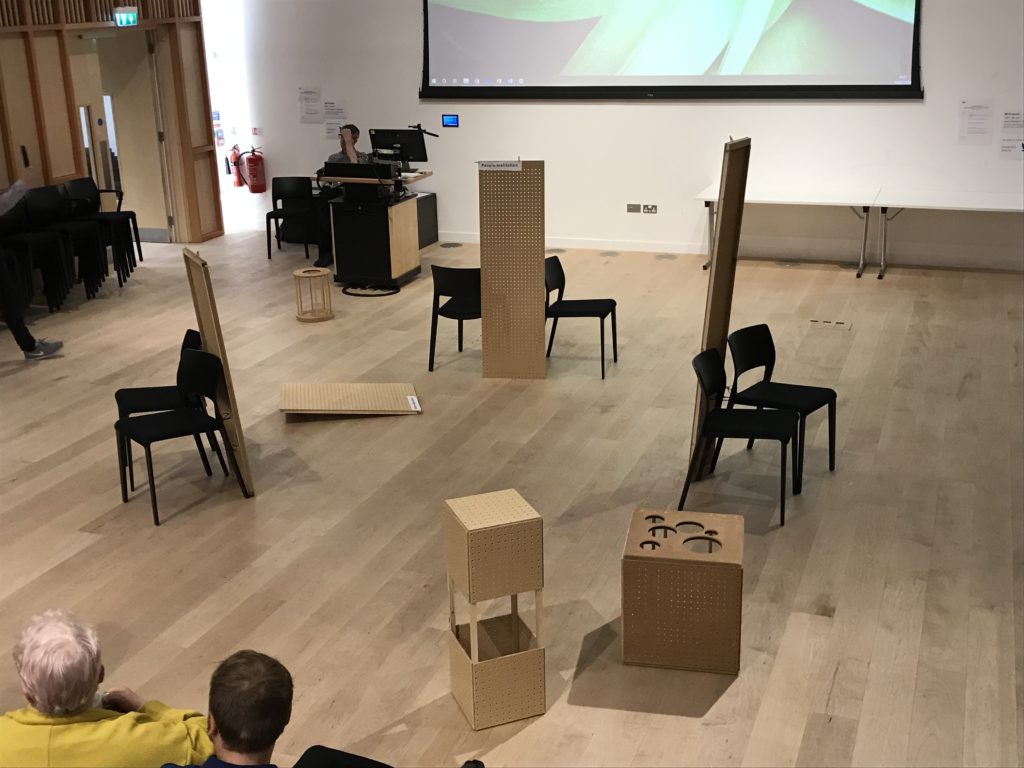
    On the 10th July 2019 we ran the ‘Networked Making’ event at the University of the Arts London. This post introduces a podcast in which myself and Jon Martin reflect on the ‘Making Networks’ workshop activity we designed for the start of the day
    (with input from Dr Sheena Calvert and the ‘Interpolate’ student group) .

    The activity was described as: “A workshop session in which participants collaboratively make and reflect on a physical model/metaphor of their networks.”

    The Making Networks space

    The Podcast is offered here unedited. I may try and edit it down to around 20min for Spark, our UAL creative teaching and learning journal.

    http://daveowhite.com/wp-content/uploads/2019/08/networkedmaking.mp3

    Themes touched upon in the podcast include: reflection, thinking-through-making, ambiguity, risk, trust, play.

    There is also a YouTube version of the podcast if you require captions

    Sheena and two Interpolate students, Jack and Safiya, helped to facilitate the activity.

    Participants were asked to ‘make’ a version of their networks and were presented with a number of peg-boards, a few other objects, cord, index cards, pegs, pens, various fasteners etc. The boards had labels on them such as ‘Work – Mode’, ‘Tool – Space’, ‘People – Institution’ and ‘Desire – Aspiration’.

    Around 30 participants engaged with the activity for about half-an-hour then we convened a short discussion.

    The best way to get a sense of the activity is to watch this very short video:

    Networked Making – Making Networks from Teaching and Learning Exchange on Vimeo.

    The full description of the event:

    Whether it be through collaboration, in a collective or as part of a cohort, the practices of making are never without context and commonly not undertaken alone.  We understand that our students are keen to make and work in disciplinary and interdisciplinary networks as this nourishes and
    supports creative practice, reflecting the fluidity of the professional environment.

    Networked making, including writing, is often facilitated by digital connections which allow us to go beyond the physical boundaries of the studio, seminar room or lecture theatre. Yet, while we all work online’ in some form, the practices of networked making are still emerging. The diversity of
    voices the digital allows us to include and connect encourages us to reconsider our modes of learning and teaching for making.

    This UAL Teaching Platform invites participants to discover and explore the potential of networked making through collaboration, discussion and, of course, making. “