Category: JISC

  • Love of Learning society

    An online society open to all dedicated to the pursuit of knowledge and the love of learning.

    “For the LoL”

    This is an idea that was developed with the help of Simon Thomson at the Jisc Creativity Workshop run by Lawrie Phipps.

    CC - https://www.flickr.com/photos/pollyann/329186325
    CC – https://www.flickr.com/photos/pollyann/329186325

    The LoLs 10 Tenets:

    1. Not for profit
    2. No credentials or qualifications given or required
    3. 100% online
    4. $5 lecture fee
    5. All lectures happen live with no limit on the number of students
    6. All lectures to be funded in a ‘kickstarter’ style with visible speaker fee
    7. Anyone can run a lecture as an expert
    8. 50% of lecture running time to be Q&A/discussion with questions chosen by the students
    9. All sessions released as a recording under an open, noncommercial license
    10. All income (after expert fee and admin) to go to educational charities that work to widen participation and make knowledge freely available

    The following to be decided by the expert for each lecture:

    • Subject focus
    • Lecture length (must be a prime number of minutes between 7 and 29)
    • Speaker fee, which will be visible to the potential students (the fee will either be waived or a prime number)

    LoLs student (sLoL) journey:

    1. Become a member of the society by signing up to the LoLs platform.
    2. Seek out an interesting  lecture and pledge $5. (It will be clear how close the lecture is to the minimum funding level needed. Beyond this point all income goes to charity. All lectures have a set start time.)
    3. If they make a pledge early (before the minimum funding has been reached) they can submit a question to be asked during the Q&A portion of the lecture. If they are in later than this then they can vote potential question up and down. The number of questions used will be proportional to the length of the lecture.
    4. They might explore some of the pre-lecture links if any have been submitted by the expert. They can also check the lecture hashtag to get involved in pre-lecture discussion and connect with others who have pledged.
    5. If the minimum funding level is reached they receive a reminder of the lecture time and an access code of some sort.
    6. The lecture runs in a Google Hangouts style platform with a video feed from the expert, a hashtag driven back channel and a text chat area. More confident experts could use whiteboards and polls etc. All lectures are supported by a facilitator to assist with the tech and to moderate. Facilitators can work for free or be paid in $5 lecture tokens. Experts will be encouraged to respond to the backchannel and text chat as much as possible.
    7. At exactly half-time the lecture moves into Q&A mode with the facilitator stepping through the top questions as voted for by participants. If there is time left they can respond to questions that have emerged from the backchannel and text chat.
    8. Exactly on time the platform shuts down the lecture with extreme prejudice (automatically 🙂
    9. The video feed is then placed on YouTube or a similar channel under an open, non-commercial license.
    10. Discussion can continue on the hashtag.
    11. Participants can rate the lecture and the expert within limited LoLs criteria.

    LoLs expert (eLoL) journey:

    1. Become a member of the society by signing up to the LoLs platform.
    2. Experts must have participated in at least two lectures before having the option to create their own lecture and have completed a LoLs expert tutorial.
    3. Create a lecture by submitting the following:
      • Subject area, title, blurb etc
      • Level (novice, intermediate, advanced)
      • Associated material and links
      • Pick a speaker fee for themselves
      • Pick a lecture length and time
      • Pick a charity or charities (from a LoLs list) that any income over the minimum will go to
    4. The expert can mark what they think are good questions with an expert tag during the voting process but can’t create questions.
    5. The expert might join in the hashtag based discussion.
    6. They may also promote the lecture via their networks to ensure it reaches the minimum funding level.
    7. If the funding level is reached they are given an expert code of some sort to access the lecture space which they can visit as much as they want to set-up.
    8. The lecture runs (all they need is a webcam and headset). Experts and facilitators arrive 30 minutes before the start time to ensure the tech is working smoothly.
    9. After the lecture the expert can chose to join in with any additional hashtag based discussion. The expert or the facilitator may put a link to the recording in appropriate Wikipedia articles.

    So that’s about it in simple terms. It’s based on a number of principles:

    • People like to be involved in live events even if this is less convenient than watching a recording. (See ‘Eventedness‘)
    • The format is honest about paying the experts if they want a fee. The $5 format also negates the need for advertising (depending on what platforms are used) or sponsorship.
    • People like to influence events and have input – in this case via submitting or voting on questions or via the live discussion. 
    • Most people can relate to ‘classic’ nomenclature such as ‘lecture’, ‘expert’ and ‘student’. This is a deliberate choice and has no bearing on the style of pedagogy experts chose.  
    • It allows for huge mainstream lectures and niche ones designed for no more than a few students.
    • People like to lead up to and away from live events – in this case via the lecture hashtag.
    • ‘Big names’ can chose a big fee or munificence.
    • in keeping with the LoL principle only lectures that people are truly interested in will run.
    • Popular lectures are very likely to bring in income for the chosen charities as there is minimal (if any) cost as student numbers increase.
    • People tend to be more invested in something they have paid for even if the fee is minimal (and incidentally a prime number).
    • The format encourages both the expert and keen students to promote the lecture.
    • No knowledge is withheld as all lectures are freely available as recordings.
    • Anyone can get involved in hashtag discussions.

    I’d estimate that a LoLs pilot could initially be developed by stitching together a number of free-to-use platforms. The difficult part is managing the way the money flows around. I suspect a bespoke pilot platform could be put together for less than the cost of developing the materials for a mainstream MOOC.

    So, who’s interested? 🙂

    P.S. If this got off the ground then I’d form a parallel organisation called the Love of Learning institute ( LoLi – pronounced lolly). This would also be not for profit and would handle any commercial interests in LoLs content. For example a number of LoLs lectures under a given theme could be built into a curriculum structure and accredited. The LoLi protects the tenants of the LoLs and would hopefully feed more money to educational charities.


  • Student-as-product

    Working at a large arts focused university and collaborating with colleagues in institutions of various types including Russell-group is giving me a broad insight into the changing character of Higher Education in the UK. A major shift we’ve all witnessed with the introduction of fees is the student-as-consumer effect. We are groping our way towards the American model, discussing the Student Experience but with institutions that are almost entirely structured to deliver curriculum. As Eric Stoller pointed out at the recent Jisc Creativity workshop we don’t have the equivalent of ‘Student Affairs’ in our institutions and anything that isn’t directly aligned with delivering the curriculum is scattered across libraries, academic support, the student union, careers/employability etc.

    Job fair CC - https://www.flickr.com/photos/frisno/3324516149
    Job fair.   CC – https://www.flickr.com/photos/frisno/3324516149

    Treating education as a product is problematic and in the Digital Student Project we are always quick to point out the importance of managing and challenging student’s expectations as well as meeting them. The student-as-consumer effect is usually concerned with the education we provide being, or becoming, ‘product’ – but that’s a mistaken reading of the situation. The real product is employability and by inference the student themselves.

    The sadness for me is that while there has always been an element of increasing-your-chances-of-getting-a-decent-job about Higher Education the underlying philosophy remained one of citizenship not economic viability (as discussed in this episode of the Philosophy bites podcast on the Aims of Education). This was even the case when taking so-called vocational courses – the focus was employment but the ideology was predominately educational not economic.

    I worry that as a sector we have lost confidence in the value of learning as part of what it means to contribute to society and to become more engaged in the world. I’m not against employability. I can completely understand student’s motivations here and the need for institutions to take some responsibility in supporting them in finding work. My concern is that we are not cutting enough space for students to come to an understanding of themselves as learners and citizens *before* constructing themselves as ‘professionals’. Our preoccupation with the problem of curriculum-as-product has masked the larger problem of student-as-product or ‘entrepreneur’.

    Unfortunately I see this being powerfully played out in digital contexts. The potential agency that the Web affords individuals is being co-opted as part of the process of student-as-product.  This became clear to me when I contributed to the design of a masters-level module called The Mediated Self at a prestigious UK university. This was an interesting co-design process with a both staff and students contributing ideas. The module was largely going to explore what it meant for the ‘self’ to be mediated on the Web and the students proposed a really strong structure complete with relevant readings and clear themes. I myself had had a fascinating time getting lost in notions of the self by reading a large chunk of Derek Parfit’s Reasons and Persons. My point was that you can always argue about the nature of the self but what’s interesting in a digital context is our ability to manage our ‘self’ in concurrent spaces, the digital and the physical. To me this is an inherently new situation brought about as an effect of the digital being a social space not simply ‘content’.

    What struck me in our discussions was that the student’s motivation to learn this type of material was mainly to help them construct a ‘successful’ identity online. Implicit in this motivation was the notion of a hypothetical ‘super-employable professional persona’ which one could somehow work towards or enact online as a self-standing entity. There was a sense that there must be a correct way to ‘be’ online and that this module would help them to uncover this truth as if being-in-the-world was similar to successfully passing an exam. In effect, there was more motivation to mediate a professional persona than there was to develop a ‘self’. Instead of the Web being viewed as a place for ‘becoming’, for self-expression and human connection (ideas my institution really understands the value of) it was being seen as the location to present a perfect model of student-as-employable-product.

    The academic staff at the design session were well aware of this and I could tell they would be gently pushing against these narrow motivations in an attempt to help the students come to a deeper understanding of the modules themes. My feeling is that most teaching staff attempt to challenge employability as the be all and end all of education but I fear that as a sector we are amplifying the student-as-product message rather than championing learning as an end in itself. The effect of this will the ‘production’ of students who are adept at modelling ’employability’ but may well lack the depth and agility to make their way in the world beyond economic success. My view is that University should be a place where we enlarge our ‘selves’ through learning. I suggest that as a sector we regain our confidence in the principle that a rich sense-of-self is the single most ‘employable’ attribute individuals can develop.

  • Breaking down digital

    I was delighted to be asked to keynote at the Designs on eLearning conference last month. It’s run by my group based at UAL and Penn State with a different host institution each year. This time it was Texas State with Claudia Roeschmann et al doing an excellent job bringing us all together.

    DeL
    One of the various designs in the DeL mini-programme booklets,

    Part of my job as Head of Technology Enhanced Learning is to develop institutional strategies around digital and learning so I thought the DeL keynote would be a great chance to propose a simple way of setting out the territory:

    ‘Digital’ is too broad a term to be useful now but it is still an area which is ‘different’ enough in the mind of institutions to be dealt with as a distinct entity. Whether this is a healthy approach is debatable as ‘digital’ and ‘technology’ tends to be defined as anything-that-is-new or anything-we-don’t-quite-know-how-to-use-yet. For example, technology that has become totally embedded stops being thought of as tech; email, texting, Googling etc. It’s not that we don’t know that it’s digital we just don’t discuss it in strategic terms because ‘everybody does it’. That tends to mean that digital strategies point towards incorporating the new without focusing on the better use of the mundane.

    (The term ‘mundane technology’ was brought up by Jo Morisson from UAL who pointed out that smartphones are now ‘mundane’ but are integral to students day-to-day learning and creative practices i.e. the fundamental incorporation of the digital into practice tends to be around the use of ‘boring’, not-new, tech)

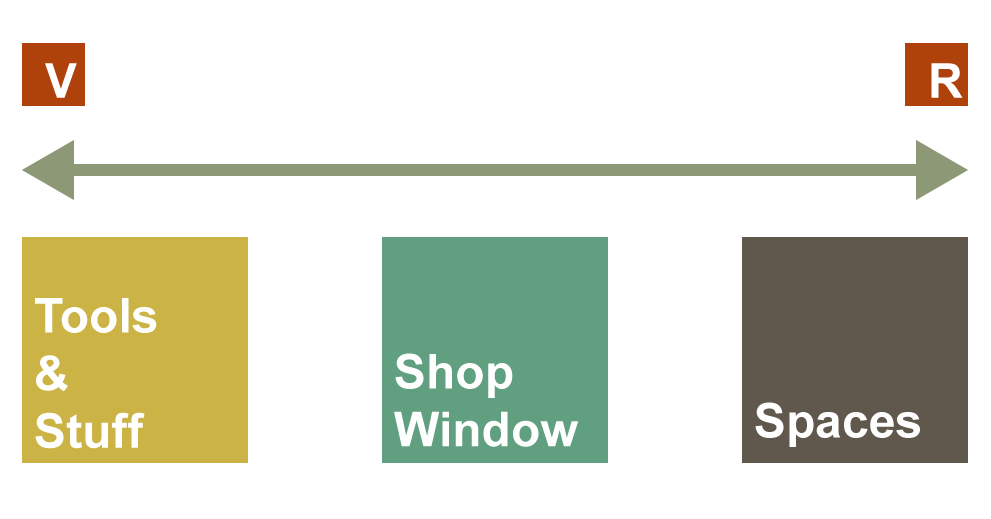
    To attempt to break down the digital into manageable areas I suggested the following ‘practice boxes’ or categories which split the manner in which we use technology into three sections. This provides a very simple framework for discussions about where and how practice intersects with, or resides within, the digital. My Visitors and Residents framework underpins this approach which means that the boxes build on motivation-to-engage rather than the functional affordances of the technology (something which can be considered after you’ve decided what it is you are trying to achieve).

    3 digital-practice boxes on the V&R continuum (CC attribution only)
    3 digital-practice boxes on the V&R continuum (CC attribution only)

    From left to right:

    ‘Tools and Stuff’ – This is the predominant institutional perception of what digital technology is – a series of tools that help to make existing practices more efficient or better quality. It also tends to be students main expectation of the digital services their institution will provide. ‘Give me access to the right tools (including the Web) and access to digital content (stuff) that will help me get through my course. This was one of the key findings from or recent work on The Digital Student project for Jisc. No social trace is left in this mode which is mainly about information seeking, and non-visible production & consumption.

    ‘Shop Window’ – This is a shift from Tools and Stuff towards using the Web as a place for publication and dissemination – the look-at-what-I-have-created motivation which is essentially using the Web as a means of distribution for self-generated content. This is institutions and individuals in broadcast mode and while work that is being presented might be ascribed to the creator of that work it is not necessarily connected to a persona as such beyond a name or a brand. The Web becomes a location to promote the best of our completed work with the actual creative or intellectual practice taking place offline or in non-visible tools.

    ‘Spaces’ – This is where the digital (mainly the Web) becomes a series of spaces or places in which we enact our practice. We go to these spaces to be present with others in some form. This could be within private groups or openly online. So the Web becomes the location where we develop work and thinking in a ‘networked’ or communal manner. This involves individuals operating via (or being embodied within) a digital identity of some form which might be a simple projection of self or could be a deliberately disassociated, managed or pseudonymous persona. (This gets philosophical very quickly but a simple version would be an individual being in ‘student-mode’ when in certain digital spaces). I’ve broken this category into three sections:

    1. Using digital spaces to communally or collaboratively create work. For example, collaborative editing of Google doc or using an online whiteboard/sketching platform to build work in groups. This type of activity could be ‘live’ or asynchronous but the closer to live it is the more the digital will feel like a space rather than a tool.
    1. Discourse around artifacts. – This is the most common form of activity within this category and is possibly the most broadly relevant in an educational context. I’m most interested in forms of discourse which influence the evolution of work, for example a constructive discussion in the comments on a blog post which leads to the original author refining their ideas. It could also be the discourse of a group negotiating the direction of future activities and posting iterations of work which is developed outside of the digital space in which the discussion is taking place. Obviously material that is posted in Shop Window mode can become the focus for discourse with the possibility of recontextualisition or remixing.
    1. Critique or re-appropriation of digital spaces – this one is more specific to Art & Design but important nevertheless. The digital is a space that should be questioned a deconstructed as a place where society resides and operates. This is something that the creative arts need to be doing if they wish to be a relevant voice. I was disappointed with the recent Digital Revolution exhibition at the Barbican which made no attempt to deconstruct the digital in this manner and simply presented a parade of amusing and entertaining digital bits and bobs. In an age of ‘elegant digital consumption’ Art & Design needs to re-present the Digital through a critical and questioning lens.

    ——

    What’s interesting is how the pedagogy we use can shifts teaching practice from Shop Window to Spaces within given platforms. For example at UAL both our blogging (WordPress) and our ePortfolio (Mahara) platforms can be used in both modes depending on the teaching approach. It’s even possible to gently transition from Shop Window to Spaces within these platforms over time which has enormous potential for supporting students in developing their practice and in building professional/practice based online personas.

    My hope is that the 3 categories will frame conversations within and beyond UAL and break down the ‘digital’ in a useful non-tech-deterministic manner.

  • Disconnected learning

    (…and why there’s no such thing as ‘information-seeking’ for school students)

    This month Jisc published a report I wrote with Joanna Wild about secondary school student’s experience of technology for learning. The report is part of The Digital Student project and makes recommendations to the Higher Education sector about how to meet and manage incoming student’s expectations of the digital environment.

    School's report

    The emphasis in the report wasn’t on the technology the schools owned but on how they incorporate it into the day-to-day curriculum. Generally what we found was that within the classroom digital technology is used in the service of making existing pedagogical processes more efficient rather than as an opportunity to engage students in new ways – an example being the frequent, non-interactive, use of PowerPoint by teachers. This appears to be an effect of the training available to staff which generally concentrates on functional skills, neglecting discussion of how technology can be effectively incorporated into teaching.

    I’ve spent the last few years discovering how students go about learning now that the Web exists. Given that I was fascinated/bemused by the apparent disconnection between the classroom and how homework gets done. It’s truly strange that homework is set by schools with the assumption that the Web will be used to complete it but without admitting this fact institutionally. This is to the extent that many students don’t even receive textbooks for key subjects.

    So on the one hand the Web is talked about as a place where you have to be wary of the quality of information and on the other it’s absolutely integral to successfully undertaking your studies. This feels to me like the start of The Learning Black Market for students and in theory puts them in a dissonant situation as they attempt to bridge the divide between the classroom and the way they complete homework. I say in theory because the quality of information to be found online will be very high and because they won’t be required to cite sources for much of their school career. So in essence the system works but not by design – it’s disconnected and I don’t see much evidence of it being brought together.

    The problem here is more to do with ‘knowing’ than with technology. I explored the notion of a loss of ontology when discussing the relationship between Wikipedia and education and I believe that this is a significant effect of the disconnect between the classroom and home. Students are developing basic approaches to finding and using information online without much support from school. Obviously the aim of the game is to complete your homework as quickly as possible and then go out and play football with jumpers for goalposts (yes, yes, I know).

    The sheer efficiency of the Web means that students can leap to a highly focused answer online without having to build a knowledge map of the discipline territory. In some senses there is no process of ‘information seeking’ – simply type a question into Google and the answer will appear. Crucially (and I’m happy to labour the point) the information ‘discovered’ will be good enough/excellent so raising eyebrows in a library-style fashion about this approach not-being-proper is not relevant.

    This then shifts the task in hand to masking the fact that most of your homework can be completed with the use of one super-convenient source that appeared in the top three links returned by Google (often Wikipedia). From what I’ve seen that means ‘how to delicately rewrite stuff I’ve found online so I can’t be accused of copying’. (…to be fair that’s the same as it ever was in school but it’s more efficient and so more prevalent with copy and paste)

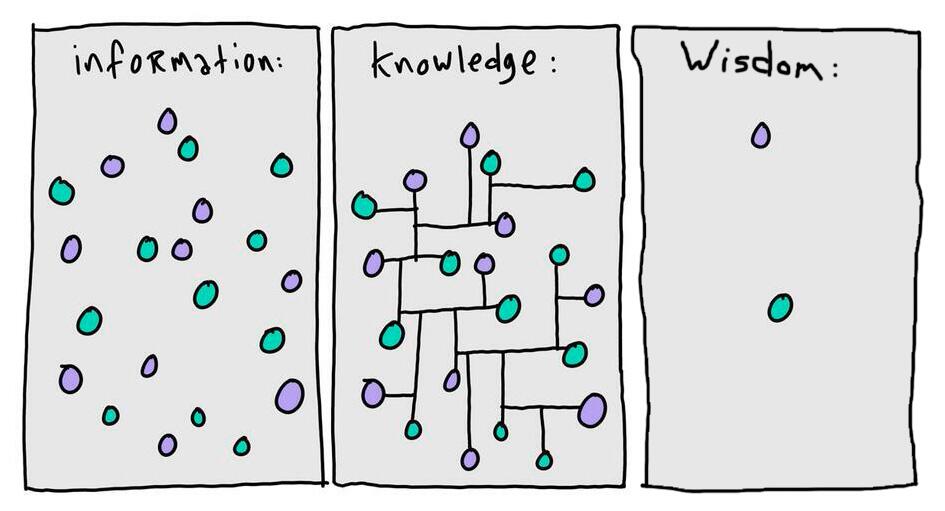
    Information Knowledge Wisdom
    Possibly Hugh MacLeod? via http://goo.gl/qkbG2B

    This (slightly trite) diagram helps to illustrate what I see as the challenge formal education needs to respond/adapt to. Historically the connecting lines that evolve ‘information’ to ‘knowledge’ (I’d use the term learning myself) were partly formed by the process of information seeking -the effort required to piece together understanding by locating and trawling through books. The connections that build an ontology of information were a side effect of this relatively inefficient process. Or, in a lesser way, they were implicit in the structure and layout of your textbook. Now that information seeking is all but dead these lines are less likely to be formed, especially when doing homework. Wisdom isn’t my specialty but I’d argue that deep understanding comes from making connections and not simply discovering scattered answers.

    This is the central disrupting effect of the Web on formal education, a disruption of pedagogy and epistemology. Our response should be to bridge the disconnect between the classroom and homework by designing curricula that explicitly accepts the Web is already central to how education operates and is a legitimate source of information.

  • Mapping online engagement

    Back in June I wrote a post about the Visitors and Residents mapping process. Since that posting I have run mapping sessions with people in various roles from a range of institutions.  This has helped me to refine and simplify the process.

    During those sessions I got requests to produce a V&R mapping kit that people could use to run the process with groups at their institution. I haven’t got as far as I would like with that yet but in the meantime I have extracted the most relevant 10 minute segment from the original mapping video. I’m hoping that anyone who watches this extract will have all the info they need to create their own map.

    A single engagement map is all that is required for an individual and should drive a useful discussion if the mapping is done in a group situation. It should also be useful to then create a map of your department/library/project/group. This way you can assess the digital footprint (The character and visibility of your group online) of your section of your institution and the various modes of engagement you may, or may not, be using. It’s worth noting that if you are mapping with students some of them may relate better to the word ‘course’ instead of  ‘institutional’ on the vertical axis of the map.

    I have collated a few maps from various people (including my own from the video) on this Padlet wall so you can get a sense of how varied the process can be depending on the context of the individual:
    http://padlet.com/wall/visitorsandresidents

    The maps on the wall have no commentary attached to them to preserve anonymity.

    The mapping process originates from research funded by Jisc

  • Visitors and Residents mapping process: the video

    This is a video of the mapping process which we first piloted at Educause last year. It’s designed to help you explore and reflect upon how you engage with the digital environment and then investigate how your students/users/staff engage with what you provide. Feel free to use the video to help plan your own mapping session and let me know how you get on. The video is CC licensed so it’s ok to embed it into your work/courses directly with an attribution if that’s helpful.

    http://www.youtube.com/watch?v=5EyH-JZWtoI&width=450&height=320

    Firstly, I should apologise for my appalling handwriting in the video. I hope that the gesturing opportunities of the whiteboard outweigh the lack of legibility. As a back-up I have included the two maps I draw in the video in digital form at the end of this post.

    This video has been created for ‘The Challenges of Residency’ project I’m piloting as academic lead for the Higher Education Academy. The project is exploring the way Resident forms of practice might differ across disciplines. A larger call for that project will be coming out in the autumn, so if you are interested and UK based keep an eye out for it.

    As mentioned in the video the mapping process is an output of the Jisc funded ‘Digital Visitors and Residents’ project which is a collaboration between Jisc, Oxford, OCLC and the University of North Carolina, Charlotte. The Jisc project has run the mapping process a number of times face-to-face in the US and the UK, with design sessions planned for a library focused ‘infokit’ on V&R being run at SUNYLA and ALA. The video will hopefully become part of that infokit, recontexualised to shift the emphasis toward information seeking.

    In conjunction with this we are going to use the mapping process in a course we are developing with Jisc Netskills based around V&R. The course is designed to help higher education teaching practitioners explore and possibly incorporate Resident forms of practice into their work.

    In the video I also make a passing reference to some work facilitated by Alan Cann at Leicester who used the V&R continuum to map the preferred modes of engagement of a complete cohort of students.

    The process itself is in three parts:

    1. Map your personal engagement with the digital environment
      This is a good way to tune-in to the issues and will make visible how Visitor or Resident you generally are in different contexts.
    2. Map how you think your students/users/staff engage with what you provide
      This can include your practice online (teaching, support, information provision etc) or the services you provide in terms of platforms (VLEs, catalogues etc). In most cases your practice and the service you provide will be interwoven.
    3. Gather a small group of students/users/staff and ask them to map how they engage with what you provide

    Depending on your role you may find large overlaps between maps 1 and 2. The overall aim here is to compare maps 2 and 3 to explore where expectations are being met or are being miss-interpreted. As I mention in the video discussions around the process tend to move from a technology focus to the underlying motivations and attitudes which inform the modes of engagement employed online. I think this is the strength of the process as it helps to avoid the technology-as-solution approach and instead focuses on practice and what it means in a range of contexts or online ‘places’.

    For more information on Visitors and Residents:

    • The original video outlining the V&R idea and continuum
    • Our paper on Visitors and Residents for First Monday
    • The progress report of the Digital Visitors and Residents project (pdf)

    Or you can contact me at david.white at conted.ox.ac.uk

    More legible versions of the maps I create in the video:

    My personal map (with a little more detail):

    Personal map

    My map of how I imagine students engage with what I provide online

    Student map