A recent Ed Tech/HE conference I attended opened day one with a high production value, inspirational, video. Traditionally at this event the opening video has outlined how technology is the future and will enhance everything ‘Empowering students to shape their destinies’ type stuff. (This is normally expressed through metaphor, and images of VR-ish stuff happening).
However, this year while the main message had a similar drive there was a new subtext. The video showed a young woman who appeared to be suffering from creative block, but through her own determination she broke through this, her ideas flourished, and she ended up inspired to paint and draw etc. I don’t recall much technology being involved beyond some laptop pointing and a bit of indistinct VR use. The human was central.
This seemed to be making the case for what, might be, unique about being human and how technology could support that. Another interpretation is that the video was actively defending humanness in an era of rapidly developing digital technologies. I’m sure this wasn’t the direct intention, but this theme did carry through the opening keynote from a Futurist who insisted, in the way that Futurists do, that we should try to imagine many possible futures. i.e. Not just the future that the technologist insist is inevitable on a hard dystopian / utopian split.
What do we bring to the table?
What I think I’m seeing is a post-AI shift towards a defence of humanity against technology. Or a gentler view might be that it’s an assertion of what is unique about being human – an attempt at defining what humans ‘bring to the table’. This theme isn’t new for example, in the nineteenth century Ruskin advocated for human centric values in the face of industrialised work which separated individuals from craft and nature. Harraway argued against the dehumanising drive of computational and technological ‘progress’ back in the 80s and the ‘what makes us human’ theme has been shot through literature for thousands of years (angels, Der Golem, Frankenstein’s monster, aliens etc.).
The new aspect for me is that this was an Ed Tech conference, not a symposium on gothic literature, a meeting of theorists. The organisation running the conference are techno-evangelists of sorts and have facilitated and funded a bunch of useful digital things for Higher Education in the UK. And yet their ‘this is what we value’ conference opening video could easily be used by the marketing department of my own university (The University of the Arts London). Our strap line is ‘The World Needs Creativity’. The strapline of the video could have been ‘Being Human Still Has Value’.
I wonder if we are seeing the culmination of a technological narrative which has been building for years. Wherein those promoting the tech must switch to promoting humanness and how the tech amplifies, rather than reduces, our ‘uniqueness’. There is a tendency here to imply a zero-sum principle to humanness: the more the tech can do the less it means to be human. This feels wrong to me and isn’t helpful in an educational context.
It’s more than the pointy bit – but it is the pointy bit.
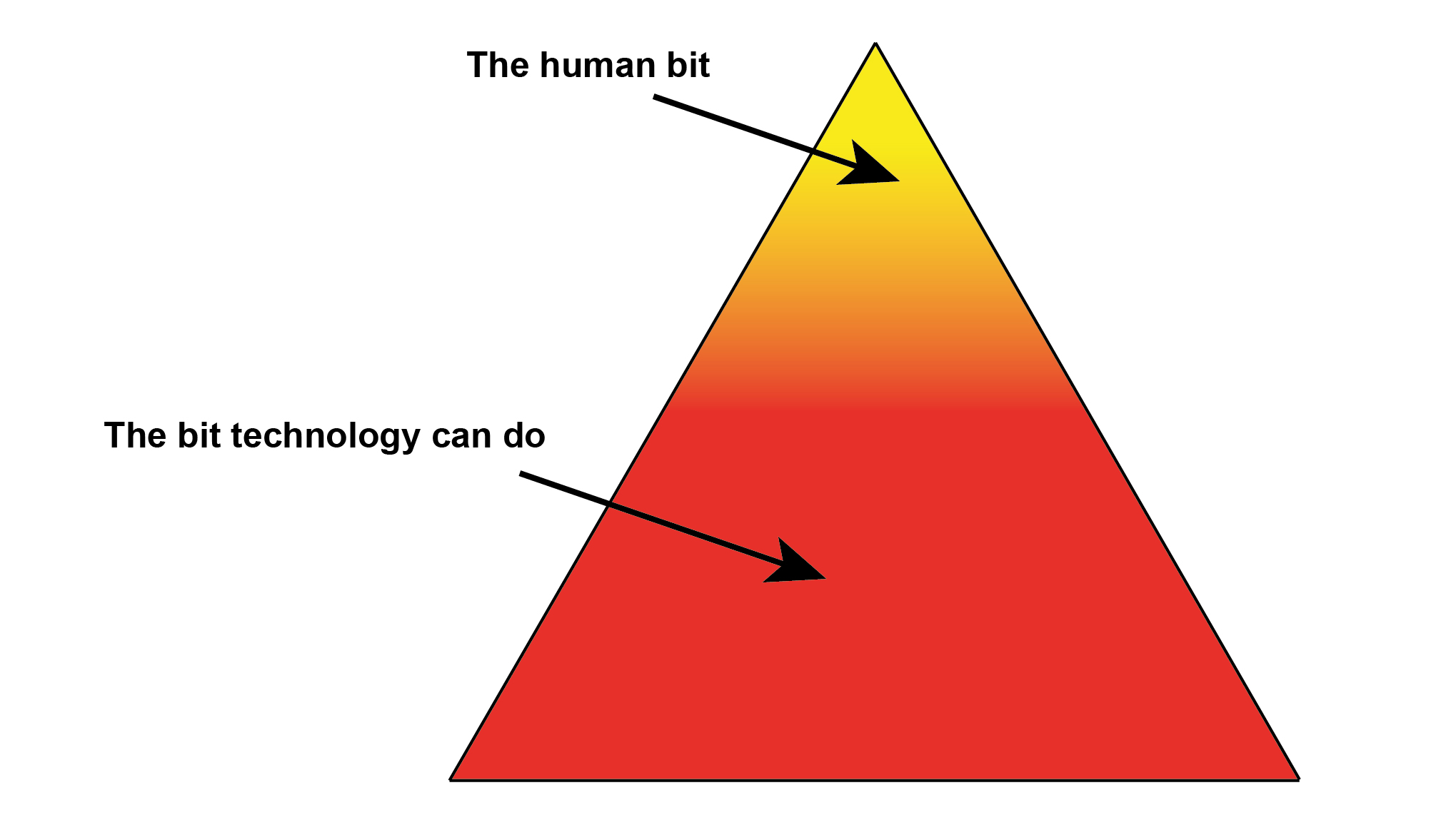
I mentioned a few blog posts back that, for me as an educationalist, the role of technology is to give us the opportunity to spend more time in the pointy, top-end, of the educational triangle diagram (you can pick any educational triangle diagram – they all imply that the pointy bit is what we are aiming for). Creativity, or something akin to creativity, often labels the pointy bit for example, in Bloom’s taxonomy the term ‘Create’ is used. In other frameworks it relates to agency and identity – various forms of self-determination and expression.
A techno-evangelist, overly simplistic interpretation of education triangle diagrams post-AI?
The downside of these triangles is that they imply ‘development’ is a kind of ladder. You climb your way to the top where the best stuff happens. Anyone who has ever undertaken a creative process will know that it involves repeatedly moving up and down that ladder or rather, it involves iterating research, experimentation, analysis, reflection and creating (making). Every iteration is an authentic part of the process, every rung of the ladder is repeatedly required, so when I say technology allows us to spend more time at the ‘top’ of these diagrams, I’m not suggesting that we should try and avoid the rest.
I’d argue that attempting to erase the rest of the process with technology is missing the point(y). However, a positive reading would be that, as opposed the zero-sum notion, a well-informed incorporation of technology could make the pointy bit a bit bigger (or more pointy). The tech could support us to explore a constantly shifting and, I hope, expanding, notion of humanness. This idea is very much in tension with the Surveillance Capitalism, Silicon Valley, reading of our times. I’m not saying that the tech does support us to explore our humanity, I’m saying it could and what is involved in that ‘could’ is worth thinking about.
It’s pleasant, in a quiet way, to see technologists reach for a simplistic only-the-pointy-bit version of creativity as the go-to concept when promoting a human-centric view. This is probably also comes about because the auteur-ish, ‘expressive’, aspects of a performative creativity make for good video visuals. My hope is that the new habit of defending, or promoting, humanness by technologists will lead to an increasing understanding of why ‘Art School’ values around not-knowing, risk, ambiguity, play and general graft are exactly what’s needed to continue to expand what it means to be human.
A conversational seminar series exploring the future of creative art and design education in digital spaces.
The material in the digital.
Digital spaces and practices are evident in almost all creative and learning journeys. This is reflected in students’ experience of Higher Education and in the Creative Industries’ increasing emphasis on online collaboration.
However, fully online creative education remains difficult to imagine as it appears to contradict key characteristics inherent in ‘residential’ provision in various ways, for example:
The ‘desituating’ of material practices, embodiment and notions of co-presence.
An assumed lack of ‘togetherness’ and group cohesion through increased flexibility of provision.
In conversation with experts this series will explore the challenges and opportunities for fully online and digital creative education, the implications for the identity of our subjects and institutions.
To what extent does online provision amplify and reflect current tensions around access, scale, and creativity? What aspects of subject tradition should be questioned in the attempt to be more inclusive and what should be protected?
Context and call
I’ve been working with Chris Rowell and Ruth Powell in the Teaching and Learning Exchange to put together a seminar series with a focus on fully online creative education. The format will be similar to Chris’ excellent ‘AI conversations’ from which he produced a digital book: ‘AI Conversations: Critical Discussions about AI, Art and Education’.
Each seminar will be a 30-minute informal interview, or conversation, with an expert on the relevant theme followed by 15 minutes of Q&A. They will take place on the 1st and 3rd Friday of each month, hopefully starting in May 2024. Below is a brief description of the series and a selection of draft themes.
If you are interested in being the ‘expert’ half of a conversation on one of the themes below, or if you’d like to suggest your own theme within the framing of the series, then let me know on david.white@arts.ac.uk. The questions for each conversation can be agreed in advance, with a focus on fully online but with space to go wider if relevant as almost all themes will have implications well beyond any single mode of ‘delivery’.
Suggested themes
Not all of these themes are my ideas, some came from Chris Rowell and Ruth Powell. I did draft them all, so they are written from my perspective. You might like the look of a theme but want to rework it so it comes from a slightly different perspective. Some of the themes are quite well thought through, while others are just the sketch of an idea. You might also notice that a similar theme has been expressed in more than one form.
Hopefully they give a sense of some of the ground we’d like to cover.
Desituated curriculum
What does it mean to teach creative subjects with little or no shared access to buildings?
Or
What are the implications of teaching and learning having no clear ‘situation’? Everyone involved is embodied in different locations, potentially with no geographical or spatial resonance?
The ‘virtual’ crit
The crit is central to Art School teaching, a practice with a heritage in Fine Art which carries through to many creative subjects and is commonly viewed as a signature pedagogy. Inherent in the crit dialogue in a communal situation. How does this play out online where a sense of togetherness is perhaps more ephemeral and the artefact under consideration will be digital or will have been translated into the digital.
What does an authentic crit look like in online spaces? What is gained and what is lost as we transpose a revered teaching practice into a new context?
Anti-oppressive online
Beyond notions of inclusion, we can ask what it means to be anti-oppressive online. What pedagogic practices “…legitimate students’ epistemologies, foster reflection and discussion, establish expectations of critical awareness, and democratize educator and student roles.”*
How does the principle of anti-oppression operate in digital spaces and places? How do we successfully navigate the ‘built-in’ power assumptions our online platforms and our own institutional cultures?
*Migueliz Valcarlos, M., Wolgemuth, J.R., Haraf, S. and Fisk, N., 2020. Anti-oppressive pedagogies in online learning: A critical review. Distance Education, 41(3), pp.345-360.
AI and creativity
Does AI make us more, or less, creative? How is It being incorporated into creative processes? Where is it redefining, or erasing, practices? Where has it morphed esteemed practices into ‘skills’? What are the implications for creative subjects and identities if we consider AI as a technology of cultural production?
AI literacy, AI use
What literacies and uses are emerging in creative education. Exploring day-to-day practices and implications (staff and students). What aspects of AI literacy should we be focusing on as creative educators?
Translate to engage?
Instantaneous text-based language translation was an early, widely available, use of Large Language Model AIs. Now the same process can work in real time with text or audio.
In UK Higher Education there is anecdotal evidence that some students who have English as an additional language habitually translate teaching into their primary language to engage.
Is this a technology of decolonisation and inclusion or a twisty example of cultural homogenisation by Silicon Valley? What does this mean in terms of belonging and the intercultural in an education system which is resolutely ‘taught and assessed in English*’?
Can we imagine the 100% translated course?
*If we are speaking from a UK perspective.
Assessment, feedback and tech
To what extent has a move into the digital environment modified our assessment and feedback practices? Are we replicating or reimagining?
For fully online provision, what does it mean to be assessing a digital simulacrum of material work? Is a shift in emphasis from ‘realisation’ to ‘process’ in assessment a radical turn or simply a reflection of ‘good practice’?
Dispersed materiality
How do we reconceptualise ‘Studio’ as a concept (a shared space, a set of practices and dispositions) when making is dispersed, distributed across time and geography?
A lack of object-ivity?
How does/should object based learning work in the immaterial digital environment?
The tantalising prospect of digital ‘immersion’ – placemaking with VR/XR.
One response to the immaterial nature of the digital environment is to simulate the ‘real’. To what extent is the use of VR/XR a legitimate method of ‘uploading’ art and design practices into the digital? Does spatial tech draw us together by providing new places of co-presence or does it exclude and isolate?
Being and belonging
Creative arts demand a pedagogy of becoming – being through doing. Given the flexible and dispersed nature of online education how do we ensure we are creating the conditions for this?
Digital mess
The spaces of online education are commonly designed in the context of a corporate philosophy of efficiency and task management – they are spaces as imagined by Silicon Valley. Add to this the inorganic nature of computing and the creative possibilities inherent in the massy and the unpredictable become attenuated. To what extent can we co-opt these environments towards mess and chaos-within-bounds which so often inspires the creative process?
Digital and climate emergency
To what extent is moving creative education online an effective response to climate emergency. What are the factors in designing a low carbon digital curriculum? Are we simply dispersing our responsibilities across a myriad of physical locations or does a reduction in travel immediately make fully online education the most climate-ethical mode of education available?
Lumpy stuff and digital
The plastic arts, getting your hands dirty, materiality etc. Where do we handle the ‘lumpy stuff’ in online creative education? What happens when the tactile, the visceral, cannot be sensed or shared through physical co-presence. Is it possible to meaningfully ‘make’ when dispersed across many localities. Additionally, how might we transpose the lumpy work into the digital without losing its essence. What does it mean when all work ends up as a digital image?
Creativity in corporate spaces: i.e., “Microsoft is the location of your college”
Similar to the Digital Mess theme but with more focus on the implications of relinquishing our spaces to Silicon Valley. There is something here about the corporate ownership of communal spaces and notions of the ‘safe space’ online.
Flexibility vs communality
Fully online education is a pragmatic option for people will full lives. It can be offered flexibly to account for the ebb and flow of work, caring responsibilities and ‘life happening’. However, this flexibility erodes the notion of the cohort and the shared experience of a group going on a journey which is ingrained in creative education. To what extent is flexibility the enemy of communality and belonging? What are the possible design responses which create the potential for communality without always mandating that students ‘build their lives around the course’?
Immaterial making
A Fine Art educator once commented that during an online Fine Art MA the students central practice became the art of making PDFs.
How do we ensure that the screen does not dominate in making subjects? What might be effective and enjoyable methods of sharing and communicating the material via the immaterial?
Access vs supervision
Creative arts education is centred on the development of individual and collective creative practice. This lends itself to a ‘pedagogy of supervision’ which supports individualised dialogue and questioning. While this is likely to be meaningful and inspiring for the few who can access it as a form of education it is inherently expensive, demanding significant amounts of academic/teaching time.
To what extent does a financially viable and accessible approach to online education negate a supervision approach? Is it possible that accessible online education unpicks the very nature of creative subjects, or perhaps demands that they be reimagined?
Structure vs reflection
All creative processes require moments of reflection, space to think, space to forget and then reconnect etc. In contract, good practice in online education tends towards structure, and the granular quantification of attention and focus. Given this, how might we design creative online education which scaffolds but does not suffocate, which provides space-to-think but not an absence of purpose? What does it mean when the most intense moments of learning and creativity are often those times that cannot be measured or entirely predicted?
The ‘SPAV’ Model (Skills, Practices, Attributes, and Virtues)
Skills, Practices, Attributes, Virtues – CC BY 4..0 David White
The model lays out a continuum spanning from Skills to Virtues to be used as a high-level tool in the design of university education. Underlying this is a doing-to-being continuum which is based on an ‘education as a journey of becoming’ principle. In short, we create the conditions for our students to develop as individuals over the time they are with us. Hopefully they leave as more knowledgeable, better equipped citizens with nuanced, and ethically informed, worldviews.
When considering the design of curriculum, the model is intended to be used as a touchstone which provides a holistic view of various strategic drives commonly applied, often unevenly, in the development of HE level courses. For example, many universities have a skills agenda, a set of Graduate Attributes and a Social Justice/Purpose strategy or themes*. These might be expressed separately, leaving those developing curriculum to interweave these educational aspirations which could, on the surface, appear to pull in different directions.
The model is intended to help those that design Higher Education navigate the breath of offer which spans from ’employability’ to ‘making the world a better place’. I believe these can, and should, inform each other but in the day-to-day of university activity they sometimes feel like dis-integrated layers.
*Examples would include positions on Anti Racism, Inclusion, Sustainability, Decolonisation, and Climate.
————————-
It is possible to insert institutionally specific frameworks into the categories to inform design. So the model will stay relevant even as institutional drivers and aspirations change over time. For example, at the University of the Arts London we have a Creative Attributes Framework (Attributes) and a Social Purpose Implementation Plan (Virtues). These are subject-agnostic, whereas frameworks in the Skills and Practices area will differ by school, faculty or subject.
A specialist process
The categories in the model are geared towards the design of education, which is a specialism in its own right. As such, they are not intended for a broad audience without translation or simplification. For example, employers tend to mix aspects from across the model under the banner of ‘Skills’. A survey of employers by Kingston University indicated that ‘Problem Solving’ was the most valued ‘Skill’. Whereas in educational design terms, ‘Problem Solving’ would be a Practice which incorporates relevant Skills and Attributes, guided by Virtues or values. Even so, I wouldn’t attempt to rewire employers use of language. The broad use of ‘Skills’ is fine as long as we, as educators, work with more nuance behind that term.
Similarly, how these categories interrelate does not always need to be made explicit to students, but a good understanding is required across the continuum to inform design. For example, a question or brief might be posed which focuses on developing a Practice but encourages this to be contextualised in terms of Virtues/Social Purpose even if these terms are not used directly.
Definitions if the categories within the model
(Health warning: The categories bleed into one another. For example, one person’s ‘Skill’ is another’s ‘Practice’. The model should be used to inform design and discussion about what is being covered in curriculum, and how it interrelates. It is not attempting to categorise definitively or be an arbiter of semantics. The discussion the model engenders about what and how to teach is more important than trying to make everything ‘fit’ in the model itself.)
Skills
These are usually instrumental, and straight forward to assess as there will be clarity around what mastery of a Skill looks like. This could be understood on a case-by-case basis, or via established competency frameworks. A Skill is likely to be an isolated competency which is expected to be combined with other Skills, or incorporated into Practices, to complete assignments/briefs. For example, brazing two copper pipes together is a Skill, knowing how to install a central heating system is a Practice. Basic numeracy is a Skill, solving a maths problem is a Practice. In short, a Skill can always be gained through a training style of teaching.
Practices
These are where Skills are applied in context to generate new knowledge or understanding (Sometimes the term ‘literacy’, as in Digital Literacy, is used in this area too). Practices can be institutionally defined (where there might be a ‘correct’ approach) or developed by the individual. Often they are a combination of both, whereby they are initially learnt in an agreed form then adapted and owned by the individual over time. As such, Practices can combine aspects of both doing (externalised actions) and being (internalised to the person). Good examples of this would be the Practice of academic writing or the Practice of drawing. Each of these has a raft of accepted techniques and skills which can be adopted and adapted by an individual in the development of a personal style or approach, namely, the development of a personal Practice.
Notably, students will often already have a collection of Practices and skills they ‘own’, which they will bring into an educational process. Curriculum which assumes that students ‘start at zero’ across any of the model’s categories is unlikely to be inclusive in nature.
Thanks to Georgia Steele at UAL for the definition of Practices used in the Model.
Attributes
Often presented as ‘Graduate Attributes’ These characterise an individual’s approach to undertaking work and engaging in the culture of work or scholarship. Attributes underpin an individuals’ ability to ‘make their way in the world’. Higher Education emphasises Attributes as important characteristics of the person (how being informs doing) which usually go beyond what is directly accredited. The successful graduate is then ‘greater’ than the sum of their Skills and can continue to adapt and learn over time in a changing environment.
Commonly referenced Attributes include ‘communication’, ‘collaboration’ and ‘resilience’, but I think more mundane categories such as ‘reliable’ and ‘personable’ give a better sense of the value of Attributes.
Virtues
Being virtuous has negative, entitled, overtones but virtue, and by extension, virtue ethics are useful when defined as ‘striving to do good’, even when doing good is not necessarily expedient – i.e., it’s complex and difficult.
Institutionally, ‘good’ is often expressed across numerous social, cultural, and environmental areas. These are now being gathered under the banner of Social Justice, a term which feels fresher than ‘virtue’ and helps to reveal what could otherwise be ‘Hidden Curriculum’. Being clear about Social Justice values helps to avoid what I call a ‘guess the culture’ approach for students, where students who are culturally aligned to the institution’s values do better in assessment while those who are not tuned into this struggle to understand what they are doing ‘wrong’.
Interestingly, while accruing wealth and power are highly prized elements of ‘success’, they are not inherently virtuous. Given this, Social Justice, as a proxy for virtue, is a useful way of promoting that an institution, and its graduates, are not only driven by revenue and profit. This is increasingly important if universities are to remain distinct cultural entities. Importantly, virtues must be lived-out by the individual and cannot be performed, they require integrity. Where Attributes might be a characteristic of a person, Virtues are embodied. Virtues, and how they relate to the development of worldviews, are therefore closely tied to notions of becoming.
Operating across levels
The model can operate across all HE levels: at the higher levels (in the UK, levels 6/7) students are expected to generate a narrative of their work which interweaves and interrelates multiple categories in a sophisticated manner. This would include the use of theory and relevant frameworks to structure, contextualise, and reflect upon interrelationships across this model. Whereas at lower levels we might expect a student to articulate connections across fewer categories. For example, discussing how they have applied certain Skills to develop a Practice.
Using the model
I’m planning to incorporate this model into our Learning Design process to help us to develop curriculum which is balanced across the categories. I see it as a tool we use at the start of the process to help shape a course or module and something the check-in with the end. Does the design cover relevant categories to the right extent? Does it connect those areas in a manner which aligns with the level of the course? Does the design of assessment reflect this?
Below are further thoughts which I wrote as a ‘way into’ explaining the model. I thought I’d include them here as they might be useful context.
——————————————————————————-
Virtuous becoming and Constructive Alignment in Art & Design education
UAL teaches subjects which are highly ontological. That is, they aspire towards becoming and the incorporation of practice and knowledge into the identity of the student as they develop nuanced and ethical worldviews. There is a requirement to incorporate anti-racism, climate crisis and sustainability, and decolonisation into curriculum in tandem with inclusive, diverse and intercultural approaches to teaching and learning. This Social Justice imperative is a form of human practical ethics which should inform Skills, Practices and the development of Attributes.
This pushes the boundaries of the Constructive Alignment approach in the design of teaching and learning, as Learning Outcomes which require a particular worldview to be demonstrated could be in tension with inclusion and decolonisation. To what extent should an institution define the ‘correct’ way to be? In this sense, as we move through Attributes and towards Virtues, Learning Outcomes could blur into something we might call Becoming Outcomes, which could be problematic or, at the very least, stretching the idea of Learning Outcomes to breaking point.
However, I suggest that Learning Outcomes can be designed which operate at this end of the continuum if they are centred on developing a position or support informed critical reflection. i.e. They do not mandate a particular view is held even where this might be in tension with the stated Social Purpose standpoint of the institution. Clearly, a student taking this approach would have to develop a line of argument which is articulated with great clarity but in an inclusive, pluralistic, (and I would argue, fundamentally educational) environment this should be possible.
The ‘Art School’ heritage of Practice
The use of Practice within this model has it roots in ‘Art School’ forms of education where Skills are applied to materials through practice to produce new work and new knowledge. This mechanism of applied Skills can be extended beyond distinctly creative contexts. For example, in the UK we might demand a specific level of English language Skills which can then be applied in the practice of academic writing. Similarly, we might require numeracy Skills which can be applied in STEM-based lab Practices.
Levering open the Practice space between Skills and Attributes
Practice is a location in which the academic and the practical can inform each other and is therefore crucial in the design of contemporary Higher Education and is in some sense what binds the model together. Practice can be theorised, and theory (including certain aspects of Social Justice) can be applied to practice. Including Practice in the model also reduces the risks of skills and attributes collapsing together and becoming a confusing, interchangeable, mix of doing and being.
(…or there is no such thing as a good picture of a horse.)
A little while back I was invited to give a talk at the University of Sydney where I argued that “The ‘Art School’ approach is increasingly relevant across all university-level teaching to avoid our graduates getting drawn into an impotent skills race with technology”. This post is a condensed version of that talk.
(Thanks to Professor Peter Bryant and the folk at the University of Sydney Business School for the invitation and the excellent hosting)
—————————–
No correct answers
I often joke that I help to run a university with 25,000 students who are mostly studying subjects with no correct answers. This can look like a bit of a conundrum, especially when it comes to assessment. We can unpick this if we take into account two Art School-esque principles.
The emphasis is on assessing the creative journey, or the narrative of the work, not the output or the ‘product’ of the work.
There is no such thing as a good picture of a horse.
Before I deal with that second point, it’s worth noting that the ‘the narrative, not the product’ is a version of the idea of ‘assessing the learning not the thing’. In that sense, all of higher education should be taking this approach in one form or another. For example, an exam shouldn’t be assessing how good you are at exams…
No such thing as a good picture of a horse
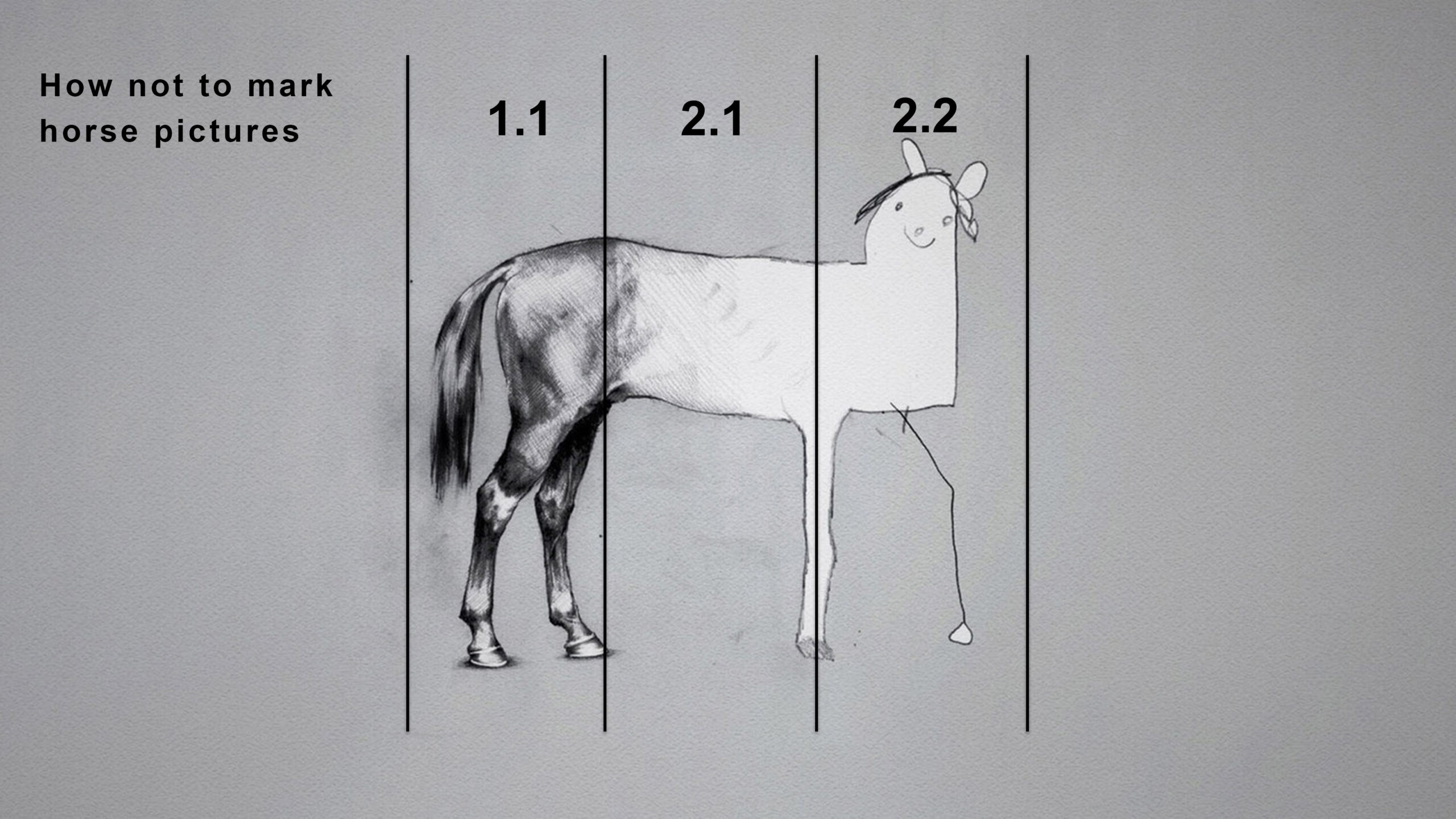
If we did operate on the ‘good horse’ or ‘correct answer’ basis then I suspect our marking criteria would look like this:
Art School assessment practice, if we marked based on the idea of ‘Good’?
This isn’t the case though as while there is significant merit in, and respect for, technical skills these are not the point or the aim. To explain this, it’s useful to consider that ‘all creative work is conceptual’, but sometimes the concept is really basic. For example, the concept might be ‘a painting of a horse that looks very much like a horse’ but it could be ‘a cartoon of a horse which encourages us to question the limits of Generative AI’ . Hiding in this ‘it’s all conceptual’ notion is something I return to a lot, namely a pedagogy of questions, reflection and critique.
Let’s say I set you the task of creating a picture of a horse, you can achieve this any way you want. The catch is that you have to explain why you have taken a certain approach, what you think the value of this approach is and the extent to which you have been successful relative to that value. (Importantly, you can also reflect on how you might have failed to do this).
You can use all kinds of tools to construct this story: theory, method, process, your identity, your cultural influences and experiences, a chosen canon of relevant work etc. This forms the narrative of your work and this can be assessed.
Beyond skills and knowledge
This pedagogy is not radical but it tends to be more prevalent at the ‘top end’ of education systems. The PhD viva and the notion of a ‘defense’ being the classic example. Intriguingly, in arts education, students encounter this form of pedagogy from day one. That’s a tough gig and figuring out how to gently scaffold students into this form of learning is an ongoing challenge. It might be a ‘defense’ in some sense but we don’t want it to be defensive as this simply privileges the privileged.
The upside here is that an ‘Art School’ approach equips graduates with the ability to go beyond the ever shifting currency of skills and knowledge by developing the ability to question and critique context. To tell a story as much about the ‘why’ as the ‘what’. Our graduates can ‘see’ systems and structures which can then variously be navigated, made visible, modified, avoided or deconstructed. All extremely useful attributes for employers, assuming they work on a trust basis.
Avoiding a skills ‘arms race’ with technology
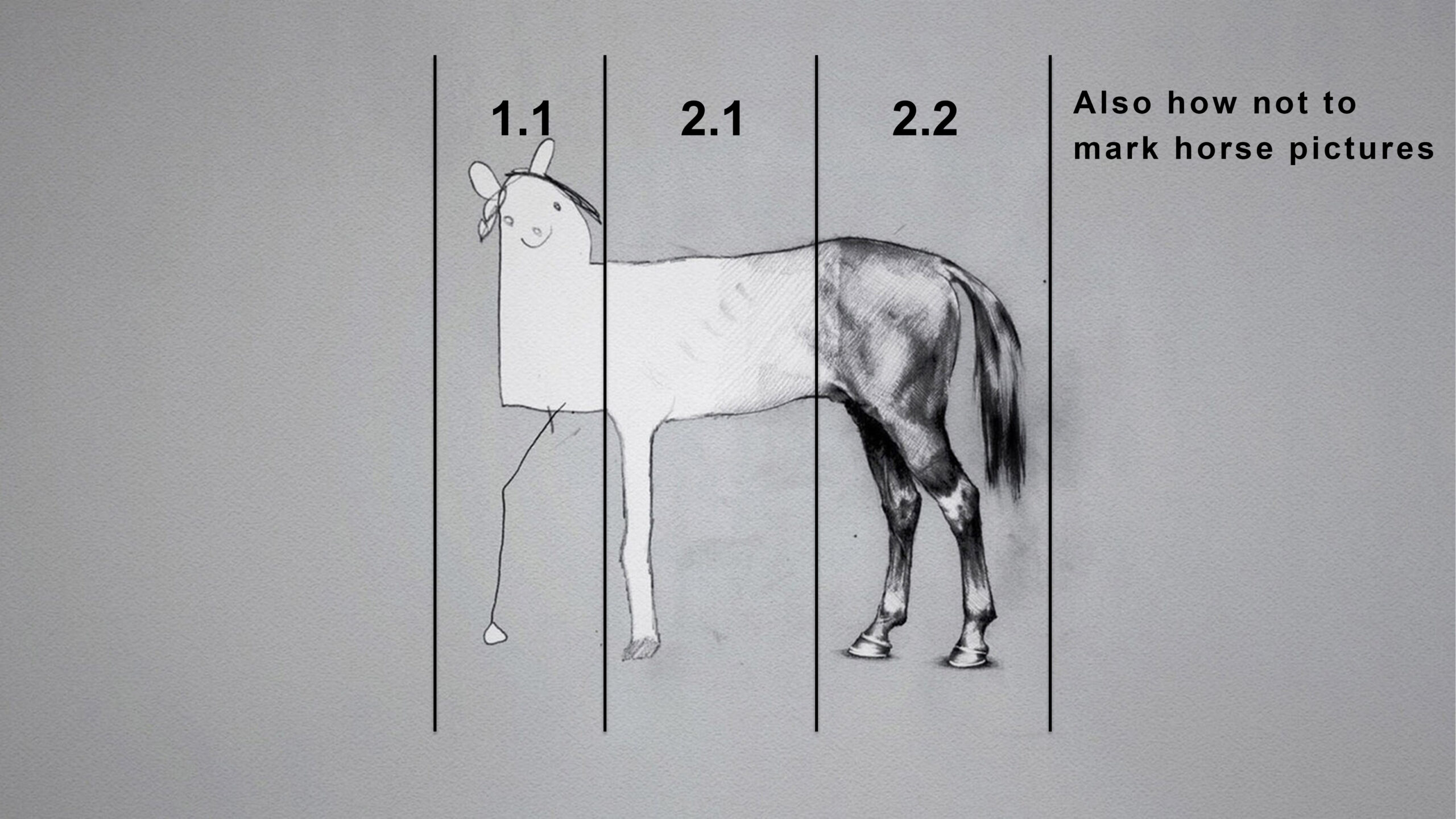
So perhaps our marking criteria should look like this?
Nope
Well no, because we are looking at an output here, not the story. Any of these representations could be strong or weak pieces of work depending on how they respond to the brief and on the quality of the critical-creative narrative of their genesis.
What we can say is that the front of the horse is the most imaginative and the least likely to be reproducible algorithmically. The cartoonish image doesn’t go head-to-head with techno-solutionist approaches because it simply side steps mainstream notions of ‘good’. It’s genuinely difficult to get Gen AI to produce the crazy looking cartoon because it simply doesn’t have enough to go on. I’m not saying this won’t improve, this is more a point about the limited value of ‘Good’ when processes can are automated. When I tried to generate ‘both ends’ of the horse with Stable Diffusion (as a prompt novice) it produced this:
My attempt to recreate the aesthetic and character of both ends of the horse using Stable Diffusion an image based Gen AI.
In the talk I used this Gen AI example as the current exemplar of a long line of what be usefully termed as technologies of cultural production. 15 years ago I might have made similar points about Wikipedia, there are many similarities in the questions raised by Gen AI and Wikipedia because they are both technologies of cultural production which rapidly emerged in the public domain. This is a category of technology we consistently struggle with because it recategorises forms of labour and professional identities.
Imagination not imitation
As mentioned, Gen AI, as with any algorithmic technology, imitates but doesn’t imagine (Yui et al. 2023). Here is where the ‘Art School’ approach becomes crucial as reproduction and remixing of canon, i.e. ‘elegant imitation’, is rapidly losing its currency. In the same way that copying and pasting from Wikipedia has very little value but can be very useful, so too with Gen AI. In practice this means much of what we characterised as creative work is being merged into broader notions of ‘production’, something Tobias Revell has discussed in terms of Design potentially ceasing to be a specialist field.
This is where we again connect with the limits of focusing on ‘Good’ as the principle of good tends towards imitation as it’s a comparative concept. Good is almost always relative to what has come before. I’d say this is also the same with the idea of being ‘correct’.
Under these circumstances there is an imperative to teach beyond ‘good’, thereby equipping our graduates to swim to the surface of imitation and operate above the ever rising tide of skills-that-can-now-be-done-by-generalists. Now that the sanctity of writing has also been eroded by technology, I’d argue that the ‘No such thing as a good picture of a horse’ approach goes beyond creative subjects and is necessary across the majority of higher education.
Yiu, E., Kosoy, E. and Gopnik, A., 2023. Transmission versus truth, imitation versus innovation: What children can do that large language and language-and-vision models cannot (yet). Perspectives on Psychological Science, p.17456916231201401.
The University of the Arts London, where I am currently employed, has ambitions to widen access to creative education through fully-online provision. You can read about this in our university strategy.
This isn’t in-of-itself radical excepting that creative subjects have not, traditionally, been the focus of online development. The ‘standard’ subjects for online tend to have a more defined scaffolding of knowledge and learning – there are more ‘correct answers’. Examples include, MBAs, Computer Science and Nursing where learning and assessment can be (if required) perpetuated without the direct intervention of academic staff, up to the point that reflection or individual projects come into play.
Creative subjects tend to be built around the exact type of individual (or group) projects and critical reflection which require specific critical feedback and dialogue. At UAL almost all of our assessment is based on coursework, not exams, and much of this is evidenced through the development of personal portfolios. This is typically ‘Art School’ in nature and, as a colleague pointed out to me, heavily influenced by the traditions of Fine Art pedagogy. This is not to say that all creative subjects are a version of Fine Art. It’s that deeply held beliefs about what it means to nurture creative practice and thinking across many subjects are rooted in Fine Art style teaching methods.
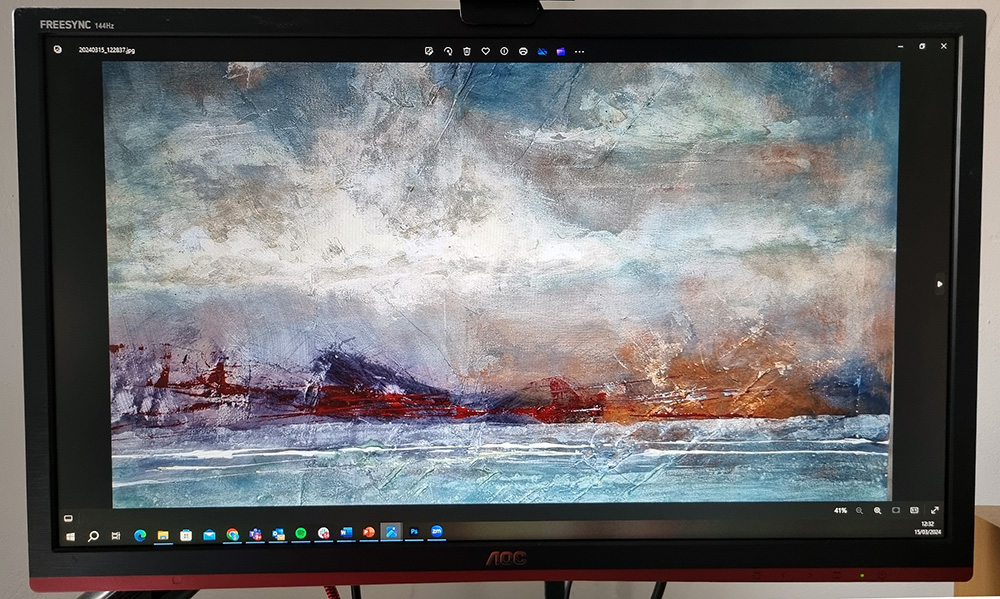
Abstract detail (painting by David White CC BY 4.0)
Four foundations of creative teaching
There are many ways to cut this in how we might describe the foundational components of a Fine Art, or ‘Art School’ inflected education. Here is my, not exhaustive, overview:
Teaching process, developing practice: ‘making’ skills, ‘craft’ or ‘technique’.
Teaching theory and canon: The history of the subject. Learning the tools required to contextualise practice and develop a critical position.
Teaching critical reflection: Applying theory to practice and vice versa, reflective writing, academic writing and research. Documenting (telling the story of) enquiry, ideation, process and realisation.
Teaching-by-supervision to support individual and collective practice.
(As ever, if we have a broad view of terms like ‘practice’ and ‘process’ then these four points cover most subjects taught at a higher education level – especially if we categorise ‘academic writing’ as a type of practice)
Supervision-as-dialogue is central
In subjects where the focus is on developing a creative practice, supervision, often in the form of dialogue, becomes the foundation of the teaching & learning approach – the ‘signature pedagogy’. Most academics at my university would see this as crucial, almost axiomatic. If we are honest in our proposition that students can interpret project briefs/assignments creatively, then teaching must mold itself around the variation in those responses, it can’t be generic, it has to be thoughtful. Is a Fine Art course without dialogue Fine Art? It certainly doesn’t feel like it.
I’d argue that the supervision model of teaching is the primary design consideration when developing accessible online provision. Developing workable models of supervision is at least as important as responding to concerns around materiality and physical making practices. The latter can be re-situated, up to a point, to be local to the student whereas supervision is hard-wired into the identity of creative education.
For some, supervision is by definition the soul of the course. Dialogue, structured or serendipitous, with experts (academic and technical) is possibly more important than access to specialist equipment and spaces. When students describe ‘the course’ they are most likely to mention moments of real-time supervision coupled with stories of personal, or group, practice. They are less likely to mention text-based feedback even if that was influential. This could simply be because embodied, live, moments tend to be easier to recall?
Supervision vs access
The uncomfortable aspect of accepting this is that a supervision model of provision is in tension with access in a number of ways:
Supervision requires significant staff time which risks reducing access in terms of affordability for students.
Supervision is commonly framed around moments of ‘live’ (synchronous) dialogue which is difficult for students with busy lives, or across time zones, to frequently engage with.
One dimension of increased access is greater student numbers. In a supervision model the limiting factor will quickly become the availability, or even existence, of teaching staff with the right balance of teaching and creative-practice experience.
So we end up with a scenario where reducing the amount of supervision in creative education provision is not just a curriculum design choice, it’s an erosion of what we believe the subject to be and a dilution of what some students believe they are paying for. On the other hand, predicating any course (and here, I’m going beyond creative education) on supervision risks attenuating access across a number of dimensions.
The powerful cultural/educational position of supervision is, I suspect, what underpins student demands for moments of ‘live’ teaching (in-building or online) which are then poorly attended. Students and staff need to know these supervisory, or live, moments are happening or they feel the course ‘doesn’t properly exist’. However, when students are not in a position to attend, or the inconvenience of attending ‘live’ is outweighed by the sense that attendance is not contingent on success, everyone feels unsatisfied at some level.
The importance of acknowledging ‘non real time’ supervision
In response, I’m not suggesting that the supervision model of teaching is a problem to be solved. The troublesome aspect is not the practice of supervision but that it is too closely associated with ‘live’, or real-time, teaching. This is often cemented by legal and regulatory approaches to ‘contact time’ – as I’ve discussed before.
It’s of note that the coupling of supervision and ‘live’ doesn’t accurately reflect day-to-day practice given that dialogue and feedback is often via text in the form of online messages, comments, annotations etc. In essence, the practice of supervision has adapted to incorporate the not-real-time opportunities of the digital environment but our conception of supervision seems stuck in a previous era. We need to accept, or rather acknowledge, that much of our dialogue takes place in non-real-time forms which are more varied than an epistolary or summative feedback.
Unfortunately this means that we underestimate, or fail to identify, the actual volume of teaching which takes place. This inability to ‘see’ teaching as anything other than ‘live’ is partly responsible for creating unsustainable work loads. A course as documented and validated is likely to not capture this middle ground between ‘contact time’ and ‘independent’ hours, except perhaps as a vaguely defined form of administration (sometimes this also falls under ‘pastoral’, ‘community’ or ‘support’ type labels).
Less ‘live’ and more ‘supported’
Extending our definition of supervision to incorporate non-live forms of dialogue is crucial if we are to balance subject and access. My team is defining this as ‘Supported’ teaching. A mode of supervision which provides flexibility for students and softens the line between ‘Live’ and ‘Independent’ teaching and learning.
The question I’m exploring is how much ‘live’ can become ‘supported’ in online provision before the nature of the subject itself is changed. Or, to put it another way, to what extent is the teaching mode and the subject itself intertwined? If we don’t understand this entanglement then any design process where academics are famed as ‘experts in the subject’ and others are experts in ‘learning’ could grind to a halt. If particular teaching methods are part of the fabric of a subject then we can’t re-design teaching without re-imaging the subject.
Is there a fundamental tension between student belonging and the flexibility of our university provision? This is the question I have been exploring recently as we develop fully online provision and one which I am repeatedly brought back to when talking with colleagues.
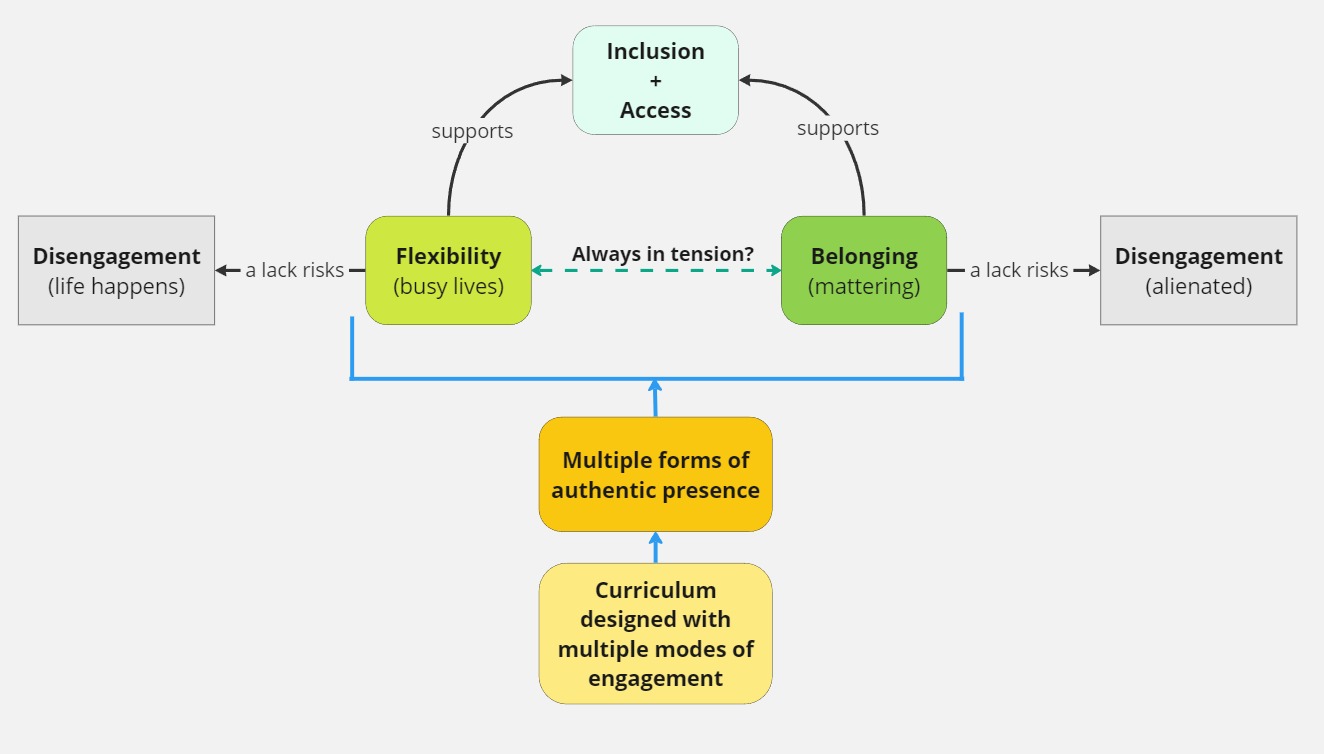
In an attempt to map the territory within this question I created a simple diagram which I’m going to step through to navigate my thinking.
Flexibility vs belonging in education provision. (David White CC BY 4.0)
Access and Inclusion
I’m unapologetically starting with the idea that access and inclusion are a good thing. This doesn’t represent the thinking of the whole of the Higher Education sector but it’s where I’m starting from. If you believe that education should be hyper selective and only support those with ‘talent’ then this probably isn’t the diagram for you (That sounds facetious but I’m not aiming to disrespect selective approaches. They are just less interesting to me than the access question.).
Flexibility
This is a classic ‘bucket term’ in that it can contain any number of definitions. Often the assumption is that flexibility is related to academic choice but here I mean flexibility in the mode of provision. More specifically, forms of flexibility which account for students having busy lives. Or which don’t assume that students are building their lives around university in the character of a ‘traditional’ school-pipeline residential student.
One could argue that the form of provision, in terms of the academic calendar, assessment practices and teaching patterns, has not changed significantly during the period UK Higher Education has expanded. Instead we have added ever more support services around a relatively fixed core. Sometimes this support requires more time from already time-poor students. So a struggling student has to find time to do ‘do the course’ and to be ‘supported to do the course’. Clearly, the support itself should be provided but I worry that we don’t add up the total time commitment of a student who is not rich in time or educational capital.
Intriguingly the fixed ‘core’, or focus, I mentioned is the course itself and not the student. This is, at least in part, because the regulatory frameworks of tertiary education tend to be structured around academic quality and what is required to put students ‘through’ Higher Education. Things are changing quickly though, and the Office for Students in the UK does attempt to advocate for students albeit with somewhat lumbering regulations which don’t necessarily account for the full diversity of life circumstances and motivations. There is still an implicit ‘right way’ to do university surrounded by an increasing set of exceptions and modifications.
Whatever the politics of this might be, what we can say is that a lack of flexibility in the form of provision risks disengagement. Not the kind of they-just-didn’t-seem-to-be-interested disengagement, but a circumstantial inability to engage with the provision because ‘life happens’. Not ideal in terms of access.
Belonging
I’m wary of this term as it assumes that belonging-to-the-academy in some form is something all students want and is rarely properly defined. Incoming students, especially those who haven’t arrived from the school pipeline, are likely to already belong to quite a few things. I think the mistake we make here is not in thinking belonging is important but in assuming that the institution should be a primary, or significant, location of belonging. Hence the reference to ‘mattering’ which is a principle that applies more evenly across all students, or in fact to everyone – who doesn’t want to matter?
A feeling of not belonging, or alternatively, not mattering is likely to lead to disengagement through alienation or lack of motivation. Not ideal in terms of inclusion.
Tension
If we run with the idea that flexibility means that students can study at their own pace (within certain bounds) and at a time which works for them, does this always cut against the possibility of belonging? What if that includes multiple course start times, elective modules, recordings of ‘live’ teaching, significant chunks of asynchronous or ‘supported’ teaching etc. That level of flexibility means that no consistent group of students will be ‘together’ at the same time and in the same place very often. The notion of the cohort is eroded, raising the question of what we imagine students are supposed to belong to? (especially in fully online provision where we don’t have the convenience of conflating belonging with ‘being in a building’)
I believe there is a tension here but that it might be being misrepresented, or centered too closely on, a ‘traditional’ student. We need to consider the extent to which any given student expects their relationship with university to be a cultural rite-of-passage or an educational journey. I’d argue that our notions of belonging contain a complex mix of rite-of-passage and education – which are, of course, interwoven. I’d also argue that a fully online student is likely to be primarily interested in aspects of belonging which keep them educationally motivated. They probably don’t imagine going punting will help them finish the course, even if it would help them to feel part of the academy (Extreme example I know).
To what extent do students who opt for a fully online course hope, or expect, for a cultural-rite-of-passage other than gaining accreditation (and hopefully the associated learning)? I’m not sure we know?
Negotiating the Flexibility-Belonging tension must be done through the design of provision, as I believe we are reaching the limit of what can be achieved by offering more support around a less-than-flexible model. This is not a simple path though, as increasing flexibility is not only in tension with foggy, but well meaning, notions of belonging but possibly also with what we believe the identity of our subjects are.
Presence
The headline design-principle for educational provision which responds to the flexibility-belonging tension is ‘presence’. I’ve written about presence before and my conclusion is that we should provide the opportunity for students to engage via a range of modes and channels i.e. multiple forms of authentic presence.
We already, variously, do this but I suspect we still have a model of ‘ideal’ engagement lurking in the background which is a subset of the many possible routes to being a successful student. For example, we will often talk of the student who submits brilliant work despite hardly ever ‘attending’ – even in institutions who do not mandate attendance. In this case their work is their authentic presence. Another example would be the student who only seems to watch recordings of teaching but gains a decent mark or the student who never asks a question etc. There has to be many routes to success to reflect the diversity in personal circumstances and motivations, as opposed to a single ‘correct’ route and a stack of support and exceptions.
Not of this is straightforward and I worry that multiple forms of authentic presence does not equate to multiple meaningful routes to success. In short, I think it is easy to accidentally choose a pragmatic, but less than enjoyable, route. This brings me back to my Belonging is Inconvenient proposition, in that sometimes it’s good to do things in a less than efficient manner. Sometimes having to go out of our way is what makes the activity worthwhile.
To be very clear, I’m not saying that it’s good to be draconian, obfuscating or needlessly complex on the basis of providing a ‘character building’ environment (unless your institution is keen to perpetuate and protect entrenched forms of generational privilege and opportunity in the classically mean British style). It may well be character building but I’m not sure I like that particular character.
If we have to go out of our way because of a lack of thought in the design of the provision then I suspect we only learn how to feel annoyed, or that we somehow don’t belong. If we choose to go out of our way because we understand the value of taking a less-than-direct-route then we are gaining in personal agency rather than losing faith in the institution.
(This post was written before the main wave of interest/anxiety around AI/Large Language Models hit. As such, it’s delightfully non specific and an attempt to outline implications in principle. For me, this is summed-up as follows:
Efficient access to abundant information (the Web) reduced the value of ‘remembering information’ as a skill.
AI reduces the value of synthesis as a skill.
In some ways, technology is climbing up Bloom’s Taxonomy and pushing more of the learning process in the pointy bit of the triangle. Although, interestingly, it does skip some layers which could be a problem. Jumping from knowledge to synthesis and circumnavigating comprehension, application and analysis might prove dangerous. (not that I think we should always run through those things in strict order).
Anyway… below is what was my first run at some of this thinking)
A developer friend of mine recently told me a simple coding task they set when interviewing new staff was successfully answered by a chat bot. My response was, “Chat bots can Google, so I’m not sure what the problem is?”. In the days following my trite response I found myself coming back to the topic and realised that the chat bot ‘problem’ is part of a long history of falsely imagining ‘learning’ to be a fixed concept we are more or less distanced from by technology.
Detail from an abstract painting by David White (CC:BY)
In 2014 I gave a keynote at the Wikipedia conference entitled, “Now that Wikipedia has done all our homework, what’s left to teach?”. This was intended to be a playful way of highlighting that the ‘problem’ was not with Wikipedia but with an education system which placed too much value on answers and not questions. Wikipedia was ‘too good, too available and too accurate’ for a system which was built on the principle that information is difficult to access and recall.
Looking back, the Wikipedia ‘problem’ seems like the quaint precursor to the lively AI-will-kill/save-education discourse. (all tech debates decend into the kill/save dichotomy, so it’s better to step back from this and ask why this comes about.)
Good / Bad – *yawn*.
Firstly, any institution or system which claims that technology becoming ‘good’ at something is the central problem won’t last long in its current form. Within Capitalist Realism, you simply never win this argument (and yes we could go to the barricades but I’m writing in the context of where we are now). Secondly, withholding technology to force people to ‘learn’, incorrectly assumes that the notion of learning is fixed. Let’s be honest, telling school kids to not use Wikipedia was never going to wash, especially as schools tried this line at around the time they stopped giving out textbooks on the (never to be said out loud) hope that the kids all had access to the internet.
Saying AI is bad (or good) is a super dull discussion. Admitting it exists and that we will use it for anything that makes our lives a bit easier is a much more interesting starting point. (side note: when I use the term AI, I really mean ‘elegant computer code that does things we think are useful or entertaining’). A brief history of humanity has to include: “We will always use all available tech for good and bad and this process is continually redefining what it means to have power, have skills, be intelligent and be creative.” These values and how they operate as currencies is always on the move and always has been.
Is ‘being right’ now wrong?
What my developer friend’s chat bot couldn’t do was reason out, or tell the story of, how it had arrived at its answer. This is how we frame ‘learning’ at the University of the Arts London, we don’t assess the end product we assess the narrative of how the student travelled towards the end product. The narrative is the learning, the artefact (often a creative output at UAL) is the output from that learning. The end ‘product’ is symbolic of the learning rather than an embodiment of it, it needs a narrative wrapped around make meaning out of the process.
The photography(tech)-drove-art-to-become-more-conceptual argument is a useful touchstone here. If we imagine a near future where most, traditional, assessments of learning can be undertaken successfully by code then our approach to education has to become more about narrative and reasoning than about ‘being right’ or ‘reflecting a correct image of the world back at ourselves’.
We are feeling our humanity squeezed by tech that can mirror what we, historically, defined as human. This is not a fight with tech but an opportunity to redefine and reimagine what we value. I’m hopeful that this will allow previously marginalised voices and identities to become heard.
I’d argue that ‘being right’ is this century’s outdated skill – this is a good thing.
Just as purely figurative Fine Art lost a bunch of its value as photography gained ground, being right will lose its status relative to being-able-to-think within our networked-tech suffused environment. In many ways, current political and identity polarization is an effect of the rise of networked technologies, both in social (the internet) and neural network (AI) terms. It’s a grasping for the comfort of ‘being right’ in response to a painful, and unsettling, shifting away from the certainty of that very rightness.
Save and adapt
Back in edu-land: A good essay is a narrative of reasoning, so it does or should, operate as an embodiment of being-able-to-think. Sadly, we have fed so many essays into the network that technology can now reflect a performance of this learning back at us. I have no sympathy for educational institutions who have a naïve understanding of data and also claim that tech which endangers its business model should be shut down. We can’t complain about tech when we use the very same tech to increase revenue. We also can’t de-tech without damaging access and inclusion.
Let’s not to fall into academic navel-gazing on the what-is-learning/what-is-the-academy questions though. Instead let’s focus on how we adapt our lumbering institutions to shifting tech-driven redefinitions of value, while also calling our unethical practices of all kinds. I’m not an accelerationist, I believe that we can adapt while not erasing historical forms of value. Universities are ideally placed to ‘protect’ that which might be destroyed by the headrush of technology but they must not be defined by that impulse.