Category: Presentations

  • Arguing with the Digital Natives guy in four vexations

    Arguing with the Digital Natives guy in four vexations

    This is difficult for me to write because I’m still tense about much of it. I have recently got one of those ‘health tracker’ watches and while reviewing the video of the session with Marc Prensky at Online Educa my heart rate did spiral upwards.
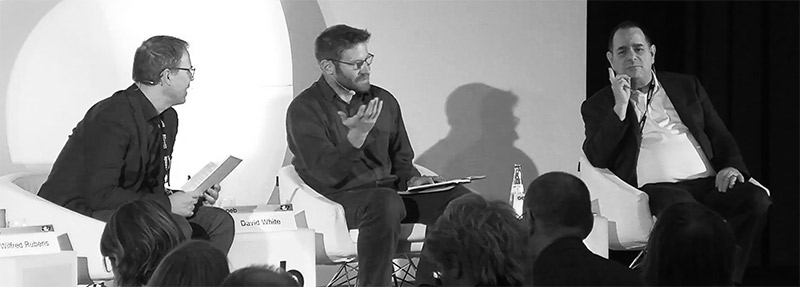
    The debate was a chaired, hour long session, between myself and Marc which promised to ‘go beyond’ metaphors to discuss the ‘realities’ of how education systems should respond to digital. In the end we didn’t discuss Visitors & Residents or Natives & Immigrants directly (something Marc was careful to avoid). However, our underlying educational ideologies were laid bare during the debate and effectively revealed the thinking behind our respective metaphors.

    A simple way to read the session is in cultural terms, as a colleague pointed out to me I had a European-style ‘critical thinking’ perspective while Marc has a ‘pioneering’ North American flavoured focus on ‘accomplishment’. If I was to put it bluntly, I characterised Marc as Libertarian while he characterised me as Elitist and an Ivory Tower academic.

    [embedyt] https://www.youtube.com/watch?v=cblSaK56AXQ[/embedyt]

    Having reviewed the video of the session I can see that Marc’s point of view was generally geared around schools level education rather than higher education. In fact, his framing of higher education approximated Oxbridge of 30 years ago (or now depending which course you are on).

    This is vexation number one: repeatedly being told by people that don’t teach that the education system is broken. Marc clearly has very little experience, or knowledge, of the majority of the higher education sector in the UK (in fact many of the speakers at Educa had little or no day-to-day experience of working in education institutions). Marc evidenced his lack of direct experience in a few comments:

    1. He described a form of group-based teaching as good idea, as if we don’t ALREADY DO THIS A LOT.
    2. He suggested we should do more project-based learning which is something WE ALREADY DO A LOT.
    3. He seemed to be under the impression that all we do is ‘think’, and teach students how to ‘think like us’, which he characterised as of little value, suggesting that it would be better if we thought less and did more.

    Vexation number two: implying that ‘thinking’ is elitist. Working on the basis that you are either thinking *or* doing is ridiculous, but I suspect Marc was alluding to ‘academic’ thinking AKA ‘not doing anything useful’ rather than the thinking required to DO THINGS(?). I believe that having learned some literacies at school it’s part of higher education’s responsibility facilitate students in extending their ability to think critically and question intelligently. That’s not to say that, as Marc suggested, I assume that incoming students don’t know how to think. However, don’t believe that we are all ‘naturally’ good at this (Excepting those who are so privileged they are never put in a position where their actions are called out an unthinking?). Most of us benefit from some teaching and some challenging in this area.

    So I take offence at the implication I’m elitist for holding the view that thinking is a good thing, especially as this is part of a process by which students can, I hope, reject or challenge dominant modes of thought and those who have taught them. I love a well reasoned argument from a student about why my views don’t stand up and I hope I’m open enough to take new ideas on board. (At one point Marc highlighted that I’d brought some notes with me to the session, as if this was somehow an elitist, academic move, rather than ‘being somewhat prepared’.)

    Vexation number three: the repeated use of terms like ‘effective’ and ‘successful’ with no frame of reference. As you would expect, the Digital Natives guy basically espoused a kind of ‘let the kids get on with it because they have the Web’ approach whereas I suggested that we need to teach critical thinking and facilitate a broadening worldview. Towards the end of the debate I gave a little speech about privilege, quoting Orwell: “All animals are born equal, but some are born more equal than others”. If our education systems can’t provide opportunities to those born ‘less equal’ then what’s the point? Obviously my problem with Marc’s position is it assumes a Libertarian equity of opportunity and runs on the basis that you just need to be your best, most individual, self and you will‘ succeed. It’s easy to see how Marc, having been through Harvard Business School, might promote this idea and how this would be lurking behind the Digital Natives stuff. It’s the old ‘being successful means being like me’ problem.

    Vexation number four: celebrating human doing over human being. For Marc, ‘success’ seemed to be about doing things to the world to ‘make it’ a better place, whereas I suggested notions of becoming and, I hope, being part of humanity. This is why I’m ok with the notion of, what is often described as, ‘learning for learning’s sake’ because I think it enriches us – it’s probably better described as ‘learning for our own sake’, and if we are active within our communities and beyond then ‘own sake’ means society as much as ourselves.

    How about we focus on becoming decent, thoughtful, human beings before confidently ‘fixing’ the world? Maybe I’m old fashioned, but I’m confident that concentrating on the former is more likely to improve the general state of affairs. Ultimately, Marc sees the Web, or the network, as a largely non-hierarchical location in which anyone with some gumption can achieve great things, as if the Web was some kind of neutral space in which the ‘good’ succeed and those that sink only have themselves to blame. This is effectively the mantra Silicon Valley hides behind.

    I hope that for those in the room our sharply opposing views led to a meaningful debate. I personally found it quite distressing but maybe I’m just not native enough to market-driven conference environments? 🙂

    Having said this, now I’ve had time to reflect I have to admit it’s been a useful process for me. I’ve learnt a lot and I value the opportunity to debate with people who hold differing views. After all, where is the challenge in only speaking to people who already agree with us? So, thanks for your time Marc, I can’t see us agreeing on much but I’d be up for round two if you are.

  • Digital leadership framework

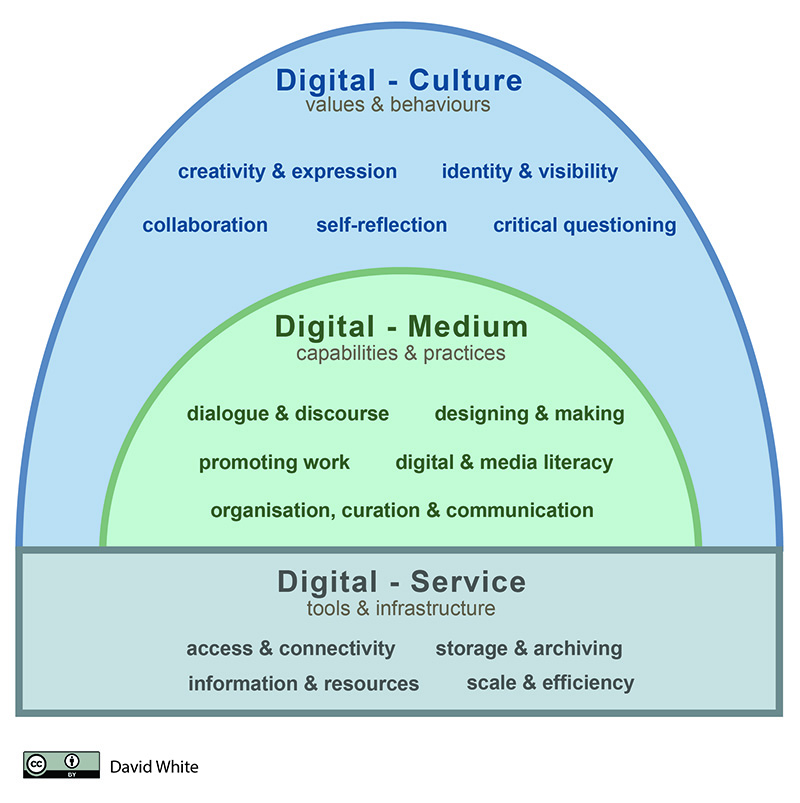
    Last year I wrote a quick post proposing a simple way to manage high level discussions about digital. This came from my involvement in digital strategy discussions which often slid across thematic and organisational areas, ending up with a scattering of actions which looked like a troubleshooting list and a desire to ‘get involved’ with new technology. The framework I jotted down simply proposed that discussions should understand their location within three areas: Digital Culture, Digital Medium, Digital Service.

    For a recent talk I was asked to give by the Leadership Foundation on Digital Leadership I refined the framework and illustrated it with categories which sit within each area. I started with three headlines which set the context for the framework:

    Digital is not the future: An idea the formed the basis of www.futurehappens.org with Peter Bryant

    To harness the digital at an institutional level we have to focus on the present and not place digital in that the-next-big-thing-will-save-us category. Clearly we need to keep an eye on the horizon but I know our students would thank us if we prepared them for the digital ‘now’ not an unknown and variously utopian/dystopian imagined future.

    The digital and physical coexist – something I’ve written about as ‘coalescent spaces’

    I’ve written about this before but in summary – we need to respond to the digital as one part of the ‘real’ world not as a separate entity. Digital and non-digital activities flow in and out of each other.

    Digital is too big

    It’s an element of almost everything we do and not a viable starting place for a discussion, hence the framework.

    Culture – Medium – Service: A digital leadership framework

    Clearly the subcategories are not exhaustive and some of the have an Art and Design twist but I hope they show how the main areas differ. What’s interesting is how decisions in one layer effect activities in the others but as institutions we struggle to make these connections. So for example we might install new technology in the service layer but neglect to discuss how this might affect teaching and learning in the Medium layer. We might make bold assertions in the Culture layer but struggle to understand the implications for the Service layer etc. This is why I think the framework is useful, assuming you can get the right mix of people from across the institution involved in discussions. Before I go any further I’ll quickly describe the layers as I see them:

    Service

    In a digital context this could simply be IT. It’s the layer students are most likely to comment on if asked about ‘digital’ because when most people think of digital they think the technology itself rather than their practices within digital contexts. If this layer isn’t working then the other two don’t stand a chance. There’s not much point in trying to develop a digital identity if the Wifi is down.

    Medium

    This is where most of our day-to-day activities take place. It’s where the digital has become the location for our work and the place where we connect with each other. This is where the real work of the institution is done, for example, teaching and learning. It’s also the layer which is often least discussed strategically as discussions swing from the need to buy more 3D printers to the risks of Social Media use and not much in between.

    Culture

    These are the high level principles which inform the character and direction of the institution. As is always the case with culture these are often implicit or assumed to be shared values. So, for example, in my institution we have a culture of creativity and the desire to help students develop their own creative practices. How this is expressed in the digital should be an ongoing negotiation. It’s also of note that emerging practices in the digital and new forms of access/connectedness shift culture or call aspects of it into question.

    You could take the framework and use it with a second axis such as scale. So we could take teaching as a subject and consider what is needed in Culture, Medium and Service terms, mapped against Individual, Course and Institution. Or to be more specific we might take a particular question from the National Student Survey in the UK such as “My course is intellectually stimulating” and consider what is required to ensure this within that grid. Or we could map against the student journey of Pre-arrival, Induction, First year, Second Year, Third year etc. These are the kind of discussions I’d like to frame at my own institution to develop a better shared understanding of the digital which cuts across traditional structural areas such as IT, Teaching and Learning and Senior Management.

    The framework was well received at the Leadership Foundation event I presented at. I hope it proves to be useful. Thanks to the many colleagues who listened to me as I was formulating the framework and offered useful feedback and advice.


  • Technology isn’t human(e)

    Why do we build our institutions on the principle that technology in-of-itself does useful or interesting things? I suspect it’s because culturally we cling to well ingrained assumptions, such as:

    1. Technology makes work more efficient – it reduces labour
    2. Technology is about automation – the machine ‘working’ while we control it
    3. Technology is neutral – it performs tasks without bias
    4. Technology is always developing – it is the ‘solution’ to our ‘problems’
    CC Dennis Hill - https://www.flickr.com/photos/fontplaydotcom/504000141
    CC Dennis Hill – https://www.flickr.com/photos/fontplaydotcom/504000141

    These do hold true to a certain extent but only if you take a strict techno-centric view. The statements above are questionable as soon as we bring people into the picture and, of course, technology is an artifact. It’s designed, made and used by us.

    The reason I feel the need to spell this, somewhat facile, principle out is because I worry that we do think of technology as an ‘other’, outside and beyond us. We can’t grasp its complexities so it becomes a mystery and, as is our habit, we develop superstitions about that which we do not fully understand. We almost go as far as personifying technology which is where the problem starts.

    Take for example the last of the statements above: ‘Technology is always developing’. It sounds ok until you consider that technology doesn’t magically develop on its own. The statement should be: ‘People are continually developing technology’. Yet we seem comfortable to extract ourselves from the picture and think of technology, if not as an independent consciousness, then as a self-evolving entity.

    The irony is that while on the one hand we lean towards personifying technology in its apparently neutral forms we are also extremely wary of those moments when it attempts to ape humanness directly. (again, I can’t get away from the forms of language here as I just said ‘it’ instead of ‘people design it to’) We like to know when we are interacting with a person and when we are interacting with code and feel at best conned and at worst abused if we confuse one for the other.

    I’ve seen this in so many forms: suspicion of bots in text-based MUDs and MOOs, our response to avatars in virtual worlds (am I controlling ‘it’ or is it ‘me’?), our distaste for algorithmically generated news, our unease with talking to search bots in public and, in my case, a complex relationship with @daveobotic, my Twitter bot.

    We dislike the idea of being socially or intellectually satisfied by an algorithm because we fear things we can’t clearly define as sentient, sensing a loss of our own humanity if we discover we’ve believed the code is a person. This is a classic human concern, whether it’s a Golem, Frankenstein’s monster, any number of cyborgs or artificial intelligence we have always been troubled by that which is animated but not explicitly alive. It’s one of the ways we explore the question of our own consciousness, a tantalising theme revisited throughout history in various forms.

    I see these tensions playing out were education intersects with the digital. The business-like element of our institutions prefer to think of technology as in-of-itself efficient and neutral. The potential of technology to be the ‘solution’ for the ‘problem’ of teaching and learning at scale is attractive and, to a certain extent, operable if you frame education as a problem-to-be-solved. This breaks down if we see learning as transformational rather than transactional though – if we see it as a process of becoming. This is where education is intrinsically human with all of the  vulnerabilities, prejudices and generally messiness that comes as standard where people are involved – a form of education that anyone who has ever taught will understand.

    Nevertheless, I see an emerging trend in which we set-out to synthesise ‘contact’ in the digital to scale-up what we claim to be transformational education using a shell of transactions masquerading as persons. An early example of this is the planned nudging messages of encouragement, warning or even advice sent to students driven by ‘learning analytics’.

    We are being tempted by this line of thought even though we have explored all this before and know that we are masters of detecting soulless interventions. Even if our algorithms are efficient and effective our experience will be hollow and unsatisfying. I deeply doubt our ability to develop as individuals on this basis (the ‘becoming’ form of education I believe in) and argue that while the digital can be a valuable place for people to connect with each other, technology is inherently limited in its ability to ‘scale humanly’. This is not because we are incapable of designing incredibly sophisticated code, it’s because we have an instinct and desire for the conscious.

    (This line of thinking extends from the “Being human is your problem” keynote given by myself and Donna Lanclos at the ALT-C conference.)

  • Connection and anxiety

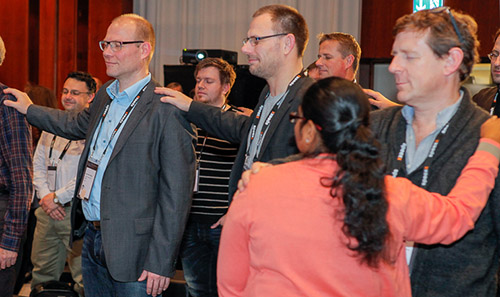
    As I hinted at in my (Re)humanising eLearning post I directed a group performance entitled “A performance of connection and anxiety” as part of my Spotlight Stage session at Online Educa. The audience played the part of first year undergraduates while I represented ‘the institution’ in all its various forms. This involved everyone standing up, putting their hand on the next person’s shoulder and closing their eyes (100+ people seemed surprisingly willing to enter into this piece of shared theater).

    Connection
    Photograph by David Ausserhofer, Mark Bollhorst and Maren Strehlau. All copyrights by ICWE GmbH. CC 2.0 Germany

    As I’d hoped this created a certain frisson in the room and when we remained silent for about 15 seconds that strange feeling of togetherness started to grow despite most of the audience being strangers to one other. I then circulated round the room ‘selecting’ individuals by tapping them on the shoulder while they had their eyes closed, representing the moments they might be ‘chosen’ or engaged with by your institution in some way.

    Discussing this with people afterwards some commented that they had hoped to be chosen but they didn’t know why as I hadn’t explained what the implications would be. Others hoped not to be chosen but overall there was a healthy tension in the room – I like to think of this as the ‘good’ form of anxiety.

    When I asked everyone to open their eyes and sit down if they hadn’t  been selected many people were looking around to see who the chosen few were. At this point I admitted that I hadn’t chosen anyone which fortunately got a laugh (possibly of relief :).

    Overall it did feel like we’d all shared in a specific moment of connection and one, as I outline in the original post, which worked between strangers because we were physically co-present. Gaining that sense of connection online requires more up-front identity work but I believe it’s crucial if we see the value of the digital as a place we can learn together.

    The three key areas I proposed for consideration to create connection online and rehumanise elearning were:

    1. Spaces
    Think of and use the digital as a series of spaces or places where individuals can be co-present and connected. (rather than just a mechanism to broadcast content)

    2. Eventedness
    Design in synchronous moments or ‘events’ online. This helps to create a feeling of belonging and that ‘I was there’ factor. The technology to support this is now pretty reliable.

    3. Conversation at scale
    Design mechanisms for discourse to take place at scale. Hashtags, commenting, shared postings, crowd-sourcing, editathons etc. This is the area which we are least adept at but I believe the technology is now in place to support conversation at scale if we can design our teaching to take advantage of it.

    All of the above are underpinned by individual’s developing an online presence and identity. Something which is central to almost all Digital Literacy frameworks but which we often don’t prioritise when supporting our students and/or staff.

  • (Re)humanising eLearning

    For my ‘Spotlight stage’ session at Online Educa (15:35 on Thursday 4th) I’m  exploring ‘Re-humanising eLearning’. This is a theme very much inspired by Catherine Cronin’s keynote at ALT-C this year in which she spoke, among other things, about the value of online identity and open practice.

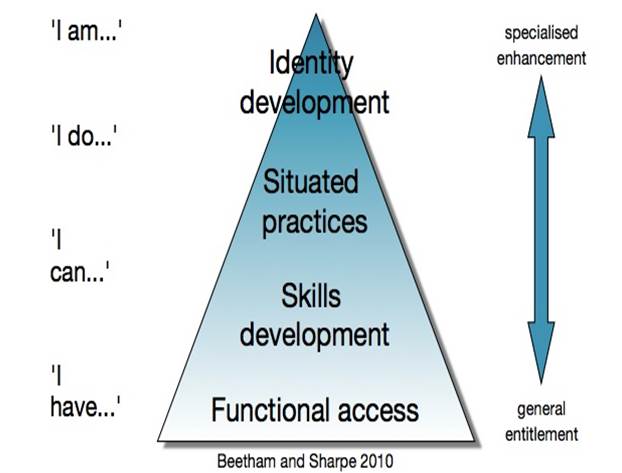
    When I’ve mentioned the theme of Re-humanising eLearning to colleagues many of them suggested that eLearning was never particularly ‘human’ in the first place. This is a reasonable, if disappointing, comment. Nevertheless, take a look at almost any Digital Literacy framework and it will have the distinctly human (in that it is about the ‘self’) concept of a Digital Identity highlighted in it somewhere. In my favourite framework/hierarchy from Helen Beetham and Rhona Sharpe Digital Identity is the apex of digital capability.

    Yet the primary experience and conception of eLearning for most learners is based around receiving a bunch of content that has been placed into a curricular structure somewhere online. No need for an identity in this scenario, just anonymously grab what you need to get your work done.

    In my session at Educa I’m going to highlight how the efficiency and flexibility of this impersonal form of eLearning risks holding students at arms length. This is especially the case those who have many calls on their time (work, childcare etc.) and can’t make it to face-to-face sessions or have chosen predominantly online forms of learning to fit around other activities.  In this scenario it’s crucial that the digital becomes a humane learning space in which a sense of ‘togetherness’ can grow.

    What interest me is how meeting in physical locations has an automatic feeling of togetherness built in, we feel we are sharing an experience without having to ‘know’ the other people in the room (a trip to the cinema is a good example of this). The very fact everyone has chosen to turn up to the event/session/lecture shows a common purpose. (I’m planning a little shared performance which involves the whole room in my Educa session to prove this point… See http://daveowhite.com/perfomance)

    Online it’s a different story, when we move to predominantly text based environments we have to project our identity before we can interact or feel a sense of connection. What good would Twitter or Facebook be if we didn’t know who was talking/posting, if the screen way just a series of sentences with no attribution?

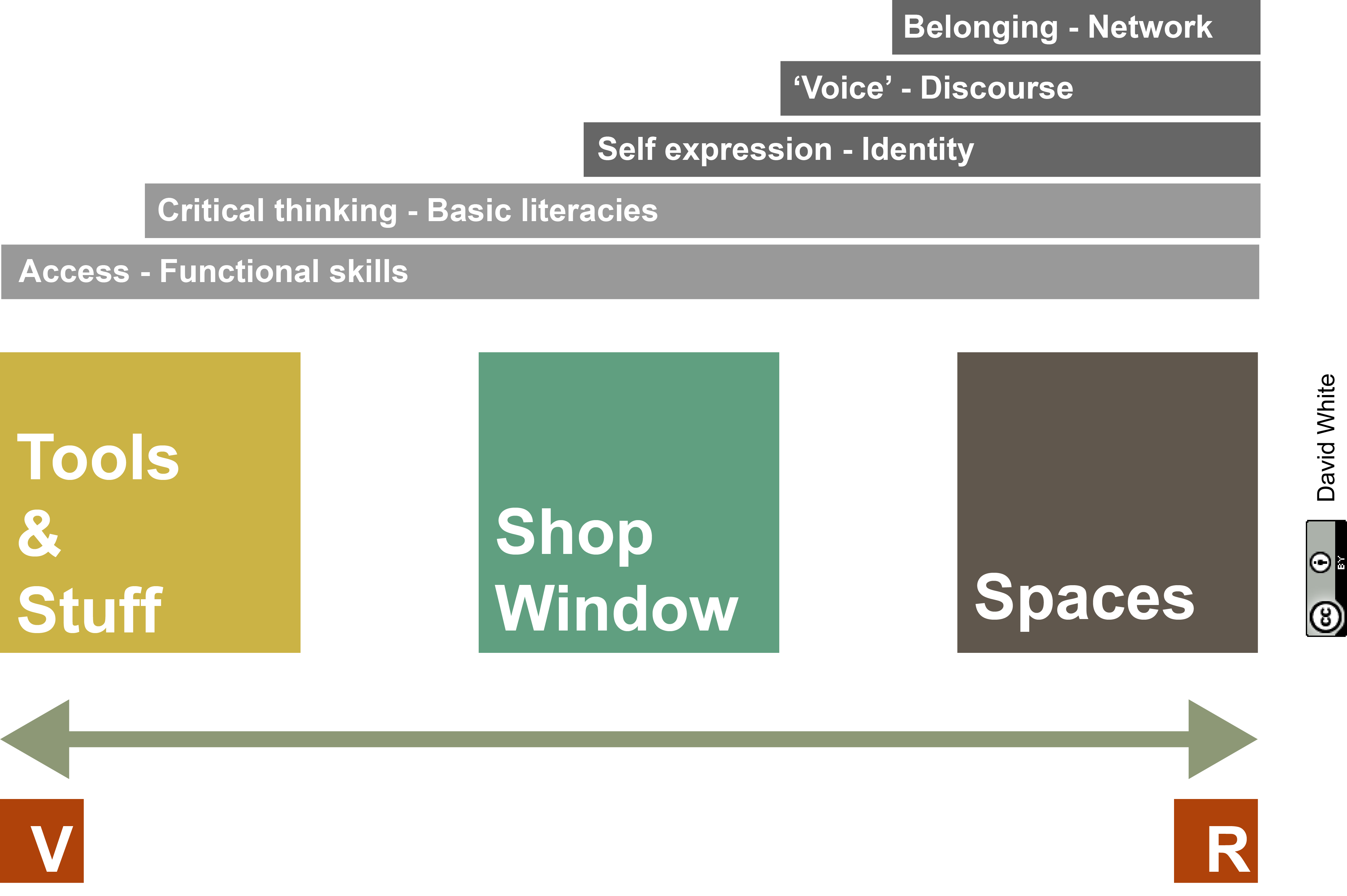
    Identity and self expression are writ large in my mapping of ‘digital capabilities’ on to my 3 category model of digital engagement (see Breaking down digital).

    I’m not sure I’ve captured everything I need to here but I’m confident that as soon as we move towards the Resident/Spaces end of the continuum we are engaging, however minimally, in forms of self-expression which leads to the projection of identity.  It could be argued that it works along these lines:

    Technology (and the people in it) fosters agency > forms of self-expression > formation of identity > increased agency > and so on…
    (note: should make this into a looping diagram)

    So in a digital context identity and self-expression are crucial to becoming and belonging, whereas in face-to-face scenarios some ‘togetherness’ can be felt without identity. Those who are fortunate enough to be able to regularity attend face-to-face sessions are likely to feel connected to their learning and their institution; to engender this online requires more explicit fostering of identity and expression.

    At this point we could switch ‘digital’ for ‘higher education’ and the principle still fits. The digital in this case is simply a mirror for what I believe to be the overall point of higher education – to encourage and challenge students to nurture their identities as legitimate participants within their field of study. They arrive with a delicate sense of who they are in the world and leave with purpose and a solid sense of self…

  • #Digitell Identity

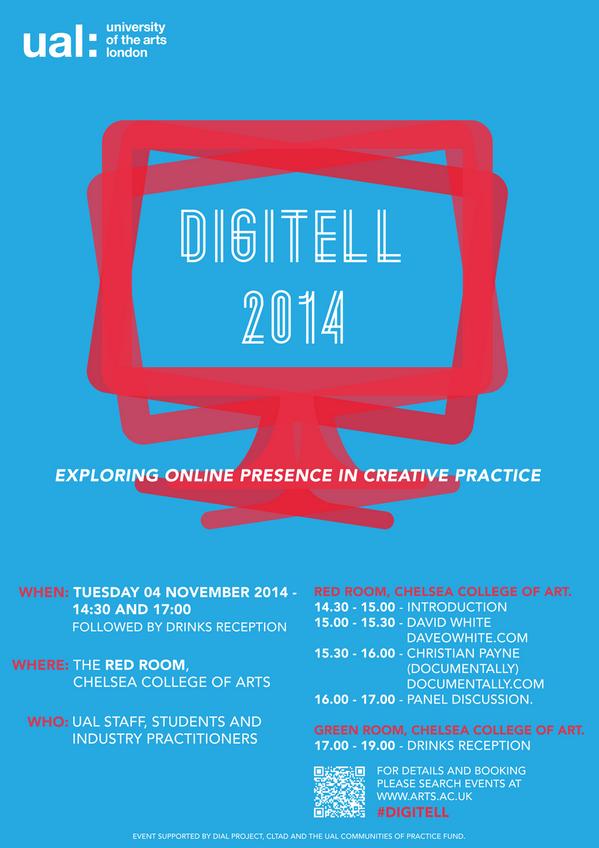
    It was lovely to be invited to speak alongside Christian Payne (@Documentally) at the Digitell symposium held at The University of the Arts London. The focus of the student run event was digital identity, one of the themes students had highlighted out of a community of practice supported by the Jisc funded ‘DIAL’ project and CLTAD.

    So I rolled up my thinking-sleeves and considered the way identity functions in the creative arts… The result was a talk which included DuchampAbramović and Banksy. Obviously it’s a complex subject and many have been lost down the rabbit-hole of identity but I gave it my best shot.

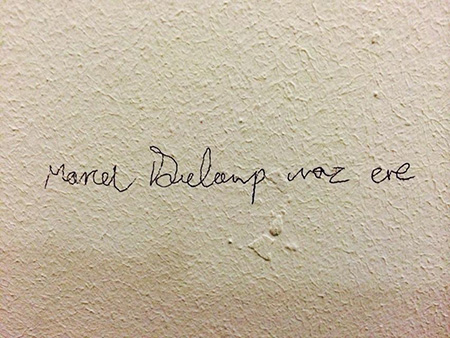
    Marcel was ere
    Found by @otheragent in the toilets at Chelsea college of art during digitell.

    With Fountain Duchamp shifted the emphasis away from the artist as sole generator of meaning but the effect of this move to the conceptual appears to have put more rather than less focus on the identity of the artist. If the art is a found object we want to know even more about what the artist was thinking and ‘who they are’. The work/piece and the identity of the artist are inextricably linked. Abramović’s The Artist is Present is the absolute extreme of this, she is both her ‘self’ and a found object. I finished this section of the talk by pointing out that a Banksy piece is valuable because of its attachment to ‘Bansky’ as an identity even though he/she is anonymous. Even when the identity of the creator is not known it is still  a powerful influence on the way we interpret and receive the work.

    My overall point here is that people are fascinated by people and most work, artistic or otherwise, is an expression of identity in some form. To my mind ‘identity’ is a proxy for ‘humanness’.

    In digital contexts I suggested that there are two major ways of realising an identity online:

    1. Identity embodied through works (Abramović being the most pointed example).

    Rather than being present directly online in social media or similar spaces individuals can express themselves through objects/work they have created. This is where the notion of the Web as a ‘Shop Window’ works well (see my Breaking Down Digital post). This form of online identity only functions when the work is created in an ‘I made this’ mode. Obviously this is closely aligned with the creative arts but I’d argue that anyone who has written an academic paper for example is doing the same thing. Our online identity is the sum of what we post and what is posted about us. This includes anything that has our name/pseudonym linked to it. The significant point here is that there is little desire for visible discourse online around the work by those posting it. The way to connect is likely to be ‘email me if you are interested’ or similar.

    1. Identity expressed through discourse

    This is where the Web is a series of spaces where we can be co-present with others, where thoughts are expressed with the expectation of response. Identity in this mode is more directly linked to a notion of the individual’s persona and presence rather than mediated or expressed through ‘finished’ work. This is likely to involve real-time or nearly-real-time discourse and connection with those around them. This is the highly Resident form of online identity of which Christian Payne was a great example. While identity embodied via work is likely to be focused on finding an audience identity expressed through discourse it likely to be about building networks and communities.

    An interesting overlap between these forms of identity is the opportunity to reveal aspects of the process involved in heading towards a finished piece of work and seek comment/input.  This is one of the most powerful and potentially rewarding ways of operating and being present online and acts as a good transition between ‘Shop Window’ and more Resident forms of engagement.

    I finished by suggesting that one of the advantages of a digital identity is that we can shape, nurture and control it to a certain extent. We can decide who-we-are online but only if we have a clear idea of what we are trying to achieve.  Christian then went on to challenge this perspective by describing how his online identity was owned/mediated  by the people who engage with him – he didn’t control the interpretation of his identity. (a statement which @otheragent pointed out echoes the notion of the art coefficient — the difference between what the artist intended and how the world interprets it)

    In the panel session we went on to discuss a broad range of topics including authenticity and value. What interested me most in the discussion was that while Christian felt authenticity was important in online identity he does chose what to post and what not to post, thereby controlling his identity with great nuance without necessarily being inauthentic. Personally I’m not sure what authenticity is but that’s a different rabbit hole…

    Thanks to Kimberly Cunningham, Joe Easeman and Chris Follows for running such great event.

    Digitell B1NQm8YIQAE0wdM

  • Breaking down digital

    I was delighted to be asked to keynote at the Designs on eLearning conference last month. It’s run by my group based at UAL and Penn State with a different host institution each year. This time it was Texas State with Claudia Roeschmann et al doing an excellent job bringing us all together.

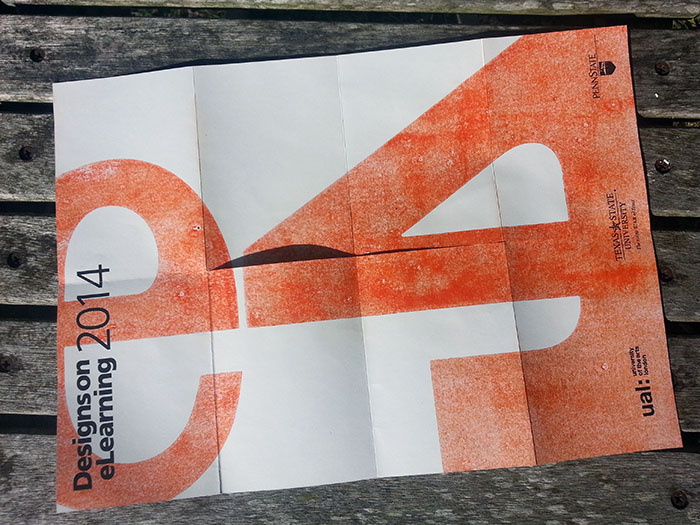
    DeL
    One of the various designs in the DeL mini-programme booklets,

    Part of my job as Head of Technology Enhanced Learning is to develop institutional strategies around digital and learning so I thought the DeL keynote would be a great chance to propose a simple way of setting out the territory:

    ‘Digital’ is too broad a term to be useful now but it is still an area which is ‘different’ enough in the mind of institutions to be dealt with as a distinct entity. Whether this is a healthy approach is debatable as ‘digital’ and ‘technology’ tends to be defined as anything-that-is-new or anything-we-don’t-quite-know-how-to-use-yet. For example, technology that has become totally embedded stops being thought of as tech; email, texting, Googling etc. It’s not that we don’t know that it’s digital we just don’t discuss it in strategic terms because ‘everybody does it’. That tends to mean that digital strategies point towards incorporating the new without focusing on the better use of the mundane.

    (The term ‘mundane technology’ was brought up by Jo Morisson from UAL who pointed out that smartphones are now ‘mundane’ but are integral to students day-to-day learning and creative practices i.e. the fundamental incorporation of the digital into practice tends to be around the use of ‘boring’, not-new, tech)

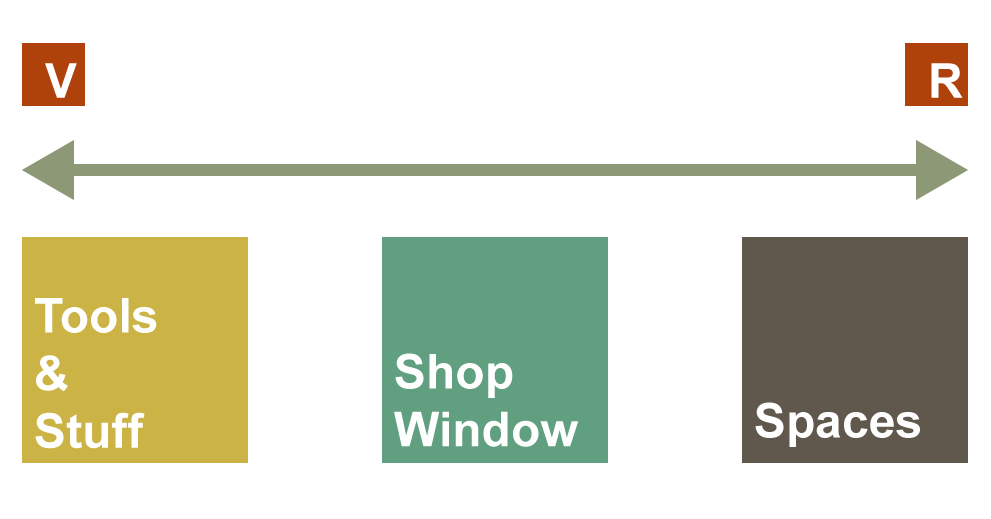
    To attempt to break down the digital into manageable areas I suggested the following ‘practice boxes’ or categories which split the manner in which we use technology into three sections. This provides a very simple framework for discussions about where and how practice intersects with, or resides within, the digital. My Visitors and Residents framework underpins this approach which means that the boxes build on motivation-to-engage rather than the functional affordances of the technology (something which can be considered after you’ve decided what it is you are trying to achieve).

    3 digital-practice boxes on the V&R continuum (CC attribution only)
    3 digital-practice boxes on the V&R continuum (CC attribution only)

    From left to right:

    ‘Tools and Stuff’ – This is the predominant institutional perception of what digital technology is – a series of tools that help to make existing practices more efficient or better quality. It also tends to be students main expectation of the digital services their institution will provide. ‘Give me access to the right tools (including the Web) and access to digital content (stuff) that will help me get through my course. This was one of the key findings from or recent work on The Digital Student project for Jisc. No social trace is left in this mode which is mainly about information seeking, and non-visible production & consumption.

    ‘Shop Window’ – This is a shift from Tools and Stuff towards using the Web as a place for publication and dissemination – the look-at-what-I-have-created motivation which is essentially using the Web as a means of distribution for self-generated content. This is institutions and individuals in broadcast mode and while work that is being presented might be ascribed to the creator of that work it is not necessarily connected to a persona as such beyond a name or a brand. The Web becomes a location to promote the best of our completed work with the actual creative or intellectual practice taking place offline or in non-visible tools.

    ‘Spaces’ – This is where the digital (mainly the Web) becomes a series of spaces or places in which we enact our practice. We go to these spaces to be present with others in some form. This could be within private groups or openly online. So the Web becomes the location where we develop work and thinking in a ‘networked’ or communal manner. This involves individuals operating via (or being embodied within) a digital identity of some form which might be a simple projection of self or could be a deliberately disassociated, managed or pseudonymous persona. (This gets philosophical very quickly but a simple version would be an individual being in ‘student-mode’ when in certain digital spaces). I’ve broken this category into three sections:

    1. Using digital spaces to communally or collaboratively create work. For example, collaborative editing of Google doc or using an online whiteboard/sketching platform to build work in groups. This type of activity could be ‘live’ or asynchronous but the closer to live it is the more the digital will feel like a space rather than a tool.
    1. Discourse around artifacts. – This is the most common form of activity within this category and is possibly the most broadly relevant in an educational context. I’m most interested in forms of discourse which influence the evolution of work, for example a constructive discussion in the comments on a blog post which leads to the original author refining their ideas. It could also be the discourse of a group negotiating the direction of future activities and posting iterations of work which is developed outside of the digital space in which the discussion is taking place. Obviously material that is posted in Shop Window mode can become the focus for discourse with the possibility of recontextualisition or remixing.
    1. Critique or re-appropriation of digital spaces – this one is more specific to Art & Design but important nevertheless. The digital is a space that should be questioned a deconstructed as a place where society resides and operates. This is something that the creative arts need to be doing if they wish to be a relevant voice. I was disappointed with the recent Digital Revolution exhibition at the Barbican which made no attempt to deconstruct the digital in this manner and simply presented a parade of amusing and entertaining digital bits and bobs. In an age of ‘elegant digital consumption’ Art & Design needs to re-present the Digital through a critical and questioning lens.

    ——

    What’s interesting is how the pedagogy we use can shifts teaching practice from Shop Window to Spaces within given platforms. For example at UAL both our blogging (WordPress) and our ePortfolio (Mahara) platforms can be used in both modes depending on the teaching approach. It’s even possible to gently transition from Shop Window to Spaces within these platforms over time which has enormous potential for supporting students in developing their practice and in building professional/practice based online personas.

    My hope is that the 3 categories will frame conversations within and beyond UAL and break down the ‘digital’ in a useful non-tech-deterministic manner.