Myself and Alison Le Cornu recently published “Using ‘Visitors and Residents’ to visualise digital practices” an open access paper reviewing the development of the Visitors and Residents idea. The paper describes the heritage of the V&R mapping process and details a visual pattern-based approach to clustering and analysing large groups of maps. This is a significant step as it expands the Visitors and Residents work beyond a discussion facilitating metaphor to a workable qualitative research instrument.
At the heart of the paper is the presentation and analysis of data from a Higher Education Academy funded project which generated circa 400 V&R maps from staff and students at 18 higher education institutions from across the UK.
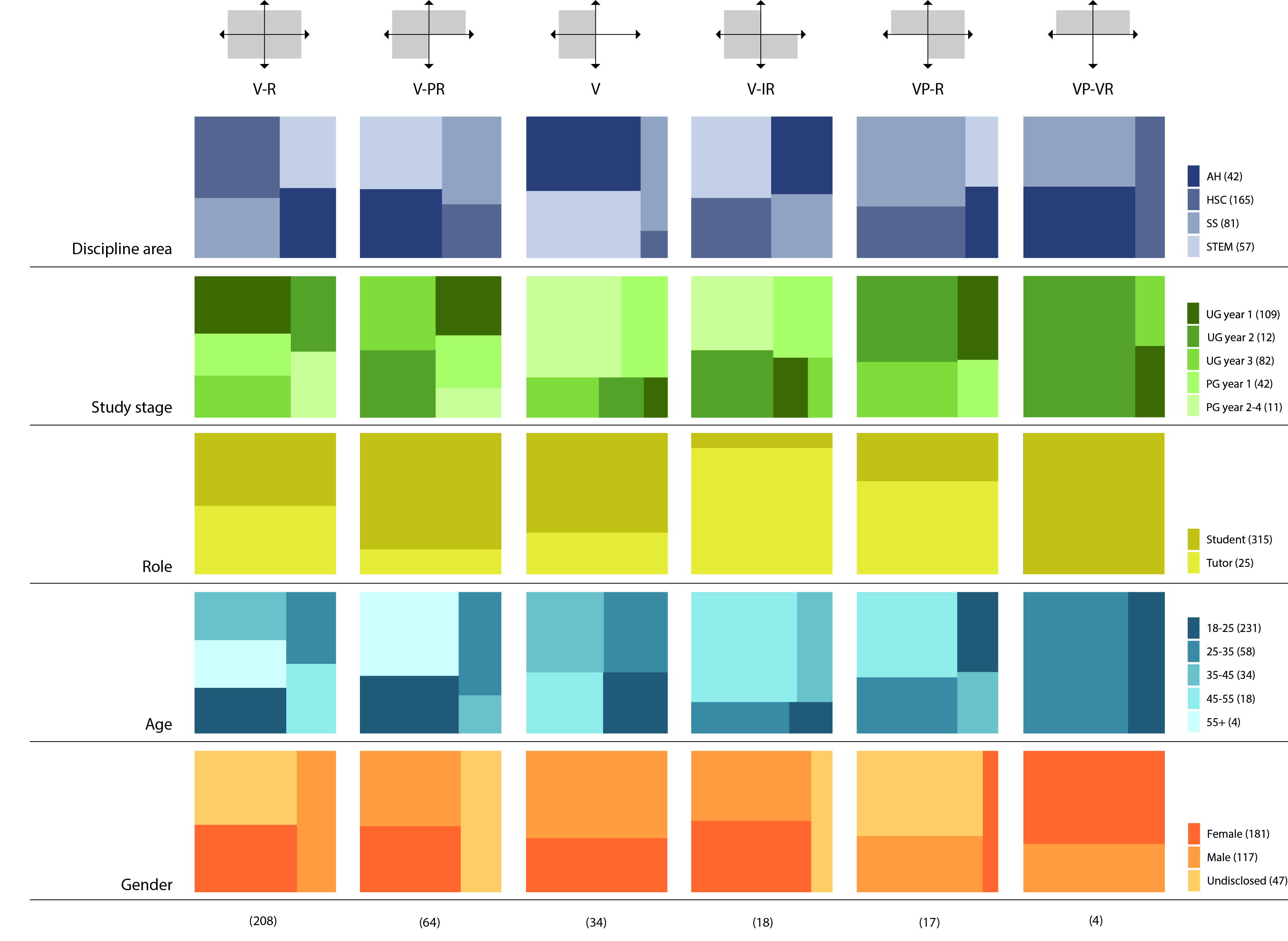
by David S. White and Alison Le Cornu.
First Monday, Volume 22, Number 8 – 7 August 2017
http://firstmonday.org/ojs/index.php/fm/article/view/7802/6515
doi: http://dx.doi.org/10.5210/fm.v22i18.7802 – (Graphic design by Paul Tabak)
I won’t rehash the description of the data collection and analysis here as that’s all in the paper, so do take a look if you are interested in using the V&R mapping as part of a qual data method.
What’s rewarding is to have finally captured the narrative of the progression of the work from ‘a fun thing to do in a conference session’ to an innovative research instrument. Significantly, the Visitors and Residents narrative contains contributions from numerous friends and colleagues who have enriched the thinking and taken the work in new directions. For me this is a perfect example of the richness of working opening and posting CC licenced materials online for others to use and modify.
I’m currently working with Ian Truelove on a version of the mapping which crosses the digital/physical space (locations) divide in teaching and learning. The mapping approach we are discussing includes ‘Independent’ and ‘Dependant’ for the vertical axis and the extension of Visitor and Resident metaphor into ‘hunter gatherer’ (Visitor) and ‘farmer’ (Resident). The plan is to use this with course teams to visualise and discuss how they provide ‘nutrition’ for students (and how they support students in developing their own, sustainable, forms of ‘nutrition’ – yes, this is a bit like the ‘give a man a fish – teach him to fish’ idea).
The original description of V&R was largely based on ‘visibility’ or leaving a social trace. That doesn’t operate as well in physical environments where it is possible to be visible while in Visitor mode, for example, studying alone in the library. The hunter gatherer/farmer interpretation allows us to describe learner modes of engagement in both digital and physical environments.
The vertical axis of Independent and Dependant draws out the important distinction between those times where teaching/technical/library staff are involved (this could be expressed as ‘contact’ time) and those times where students are working without direct input from staff. We have been careful to ensure that the digital/physical boundary is not tied to either axis as all modes of learning engagement can take place in either type of space.
I’m keen to counter the idea that particular spaces (physical or digital) are intrinsically linked with a specific pedagogy. For example, while a lecture theatre does engender or encourage (partly through tradition) more didactic forms of teaching it can be used in many different ways (especially when digital spaces are incorporated into the face-to-face teaching). Similarly, Social Media as a genre of space does not mandate a particular form of dialogue or engagement. The new mapping process we are working on is designed to explore the relationship between spaces of all forms and modes of teaching and learning.